“HBM shortage” and “HBM concept stocks soaring” have been regulars on the financial pages these past couple of years. But many people miss one key fact: the HBM chip itself isn’t actually made in Taiwan. So what’s behind the rally in Taiwan’s basket of “HBM concept stocks”?
This piece lays the HBM supply chain out plainly. First, who makes the HBM itself and where Taiwan sits; then a breakdown of how HBM is made and what role Taiwan’s firms play in packaging, test, and the like. This is the concept-stock and supply-chain extension of the HBM gate.
The Bottom Line First: Taiwan Doesn’t Make HBM Itself
This matters, so let’s say it up front: making HBM (high-bandwidth memory) itself is an oligopoly of three players, none of which are homegrown Taiwanese companies.
Korea’s SK hynix leads, with America’s Micron and Korea’s Samsung in pursuit. Taiwan’s listed homegrown companies do not make complete HBM. (One caveat: Micron has DRAM- and HBM-related capacity expansion in Miaoli and Taichung in Taiwan, but Micron is a U.S. company, not a Taiwan-homegrown firm.)
So when you see “HBM concept stocks,” build the right mental model first: most of them play supporting roles, orbiting HBM and AI accelerators, doing the packaging that binds the GPU and HBM together, chip test, substrates, and equipment. Making the HBM itself sits with the Korean and American big three. Grasping this is the first step to understanding this group.
Core-Data Snapshot
A few numbers below to help you grasp the shape of the HBM supply chain. Shares are mostly research-firm estimates, so read them for orders of magnitude.
| Topic | Data | Timing / Nature |
|---|---|---|
| HBM big-three shipment share | SK hynix ~62%, Micron ~21%, Samsung ~17% | Counterpoint, 2025 Q2 shipment-volume estimate |
| HBM4 progress | SK hynix completed development in 2025; Samsung volume production in early 2026; Micron volume production in 2026 Q1 for Vera Rubin | Each company’s official |
| Micron HBM4 | 36GB 12-high, volume production in 2026 Q1, for NVIDIA Vera Rubin | Micron official |
| HBM4 standard | 2,048-bit interface, up to ~2 TB/s, up to 64GB per stack | JEDEC standard |
| Taiwan’s role | Packaging, test, probe cards, substrates, equipment and the like around it (not HBM itself) | Industry division of labor |
The HBM Big Three: SK hynix, Micron, Samsung
The competition over HBM itself is the battlefield of these three.
SK hynix leads in both technology and market share — about 60% by 2025 shipment estimates — and has completed the development and volume-production system for the next-generation HBM4. Micron has surged from a low-single-digit share to around 20%, and has publicly stated that its HBM4 is in volume production for NVIDIA’s Vera Rubin platform. Samsung, in the teens, also announced HBM4 volume production and commercial shipment in early 2026 as it pushes to catch back up.
The competition centers on whose yields are higher and who locks into the next-generation specs of big customers like NVIDIA first. The outcome of this fight directly affects HBM’s supply and price, and it moves the shipment pace of the entire AI chip.
How HBM Is Made: Where Taiwan Plugs In
To understand Taiwan’s role, you first have to see how HBM is made.
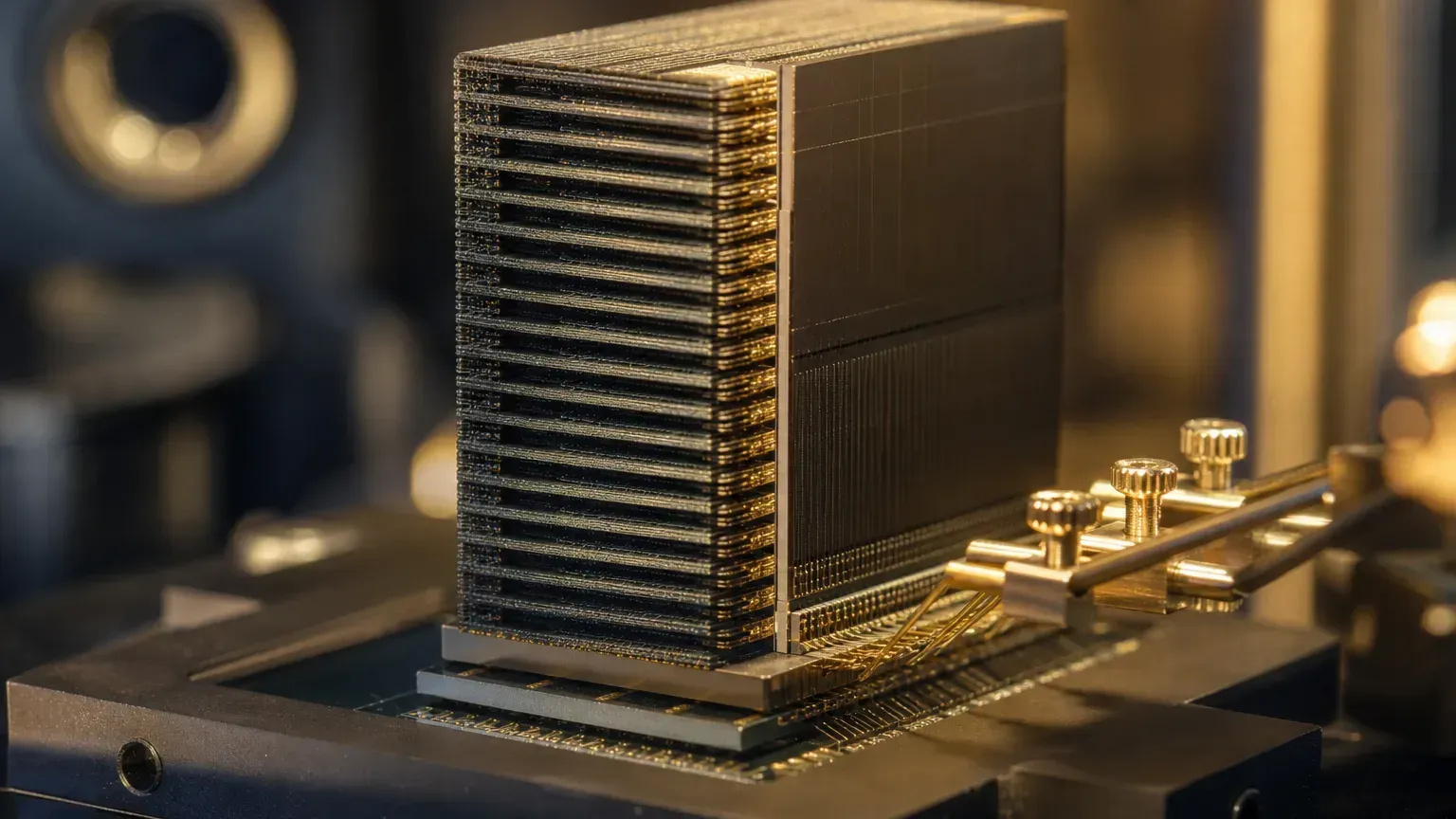
HBM stacks multiple bare DRAM dies vertically, connects the upper and lower layers with through-silicon vias (TSV, vertical conductive holes drilled into the chip), and seals the whole stack with a special process; at the bottom there’s a base die that handles communication with the GPU (HBM4 onward relies more on a logic process to make it). Finally, this whole HBM chip still has to be bound onto the same substrate as the GPU through advanced packaging such as TSMC’s CoWoS.
What Taiwan plugs into is mainly that “final integration” step: the advanced packaging that seals the GPU and HBM together, and chip test. The DRAM stacking itself is the big three’s turf. In other words, Taiwan is the key partner once HBM is “on board,” not the maker of the HBM itself.
Taiwan’s Role in the HBM Supply Chain
Slotting Taiwan’s firms in by role is clearer than memorizing a list. Everything below is a description of industry roles; public information is limited, and a name on a list does not mean an order or a benefit.
- Advanced-packaging integration: TSMC’s CoWoS binds the GPU and HBM into one module, the most critical step; it also works with SK hynix on the base die and CoWoS integration for HBM4. ASE’s VIPack and other advanced-packaging platforms can also do high-density integration of ASICs and HBM.
- OSAT and test: Powertech provides memory and logic packaging and test, and KYEC is test-focused — both are on the test chain for AI chips.
- Probe cards and test interfaces: MPI, WinWay, and Chunghwa Precision make the probe cards and interfaces used in testing, the key consumables for high-speed, high-pin-count testing.
- Substrates: Unimicron, Kinsus, and Nan Ya PCB supply packaging substrates.
- Equipment and inspection: Grand Process, Wonik, Scientech, and Gallant are often grouped into the equipment chain for advanced packaging and HBM capacity expansion.
- Design services / silicon IP: GUC and others provide HBM controllers, interface silicon IP, and design services for CoWoS integration.
To stress it again: these companies orbit HBM and AI packaging, but which memory major or which project they actually map to is mostly analyst speculation, not company announcements.
How to Read “HBM Concept Stocks”
“HBM concept stocks” have been a heavily discussed theme in Taiwan’s stock market in recent years, and the market lumps all the packaging, test, substrate, and equipment firms above into the discussion.
When you look at this group, keep two things in mind first. One, Taiwan’s firms are mostly in the “periphery” of HBM, on a different scale and standing from the HBM big three — don’t conflate the two. Two, whether these companies actually win HBM orders, and how much, is mostly not publicly disclosed, and the pairings cited in the market are often analyst speculation. This article only describes industry roles and supply-chain division of labor; it does not compile beneficiary stocks, does not rank individual stocks, and does not constitute investment advice.
Read it as a “who does what around HBM” map and it’s far more useful than treating it as a stock-picking list.
Key Takeaways for This Gate
After looking at the HBM supply chain, first remember the one most critical line: Taiwan doesn’t make HBM itself — HBM is an oligopoly held by Korea’s SK hynix and Samsung and America’s Micron.
But Taiwan has a complete supply chain and set of roles in the steps before and after HBM, such as advanced packaging, test, probe cards, substrates, and equipment. When you look at “HBM concept stocks,” the point is to understand where each company sits in the chain and what it does, not to treat a name on a list as an order won or a benefit.
To get the basics of what HBM is and why it’s in short supply, go back and read the HBM gate; to see the packaging that binds the GPU and HBM together, see CoWoS and advanced packaging; to look back at all eight gates of the chain, head back to the supply-chain overview.