



An AI Agent Is Not Just a ChatGPT That Chats Better
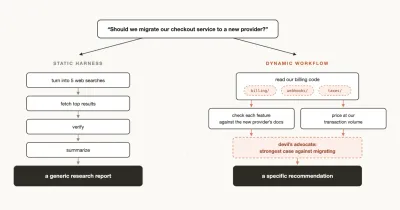
ChatGPT’s shape is “you ask, it answers.” An Agent’s shape is “give it a goal → it breaks down steps → uses tools → checks results → adjusts.” The difference is whether AI is connected to action, not which model is stronger.
Three Cores: Tools, Memory, Decisions
Tools
Calling APIs, reading files, writing databases, sending messages, querying external systems. Without tools, AI can only chat.
Memory
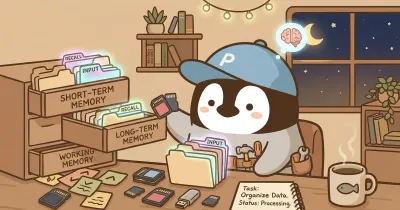
Context across conversations and tasks. The model itself has a context window, but “what we discussed last week” and “this project’s preferences” need files, vector databases, or structured memory layers to persist.
Decision Loop
The Agent iterates by itself: plan → act → observe → adjust. A one-shot answer does not count. Stable Agent systems also design:
- Per-round budget to avoid infinite loops
- Fallback paths when things fail
- Observable intermediate states
Chatbots, Automation, and Agents
| Category | Behavior | Example |
|---|---|---|
| Chatbot | One question, one answer; no memory / no tools | Support FAQ, one-off ChatGPT conversation |
| Automation | Prewritten fixed workflow, no language judgment | n8n schedule, cron script |
| Agent | Receives a goal → breaks down steps → uses tools | Claude Code subagent, OpenClaw |
| Hybrid | Automation trigger → Agent executes a segment | n8n schedule + AI step |
Many products marketed as “AI Agents” are actually chatbots or automation. Understand the positioning before paying for the label.
Real Examples: Support, Reports, Coding, Social Listening
① Customer-Support Retrieval Q&A (RAG) Agent
- Tools: knowledge-base retrieval, CRM lookup, ticket creation
- Memory: customer conversation history and handling records
- Decision: answer if possible; hand off to a human if not
Benefit: triage the front line and reserve human support for cases that truly need judgment.
② Automatic Weekly Report Agent
- Tools: Slack / GitHub / Sheets API
- Memory: what was written last week, what tasks were added this week
- Decision: merge same-topic items, push important items up, collapse minor items
Benefit: compress repetitive reporting work and reduce review time for managers.
③ Coding Agent
- Tools: read / write / execute code inside a repo, run tests, interact with GitHub
- Memory: CLAUDE.md / project conventions / context
- Decision: subagent assignment for review / debugging / documentation
Benefit: project-wide changes, batch refactors, and cross-file audits become much faster than editing one file at a time.
④ Threads Social-Listening Agent
- Tools: fetch posts from Threads / X, keyword filtering, reply drafts
- Memory: posts already seen, topics you care about
- Decision: pick posts worth replying to based on keywords + engagement; draft replies for human approval
Benefit: reduce the daily time spent scrolling social platforms for potential leads or conversation openings from one hour to five minutes of notifications.
Most People Should Not Chase Full Automation First
“Running automatically 24 hours a day” is attractive, but the most common real-world traps are:
- Permissions are too broad: once an agent can touch real money or real data, the cost of mistakes jumps.
- Memory design is missing: the next day it does not remember “what we agreed last time.”
- Failure notifications are absent: the agent breaks for three days before anyone notices.
A steadier starting point: semi-automatic first → human review gate → grant more permissions after it is stable.
Dify / Coze: Where No-Code Agent Builders Fit
| Tool | Form | Focus |
|---|---|---|
| Dify | open source + cloud (Free / Pro $59/month / Team $159/month) | RAG workflows, agentic workflow, prototype-friendly |
| Coze | Bytedance-family SaaS | low-barrier bot/plugin builder, many templates |
Good for: product prototypes, support RAG, validating an idea before deciding whether to code.
Watch out:
- Dify Free is a sandbox (200 message credits, 1 member, 5 apps), not a production tier.
- Coze plan / quota details differ between international and China versions; check official pages before implementation.
- For any cloud platform, first confirm where your data goes, how long it is retained, and whether it is used for training.
Claude Code / OpenClaw Style: Coding Agents and Multi-Agent Architecture
| Form | Focus |
|---|---|
| Claude Code | terminal-first agent, subagents with separate context, slash / MCP commands, hooks |
| Self-built multi-agent systems such as OpenClaw and Hermes | model specialization, shared memory layer, permission isolation |
Good for: repo-wide tasks, automation schedules, scenarios where different tasks need different models / contexts.
Cost: you must design memory structure, permission boundaries, and failure recovery yourself. It is not “install and use.”
Self-Built Frameworks: The Cost of LangGraph and CrewAI
If you need program-level control, use LangGraph (graph-based agent flow) or CrewAI (multi-agent orchestration). The benefits are transparent logic and version control. The cost is handling these yourself:
- memory persistence
- tool registry and permissions
- failure retry and incident handling
- observability / log / cost tracking
This is not a good “just trying it out” entry point. It is better for engineering teams that already know what kind of agent system they need.
Why Memory Breaks Most Easily
Agent memory systems most often break for three reasons:
- No layering: all information goes into one context until volume causes interference.
- No summarization: raw old conversations keep getting brought into new conversations, increasing token cost and noise.
- No lifecycle: there is no design for what should expire, be archived, or be promoted to core files.
A design can start from this prototype:
- Index layer (≤ 1000 lines): loaded every time, storing the agent’s identity, current tasks, and file locations.
- Topic layer (on demand): one file per project / topic, read lazily when the agent receives a task.
- Working memory (daily / weekly): log-style, append-only event stream.
Separating these three layers is more practical than “giving the agent a larger context window.”
Permissions and Safety Matter More Than Prompts
The real risk in agent design is not whether the prompt is good. It is:
- whether it can write / delete / send externally / move money
- whether it should do so
- how to roll back after an error
Practical red lines:
- Money, data deletion, external communication: always keep a human review gate.
- Use least privilege for secrets. Do not give an agent a full-account admin token.
- Write audit logs for all tool calls; make them replayable and reviewable.
- Dangerous operations should have dry-run mode.
Low-Risk Agents for Beginners
| Starting point | Reason |
|---|---|
| Local single-machine assistant | no external actions, no data writes, low failure cost |
| Internal FAQ bot | standardized workflow, reviewable |
| Automatic weekly summary | low failure cost, easy to inspect visually |
| First-line customer support that can hand off to humans anytime | semi-automatic, not directly deciding for the agent |
Avoid starting with automatic messages, automatic orders, cross-department data writes, or external publishing without human approval.
Conclusion
The value of an Agent is not “smarter chat,” but “connecting conversation to action.” But action needs boundaries: memory, permissions, and failure recovery are core design, not an appendix. Choose the route first (Dify / Coze / Claude Code / self-built framework), build the first low-risk workflow, and only then discuss scaling.
Penchan’s Take
OpenClaw is the multi-agent system Penchan currently runs: Opus handles strategy / writing judgment, Sonnet handles mechanical tasks, Codex handles coding, and scheduled scripts tie everything together. In practice, the most troublesome part really is memory. After a few days, an agent starts “forgetting last time’s decisions,” and the root cause is poor memory-layer design, not a weak model. The bleeding stopped only after core files were made concise and layered.
Penchan’s take on whether ordinary office workers can build their own AI Agent: yes. But start from a mature optimization architecture and self-healing design. Do not chase 24-hour full automation from day one.