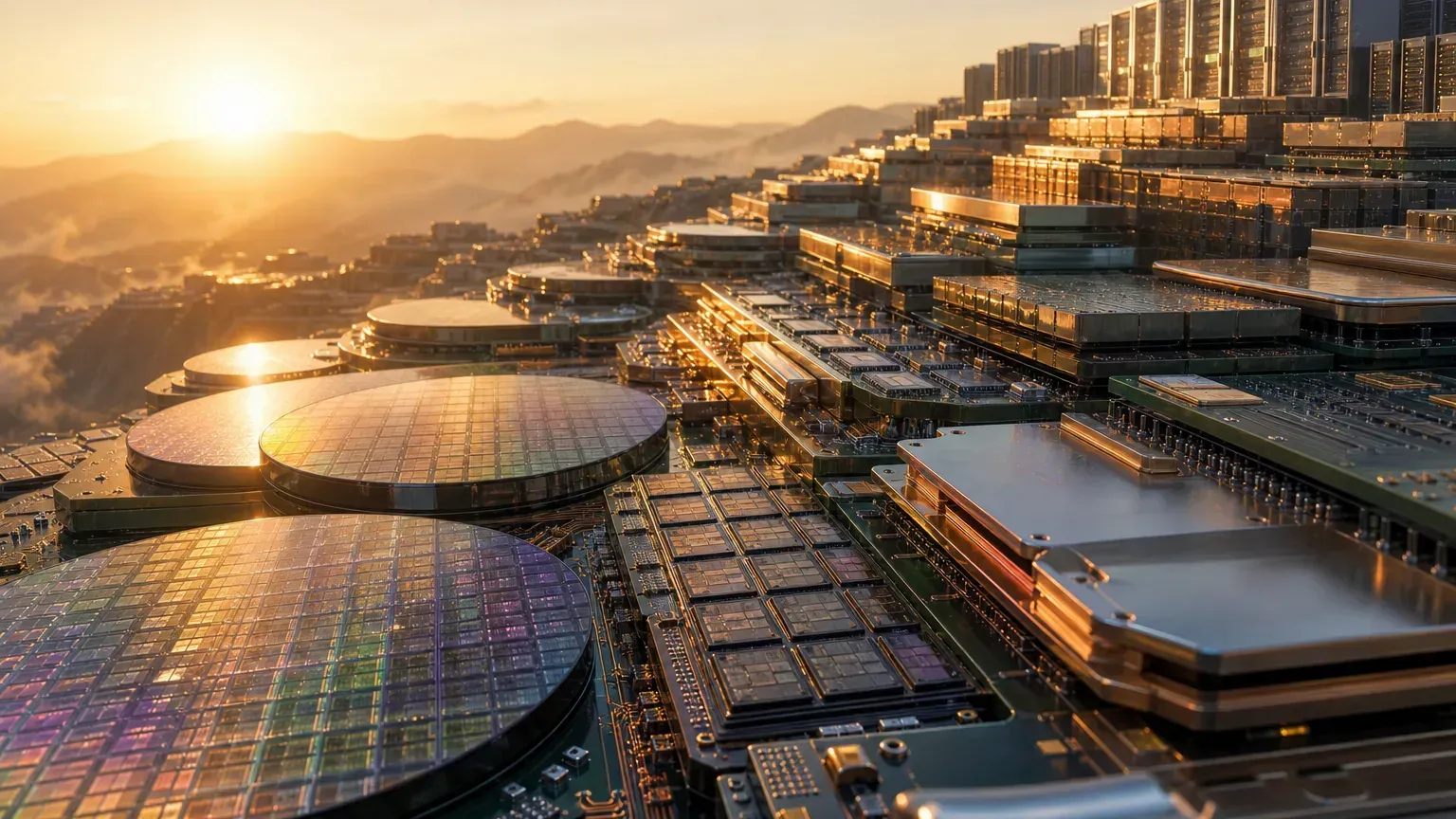
Whenever “Taiwan semiconductors” comes up, the first name everyone thinks of is TSMC. TSMC is of course the lead, but looking only at it misses what makes Taiwan truly formidable: there’s a complete supply chain here that goes from drawing the chip, to making the chip, to packaging the chip, all the way to assembling an entire AI server — every link interlocking, the division of labor dense and tight.
The end-to-end supply-chain piece breaks down the world’s eight chokepoint gates from a technical angle; this one takes a different view, looking specifically at how Taiwan’s chain divides the work — from IC design all the way to the AI server — to see exactly which “peaks” make up the guardian mountains.
Why Taiwan Is the Core of the AI Supply Chain
Taiwan’s pivotal position is easiest to feel through a few numbers.
The most advanced chip manufacturing is heavily concentrated in Taiwan. TSMC’s share of the global foundry market in Q4 2025 was around 70% (by revenue), and capacity for the most advanced processes and advanced packaging is also heavily concentrated in TSMC and Taiwan — mass production of AI chips leans especially hard on this segment. Taiwan’s IC design accounts for about 40% of the world, putting it among the top three design hubs alongside the US and China. Downstream, AI-server assembly is estimated by the market at roughly 90% handled by Taiwanese firms (the definition of this figure varies, but the order of magnitude is high).
String these segments together and you see it: an AI chip’s journey from design, manufacturing, and packaging to finally becoming a server packed with GPUs runs most of its course in a loop around Taiwan. That’s why, when the world talks about AI hardware, there’s no getting around Taiwan.
Core-Data Snapshot
The numbers below are Taiwan semiconductors’ “dashboard.” Output values and market shares are mostly estimates from research firms or industry associations, so read for the order of magnitude and the trend rather than the decimal point.
| Topic | Data | Timing / Nature |
|---|---|---|
| Taiwan IC industry output value | ~NT$6.5 trillion in 2025 (+22.7% YoY); estimated ~NT$7.7 trillion in 2026 (+18.3% YoY) | ITRI IEK / TSIA estimate |
| TSMC global foundry market share | ~70% (by revenue) | TrendForce, Q4 2025 estimate |
| TSMC advanced-process share | 7nm-and-below is ~74% of its wafer revenue | TSMC official, Q1 2026 (its own metric, not a global share) |
| Taiwan IC design global share | ~40%, among the top three with the US and China | IDC estimate, 2026 |
| Taiwan’s AI-server assembly share | Market estimate ~90% | Market / research estimate, definitions vary |
| 2026 AI-server shipments | +28% or more YoY; ASIC models nearing 28% of the mix | TrendForce estimate |
The Semiconductor Value Chain: From Design to Packaging-and-Test
First the upper half, from “drawing a chip” to “making it and packaging it up.”
IC design (drawing the chip). Fabless firms (chip companies that only do design and don’t build their own fabs) handle a chip’s architecture, circuit design, and product definition, outsourcing the manufacturing. Representatives include MediaTek (mobile SoCs plus connectivity and AI platforms), Novatek (display driver ICs), and Realtek (Wi-Fi, Ethernet, audio, and PC peripherals). MediaTek is one of the world’s top five IC design houses.
IP and design services (providing blocks and contract design). This layer helps customers take a custom chip from spec and IP integration through to tape-out and volume production. Alchip and GUC (Global Unichip) are design-service firms for high-complexity ASICs and SoCs (closely tied to the in-house silicon discussed in the ASIC gate); M31 offers re-licensable silicon IP.
Foundry (turning designs into chips). This is Taiwan’s strongest segment. TSMC focuses on the most advanced logic processes and advanced packaging; UMC and Vanguard focus on mature and specialty processes; Powerchip spans both memory and logic foundry. The key point of this division of labor is that not every chip needs the most cutting-edge process — mature processes carry enormous demand just the same.
Memory. In memory, Taiwan leans toward mature generations and niche products rather than leading in the highest-end DRAM like HBM. Nanya makes DRAM, Winbond makes niche DRAM and storage-grade flash, and Macronix focuses on non-volatile memory such as NOR Flash.
Packaging-and-test (packaging and testing). Once a chip is made, it has to be packaged and tested before it can ship. ASE Technology Holding (including subsidiary SPIL) is the leader in turnkey packaging-and-test services; PTI leans toward memory and logic packaging-and-test; KYEC is test-centric; and Chipbond focuses on the back end for driver ICs and the like.
IC substrates and equipment/materials. The substrate is the key material that carries the chip and makes its electrical connections; high-end chips use ABF substrates (the advanced connection boards used to package chips), with Unimicron, NPC, and Kinsus as important suppliers. On the equipment/materials side, Gudeng makes EUV (extreme-ultraviolet lithography) reticle pods and wafer carriers, while Kinik, Topco, and Scientech fill in on consumables, materials distribution, and process equipment (this layer doesn’t replace the international front-end equipment giants like ASML and Applied Materials — it’s the local role within the supply chain).
From Chip to AI Server: Taiwan’s System Assembly
Once a chip is packaged, the next step is turning it into an AI server that can go into a data center — and here, too, Taiwan is the mainstay.
Whole-system and full-rack assembly. Integrating GPUs or ASICs, CPUs, memory, switches, power, cooling, and the rack into a deliverable system is Taiwan’s signature skill. Foxconn, Quanta, and Wistron are the main builders of whole AI servers and full racks; Wiwynn specializes in full-rack systems for the cloud hyperscalers; Inventec participates in general-purpose and ASIC models; and Gigabyte leans toward server motherboards plus branded and white-box supply. Each firm’s shipment metrics and customer mix differ; this article only describes roles and does not compare the merits of individual stocks.
Cooling, power, and networking. Once AI-rack power draw spikes, cooling, power delivery, and switches all become critical to delivery. AVC and Auras supply fans, cooling modules, cold plates, and liquid-cooling components, while Jentech makes high-end cooling and metal structural parts; Delta Electronics and Lite-On supply power; and Accton makes data-center switches and white-box networking systems. To understand why cooling has become so important, see the liquid-cooling gate.
Add these two segments together and Taiwan’s role is crystal clear: it doesn’t just make chips — it turns chips into a whole, working AI machine.
How to Read “Taiwan Semiconductor Stocks”
There are too many listed companies tied to Taiwan semiconductors to count — from design, manufacturing, and packaging-and-test to servers, cooling, and power, nearly every group has a slate of companies. Faced with such a long list, one principle works well: treat it as a map, not a list.
Once you know which segment of the supply chain each company sits in and what it does, you can quickly judge, when reading the news, “which layer this affects.” That’s far more useful than rote-memorizing a pile of ticker symbols. But a reminder: these companies’ orders, customers, and operating conditions all differ, and the supply-chain pairings commonly cited in the market (which company supplies which big customer) are often analyst speculation or market discussion, not company announcements. This article only describes industry roles and the division of labor; it does not compile beneficiary stocks, does not rank individual stocks, and does not constitute any investment advice.
Key Takeaways for This Gate
After looking at Taiwan’s semiconductor supply chain, it can be distilled into three judgments.
First, Taiwan’s strength is one complete chain. From IC design, foundry, and packaging-and-test to AI-server assembly and cooling-and-power, Taiwan has a representative player in nearly every segment, and that degree of completeness is hard for any single country to replicate quickly — which is the real meaning of the “guardian mountains.”
Second, the most cutting-edge links are heavily concentrated. Resting the most advanced manufacturing and packaging in Taiwan is both a strategic asset and the single-point risk the world worries about most — the same thing the bottlenecks in all eight gates of the chain are about.
Third, understanding the division of labor is more practical than chasing themes. Stock lists will change, but the structure of “who’s on this chain, doing what” is relatively stable. Read the structure, and you can read which way the wind is blowing.
To see the whole world’s eight gates from a technical angle, head back to the supply-chain overview; to dig into individual links, read on to advanced packaging, CoWoS, HBM, and ASIC.