NVIDIA designs the most sought-after AI chips on earth and has rocketed to the top tier of the world’s most valuable companies — yet it doesn’t own a single wafer fab. How is that possible? The answer: it outsources manufacturing the whole way down, and most of that supply chain loops around Taiwan.
This piece spells out the NVIDIA supply chain. First, what NVIDIA does itself and what it outsources; then we trace a chip all the way to a full rack, seeing where TSMC, SK Hynix, and Taiwan’s ODMs each stand; and finally, where the 2026 bottleneck sits. This is the NVIDIA-angle extension of the Blackwell gate and Taiwan’s semiconductor supply chain.
What NVIDIA Does Itself, and What It Outsources
NVIDIA is a fabless (factory-less) semiconductor company. Its core strength lies in “design”: designing GPU chips, designing system architecture, and writing the CUDA software ecosystem that locks in developers. As for actually making the chips, it outsources the whole way.
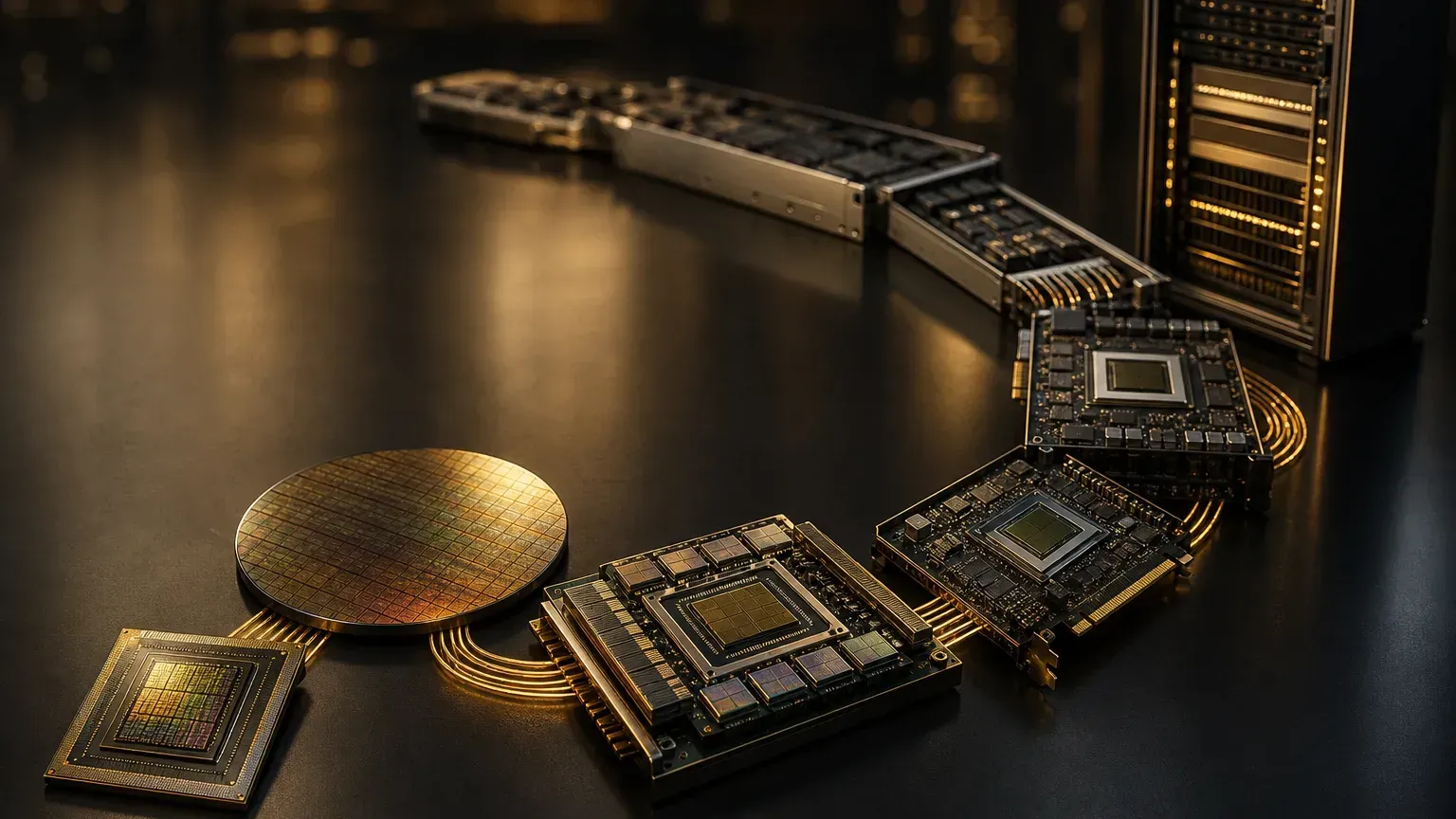
What does it outsource? Roughly this: foundry (turning the design into a physical chip) goes to TSMC; advanced packaging (binding the GPU and HBM into a module) uses TSMC’s CoWoS; HBM memory is bought from SK Hynix, Micron, and Samsung; full system-and-rack assembly is handed to Taiwan’s ODMs. String it all together and you’ll find that a NVIDIA GPU, from silicon to a usable system, spends most of its journey looping through Taiwan.
Core-Data Snapshot
The numbers below help you grab the key nodes of the NVIDIA supply chain. Most are official specs or research-firm estimates.
| Segment | Detail | Timing / Nature |
|---|---|---|
| Foundry | Blackwell uses TSMC’s custom 4NP; Rubin moves to 3nm (per supply-chain / research-firm reading) | NVIDIA official (Blackwell) |
| Advanced packaging | CoWoS led by TSMC; capacity tight, needs OSAT partners | TSMC 2026 Q1 earnings call |
| HBM | Bought from SK Hynix / Micron / Samsung; supply split not disclosed by NVIDIA, reports diverge | Vendors’ official / media |
| Full system & rack | Foxconn, Quanta, Wistron, Wiwynn, Pegatron, and other Taiwan firms do the manufacturing | NVIDIA official partner list |
| 2026 bottleneck | TSMC advanced packaging (CoWoS) capacity; 2.5D packaging shortage estimated to last into 2027 | TrendForce |
From Chip to Full Rack: The NVIDIA Supply Chain, End to End
It’s clearest to walk the journey of a single GPU.
Stop one, foundry: NVIDIA hands the GPU design to TSMC to manufacture. Blackwell uses TSMC’s custom 4NP process; the next-gen Rubin moves to 3nm (per supply-chain and research-firm reading). Stop two, advanced packaging: once the chip is made, TSMC’s CoWoS binds the GPU and several HBM stacks onto a single substrate — this is currently the most jammed-up bottleneck. Stop three, HBM: high-bandwidth memory is bought from SK Hynix, Micron, and Samsung, and packaged into the module. Stop four, full system and rack: once the module becomes a GPU board, it’s handed to Taiwan’s ODMs to integrate into a full-rack system like the GB300 NVL72, plus cooling, power, networking, and the rack itself.
Only after these four stops does a GPU go from a design drawing to a system that can actually run in a data center. And at stops one, two, and four, Taiwan is the lead player.
The Taiwan Partners NVIDIA Names
When NVIDIA launches a platform, it announces its system-manufacturing partners, and that list is the best window into how much weight Taiwan’s firms carry.
In the official materials for the Blackwell Ultra (GB300) and Vera Rubin platforms, the named system-manufacturing partners include Taiwan’s Foxconn, Inventec, Pegatron, Quanta, Wistron, Wiwynn, Gigabyte, ASUS, and more. In practice, Foxconn (via its Ingrasys arm), Quanta (via QCT), Wistron, and Wiwynn all have publicly disclosed GB300 NVL72 full-rack or liquid-cooling solutions.
The component segments also involve a slew of Taiwan firms: cooling and liquid cooling, power and electrical architecture, networking switches, rack mechanicals, connectors and cabling, and so on. One thing to be clear about: NVIDIA’s core networking chips (such as InfiniBand, Spectrum-X, and ConnectX) are its own — Taiwan’s firms mostly sit at the system-assembly, cabling, and integration layer. And being named or showcased does not equal order value, much less guarantee that a firm benefits; NVIDIA doesn’t disclose the actual allocation.
Where 2026 Jams Up: Advanced-Packaging Capacity
The most closely watched bottleneck in the NVIDIA supply chain is, in fact, advanced packaging.
On its 2026 first-quarter earnings call, TSMC said outright that advanced-packaging capacity (the 2.5D packaging used in CoWoS and the like) is “very tight,” and that it can only expand it by working with OSAT partners. Research firms also estimate that the 2.5D packaging shortage may not ease somewhat until 2027. As a knock-on effect, some high-end PCB and materials segments are running tight too.
This makes one thing clear: with AI demand exploding right now, how much NVIDIA can ship often comes down to how much capacity the most jammed-up link in its supply chain can release. TSMC’s advanced packaging is that key valve.
How to Read ‘NVIDIA Supply-Chain Concept Stocks’
“NVIDIA supply chain” and “NVIDIA concept stocks” are an evergreen theme in Taiwan’s stock market, and the market lumps in all the manufacturing, packaging, assembly, and component firms above.
When looking at this group, hold to one principle: understanding where each company stands in NVIDIA’s supply chain is more useful than chasing a list. But remember, NVIDIA does not disclose each supplier’s order value, allocation, or margins; an official partner list and a media showcase only signal “role fit” — not how many orders have been won or that a firm will necessarily benefit — and many of the market’s pairings are analyst speculation. This piece only describes industry roles and supply-chain division of labor; it does not compile beneficiary stocks, does not rank individual names, and does not constitute investment advice.
Key Takeaways for This Gate
After looking at the NVIDIA supply chain, first remember its skeleton: NVIDIA only does design, outsourcing foundry (TSMC), advanced packaging (CoWoS), HBM (SK Hynix and others), and full system-and-rack assembly (Taiwan’s ODMs) the whole way down, with Taiwan carrying serious weight at the manufacturing and system-integration ends.
The key bottleneck in 2026 is TSMC’s advanced-packaging capacity, one of the main constraints on NVIDIA’s shipments. When looking at NVIDIA concept stocks, the point is to understand the supply-chain division of labor — not to treat an official partner list as a guarantee of orders.
To see NVIDIA’s flagship chip generation, go back and read Blackwell; to see how concept stocks at the server-system layer are categorized, see AI server concept stocks; to see Taiwan’s full semiconductor division of labor, see Taiwan’s semiconductor supply chain; to go back through all eight gates of the chain, head back to the supply-chain overview.