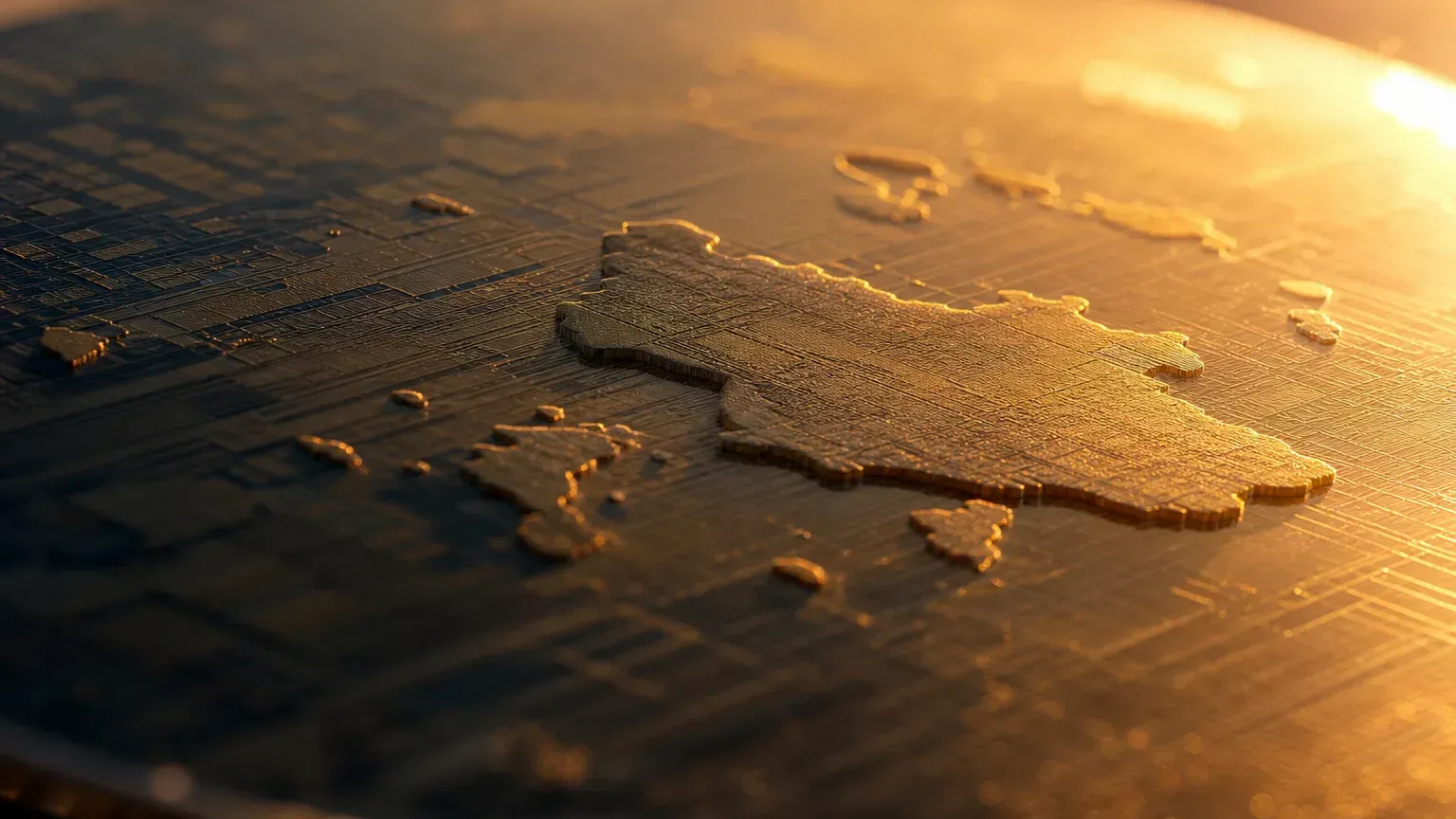
Every time the situation around the Taiwan Strait makes international headlines, someone brings up a term: the Silicon Shield. The rough idea is that “Taiwan’s chips are so important that they have become a shield protecting Taiwan itself.” It sounds reasonable, but does it actually hold up?
This piece spells out the Silicon Shield, and tries to stay neutral. First the logic of the claim, then the arguments on both the supporters’ and the skeptics’ sides, and the dilution debate that TSMC’s overseas expansion has stirred up. To be clear up front: the Silicon Shield is a widely discussed hypothesis, not a settled conclusion; this article presents multiple views and makes no political prediction. This is the geopolitical-dimension offshoot of The AI Hardware Supply Chain, End to End.
What Is the Silicon Shield?
The Silicon Shield is an analytical lens, and the logic runs roughly like this:
Taiwan holds the great majority of the world’s most advanced chip manufacturing, and those chips are key components of AI, phones, cars, industry, and even defense systems. So a major disruption to the supply chain would deal a heavy blow to global technology and the economy. On the basis of that shared interest, many countries would lean toward maintaining stability across the Taiwan Strait, and so Taiwan’s standing in semiconductors indirectly forms a kind of strategic deterrent.
It’s worth stressing: this is a hypothesis, a way of looking at things — not an already-verified security guarantee. The value of understanding it lies in seeing why the whole world cares so much about Taiwan’s chips, rather than treating it as an iron rule.
Core-Data Snapshot
The figures below are the basis of the Silicon Shield argument. Capacity and market share are mostly research-firm or official estimates.
| Topic | Data | Timing / Nature |
|---|---|---|
| TSMC advanced-process share | 7nm and more advanced processes account for about 74% of its wafer revenue | TSMC official 2025 (company’s own framing) |
| Taiwan’s share of the most advanced chip capacity | Estimated around 92% | USITC (framing around 2021) / cited by Stimson 2025 |
| Taiwan’s global foundry market share | About 78% | Cited by Stimson |
| TSMC overseas investment | About US$165 billion planned in the U.S., with fabs in Japan and Germany too | TSMC official |
The Arguments for the Silicon Shield
Those who support this claim usually argue from two angles.
One is the high concentration of the supply chain. Taiwan holds the great majority of the world’s most advanced chip capacity, and semiconductors flow into nearly every electronic system, from data centers, telecom, and cars to defense and industrial systems. Any disruption would have global impact. This “pull one hair and the whole body moves” standing makes maintaining stability across the Taiwan Strait a shared interest for many countries.
Two is the complementary relationship within the supply chain. U.S. firms largely handle chip design and end demand, while Taiwanese firms handle high-yield manufacturing; the two ends are highly complementary within the supply chain. Some think tanks argue that the deepening of the AI supply chain will make this complementarity even tighter. When everyone’s interests are deeply intertwined, the status quo becomes more valuable to all parties.
The Arguments Questioning the Silicon Shield
On the other hand, plenty of people are reserved about the Silicon Shield. They do not deny the importance of Taiwan’s semiconductors; what is actually being questioned is whether “important” equals “an effective deterrent.”
Some think tanks note that countries do indeed need chips, but that does not directly mean they would take some particular action in a Taiwan Strait crisis, because decisions must also weigh escalation risk, military cost, and political constraints. Some academic research argues that the Silicon Shield narrative lacks a rigorous theoretical basis and looks more like a “wishful claim” than a solid theory of deterrence. There is also the view that dependence on semiconductors does not necessarily lead to a specific external security action.
These questions remind us that the Silicon Shield is a lens worth knowing, but treating it as a guarantee of Taiwan’s security may be overly optimistic.
Overseas Expansion: Is the Silicon Shield Being Diluted?
TSMC’s recent fabs in the U.S., Japan, and Germany have stirred up a popular debate: does this dilute the Silicon Shield?
The dilution camp argues that if advanced capacity moves out of Taiwan on a large scale, Taiwan’s “stickiness” to outside security interests may decline. That is also why capacity moving offshore is a sensitive issue in Taiwan; relevant officials have said that moving 40% of semiconductor capacity to the U.S. is “impossible.”
The no-dilution camp notes that the overseas fabs are mostly new capacity that disperses geographic risk, that TSMC is still advancing its most cutting-edge 2nm and advanced packaging in Taiwan, and that Taiwan’s accumulated talent, suppliers, equipment maintenance, and high-yield manufacturing ecosystem are very hard to replicate elsewhere in the short term.
Both views have their proponents. Which is right is not settled for now; it depends on how the capacity ratio, technology generations, and policy evolve in the future.
Why It Is Discussed More Often in the AI Era
The Silicon Shield is not a new term, but AI has brought it back into the spotlight.
The reason is that AI has pushed advanced logic chips, HBM, advanced packaging, and data centers from a purely technological topic up into a matter of economic security for many countries. When advanced chips are seen as a key bottleneck for developing AI, the supply-chain nodes that hold this manufacturing capability — Taiwan, Japan, the Netherlands — naturally get placed into geopolitical discussions more often. In other words, the race for AI compute has made “who can make the most advanced chips” carry more strategic weight than ever.
Key Takeaways for This Gate
After looking at the Silicon Shield, first remember its positioning: it is one lens for understanding the geopolitical significance of Taiwan’s semiconductors, but it is a hypothesis, not a settled conclusion.
Supporters emphasize the high concentration of the supply chain and the U.S.–Taiwan complementarity; skeptics argue that being important does not necessarily equal a deterrent, and that the academic basis is not solid enough. Whether TSMC’s overseas expansion strengthens resilience or dilutes the shield is a point on which views differ. On this topic, the most practical attitude is to understand the arguments on each side, rather than treating any one claim as the conclusion.
To see the full picture of the chip war and export controls, read The Chip War and Export Controls; to see the industry division of labor in Taiwan’s semiconductors, see Taiwan’s Semiconductor Supply Chain; to look back at all eight gates of the chain, head back to the supply-chain overview.