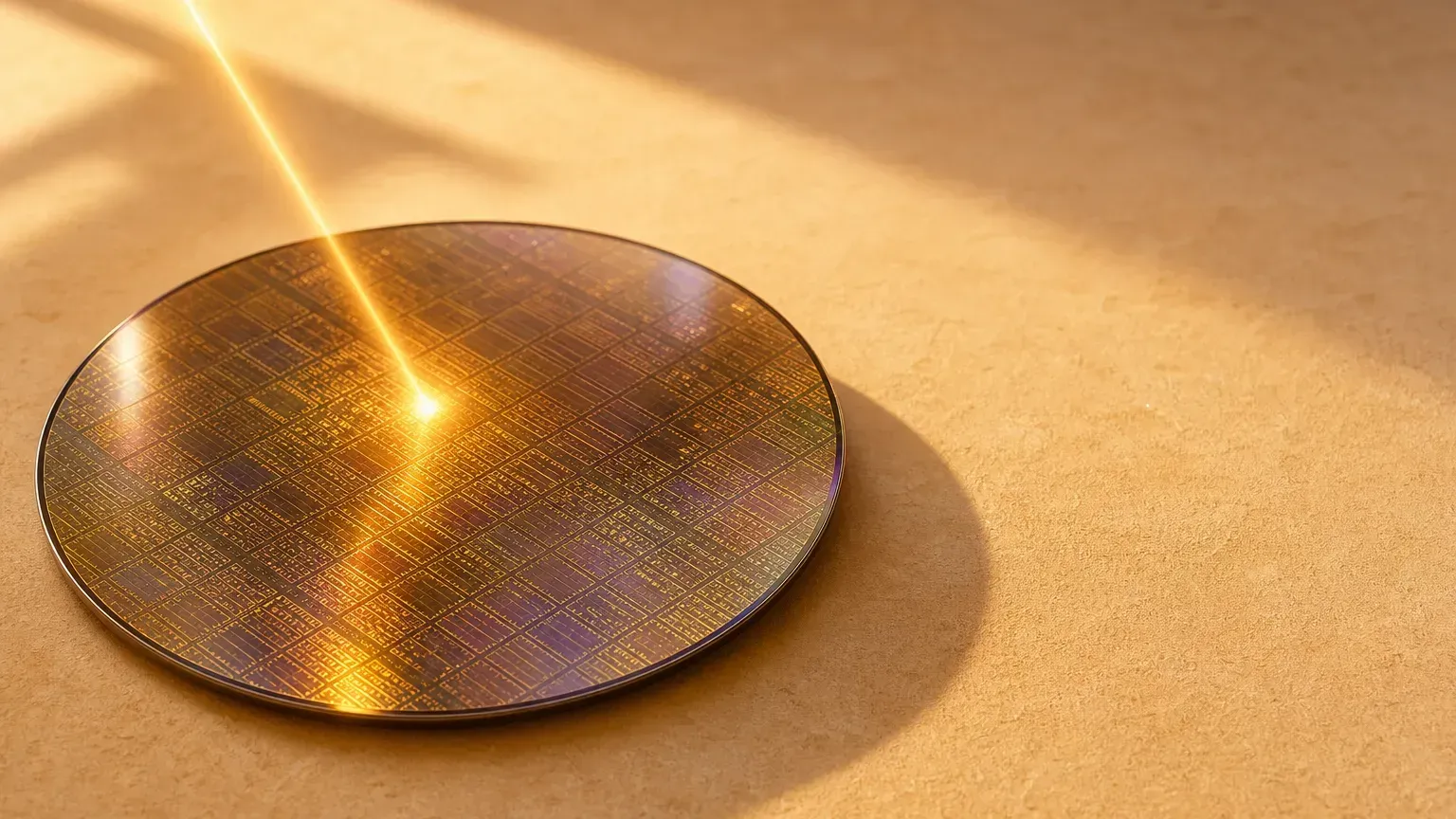
When AI chips come up, people think of TSMC making them and NVIDIA designing them. But push one rung further upstream and you find this: to make the most advanced chips, TSMC first has to buy machines from a Dutch company — and one particular machine that company builds is something no one else in the world can build. That company is ASML.
This piece lays out ASML and EUV all at once. First, what EUV is and why advanced nodes can’t do without it; then why ASML is a monopoly, how export controls use it to hem in China, and TSMC’s latest choice. This is the deep-dive version of Gate 4, “foundry and lithography equipment,” in The AI Hardware Supply Chain, End to End.
What Is EUV? One Sentence Plus a Metaphor
ASML’s most famous product is the EUV (Extreme Ultraviolet) lithography machine. What it does is project and etch a chip’s circuit pattern onto a silicon wafer using light — a step called “lithography.”
The key is the wavelength of the light. EUV uses extreme ultraviolet light with a wavelength of just 13.5 nanometers. Think of it this way: light is like a pen, and the shorter the wavelength, the finer the pen tip, and the finer the lines it can draw. To cram tens of billions of transistors into an area the size of a fingernail, an advanced chip needs that “ultra-fine pen.”
So can you get by without EUV? The earlier generation, DUV (deep ultraviolet), has a longer wavelength and a thicker pen tip. To draw fine lines with a thick pen, you can only trace the same spot over and over (the industry calls this multi-patterning). It works, but it’s painful — and you’ll see just how big the cost is below.
Why Advanced Nodes Can’t Do Without EUV
First, a commonly misunderstood point: DUV can in fact be pushed hard enough to make 7nm, or even 5nm. The problem is the cost.
Industry estimates suggest that making 7nm with DUV might require as many as thirty-something exposures for certain critical layers; switch to EUV and the same result takes roughly nine. As exposure counts climb, process time stretches out, yield drops, and cost soars — to the point where it can barely survive in commercial volume production. So the conclusion is very practical: EUV makes advanced nodes “both achievable and economical,” and that’s why it became mainstream.
For AI, this gate is especially critical. The highest-end AI chips almost all use advanced nodes in the 3-to-5nm class, meaning they all sit on the EUV production line. If EUV can’t keep up, advanced chips can’t be made.
Why ASML Is the Chokepoint of the Whole Chain
The hard part about EUV isn’t just that it’s hard to use — it’s even harder to “build.” A single EUV machine is made up of tens of thousands of parts, and the technical bar for the light source, mirrors, and precision mechanisms is extraordinarily high. The result: ASML is the only company in the world that can volume-produce EUV machines.
Just how complete is this monopoly? Industry estimates put ASML’s EUV market share at close to 100%, and its share of the overall lithography-equipment market at around 80-something percent. The prices are staggering too: a mature Low-NA EUV machine runs about €200 million, and the newest High-NA is estimated at around €350 million (ASML doesn’t publish official pricing — these are media and market figures). In other words, the customers who can both afford and obtain EUV were never more than a handful to begin with.
ASML itself is raking it in. Full-year 2025 revenue was about €32.7 billion, and AI-driven expansion demand has its order book overflowing — which is also why it’s seen as the bellwether of the most upstream part of the semiconductor chain.
Core-Data Snapshot
A few numbers below help you grasp the current state of ASML and EUV. Machine prices have no official figures and use media and market estimates.
| Topic | Data | Time / Nature |
|---|---|---|
| EUV light wavelength | 13.5 nanometers | Spec |
| ASML EUV market share | Close to 100% (overall lithography about 83%) | 2025, estimate |
| Low-NA EUV | 0.33 NA, single-exposure resolution about 13nm, about €200M per machine | Estimate |
| High-NA EUV | 0.55 NA, about 8nm, about 1.7× finer, about €350M per machine | Estimate |
| ASML 2025 EUV shipments | About 48 units (plus about 279 DUV) | 2025 |
| ASML 2025 revenue | About €32.7 billion | Full-year 2025 |
Low-NA and High-NA: The Next Generation Has Only Just Set Off
EUV comes in generations too, and the difference is mainly the lens’s “numerical aperture (NA)” — the bigger the NA, the finer it can draw.
The current mainstream is Low-NA (0.33 NA), with a single-exposure resolution of about 13nm; this is exactly what TSMC’s advanced nodes rely on today. The next-generation High-NA (0.55 NA) pushes resolution to about 8nm, making patterns about 1.7 times finer — but each machine costs more and the body is larger.
The interesting part is who goes first. The first to bring High-NA into volume production wasn’t TSMC: SK hynix was first to use a commercial High-NA machine for next-generation DRAM in 2025, while Intel completed acceptance testing of its new machine — but the corresponding advanced node won’t reach volume production until 2028-2029. Samsung has also been reported to be purchasing. TSMC’s current choice is to wring every drop out of the more mature Low-NA EUV paired with multi-patterning, deferring High-NA until the technology and costs are more mature. For readers, this illustrates one thing: the most expensive, newest tool isn’t necessarily the most economical answer right now.
Export Controls: Why Major Powers Are All Watching ASML
Since EUV is the only ticket to making the most advanced chips, and only one company issues that ticket, it naturally became a lever of geopolitics.
The US and the Netherlands have already barred ASML from exporting EUV machines to China, and since 2024 have gradually tightened export licensing for older DUV immersion machines (shifting to case-by-case review). In 2025 the US Commerce Department closed another loophole, tightening the treatment of equipment at foreign-owned fabs in China. The logic behind this string of moves is the same: choke the equipment gate and you can directly limit whether a country can make more advanced nodes — more upstream and more effective than banning chips directly.
Taiwan and TSMC: Deeply Dependent, but Moving to Its Own Rhythm
Behind TSMC’s ability to make the world’s most advanced chips, there are always ASML’s EUV machines. This is a deep dependence: without ASML, TSMC’s advanced nodes would be stuck in place.
But dependence doesn’t mean passivity. As noted above, TSMC’s 2026 strategy is to stretch the lifespan of Low-NA EUV as far as possible, leaning on its overall strength in process integration, yield, and advanced packaging to squeeze the value out of the same batch of machines to the extreme — rather than racing to be High-NA’s guinea pig. Taiwan’s value at this gate has never been merely “being able to afford the machines,” but “being able to turn the machines into the world’s highest volume-production yield.” That’s also why, even though EUV is made in the Netherlands, the capacity for advanced chips still rests in Taiwan.
As an aside, ASML also invested in the European AI startup Mistral in 2025, bringing AI into its own lithography processes and R&D — a footnote to how, on this chain, “the equipment makers are starting to embrace AI too.”
Key Takeaways for This Gate
After looking at ASML, first remember its position: it sits at the most upstream point of the entire semiconductor chain, building the lithography equipment that advanced chips must pass through, and EUV machines are something only it can build.
Technically, EUV uses the ultra-short 13.5nm wavelength to draw circuits extremely fine, making advanced nodes economical and viable; it splits into the Low-NA and High-NA generations, with the new generation only just set off in the hands of a few customers, while TSMC chooses to push Low-NA to its limit first. And because of this monopoly, ASML has become the main lever for export controls aimed at China.
To see how a chip, once made, gets packaged together with memory and fed data, check out What Is CoWoS and What Is HBM; to see how all eight gates of the chain string together, head back to the supply-chain overview.