
📖 This is Part 1 of the “Dissecting AI Agents” series. Across four articles, I walk from zero through AI Agent architecture, memory, security, and automation.
Tech news often hypes “AI Agents” as if they can work 24/7, manage email, or even run a YouTube channel on their own. It sounds impressive, but what is it actually?
Many people mix up one basic idea: an AI Agent itself is not artificial intelligence.
Language Models Only Do One Thing
Before talking about Agents, we need to understand what a language model, or LLM, actually does.
Whether it is Claude, ChatGPT, or Gemini, the core behavior is text continuation. You give it an unfinished piece of text, also called a Prompt. It predicts the next most likely word or token, appends that token to the input, predicts the next one, and repeats until it stops.
That is it. Nothing more mystical than that.
You can picture a language model as a person sealed inside a room: no windows, no calendar, no internet. The only way to interact is that someone slips a note under the door. The person reads it, writes the next part, and passes it back. They do not know who is outside, and they do not remember the previous note.
So What Is an AI Agent?
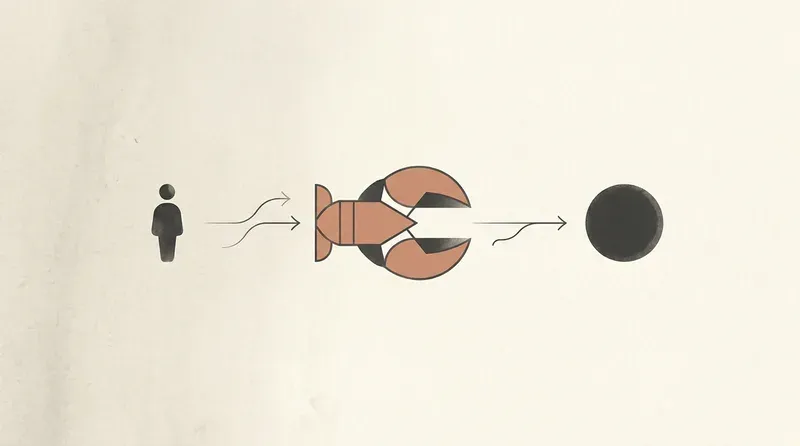
An AI Agent, such as OpenClaw or Claude Code, is the person standing outside the door.
Its job is to:
- Receive the user’s instruction through chat software, a web page, or a terminal
- Package the instruction into a Prompt with a lot of background context
- Slip it under the door to the language model
- Take the language model’s reply and handle whatever comes next
So an Agent is closer to a relay station or translator. It has no intelligence of its own. It is just hard-coded software following fixed rules.
A livelier metaphor: the language model is the “brain,” and the AI Agent is the “body.” The brain thinks, but it needs hands and feet to act. The body follows instructions from the brain, but it does not make decisions by itself.
Same Framework, Different Intelligence
This architecture creates an interesting effect: how smart an Agent feels depends almost entirely on which model sits behind it.
The same OpenClaw framework connected to an older model may fail at almost everything and feel like pure hype. Swap in a newer model, and its ability can jump immediately.
It is like putting different engines in the same car. The frame is the same, but the speed is not.
How This Differs from a Normal Chatbot
So what is the practical difference between an Agent and the ChatGPT or Claude you normally use?
Imagine someone gives this instruction: “Create a YouTube channel for me, then propose one video every day at noon.”
A normal chatbot would say something like, “I cannot create the channel directly, but here are some suggestions…” It can talk, but it cannot act.
An AI Agent receiving the same instruction can actually do it. It can use tools: open a browser, operate files, call APIs, or even write code to solve a problem. It can create the channel, upload an avatar, write scripts, make videos, and notify the owner at the agreed time.
This ability to use tools is the key difference.
Why This Matters
Understanding this architecture changes how you use these tools:
- Choosing the right model matters more than choosing the right Agent framework: the framework is the shell; the model is the core.
- Agent behavior is predictable: it is hard-coded rules, so it is not “persuaded” in the same way.
- Model behavior is not always predictable: it is doing text continuation, and the output has randomness.
Further Reading
- Your AI Assistant Keeps Forgetting: A Full Breakdown of AI Agent Memory
- Security Risks of AI Agents
- Skill, Sub-agent, Cron: Three Mechanisms That Let AI Work 24/7
- What Is an AI Agent? Complete Guide
- Complete OpenClaw Guide
📖 Next: Your AI Assistant Keeps Forgetting: A Full Breakdown of AI Agent Memory
Penchan’s Experience
I run the OpenClaw Agent framework in practice, and behind it I can connect Claude, ChatGPT, Gemini, and other language models. With the same OpenClaw setup, switching to a newer model immediately improves capability. The division of labor is very obvious: the model decides the ceiling of intelligence, while the Agent decides execution ability. For normal users, choosing the right model before choosing the framework saves a lot of painful detours.