
One of the fastest ways to understand where a company is taking its AI is to look at who’s steering. Google’s AI is led by a rather unusual group of people, with three layers of power stacked on top of one another, each playing its own role.
At the very top are two founders who stepped back but never truly left, holding ultimate veto power through a special share structure. In the middle is Sundar Pichai, a CEO wearing two crowns at once. On the research side stands Demis Hassabis, a Nobel-winning king of research. If you’d like to get to know the company as a whole first, start with what kind of company Google is.
Here’s the one-line summary: Hassabis runs research, Pichai runs the company, and the two founders sit at the very top holding the shares. Understand these three layers and you’ll see why a semi-retired founder can mobilize the entire team with a single memo.
Demis Hassabis: The King of Research
If you can only remember one name behind Google’s AI, it should be Demis Hassabis.
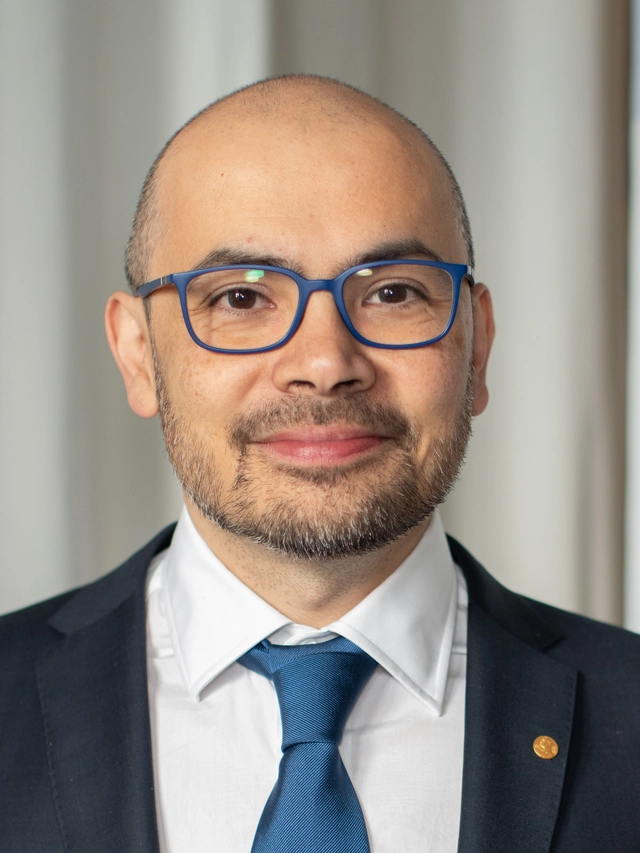
He is the CEO of Google DeepMind, leading all of Google’s frontier AI research and sitting at the heart of Gemini strategy. His résumé is rare: a chess prodigy as a teenager, he later turned to neuroscience, co-founded DeepMind in London in 2010, and sold the company to Google in 2014. DeepMind went on to deliver milestones like AlphaGo and AlphaFold; AlphaFold’s contribution to predicting protein structures earned him, alongside his colleague John Jumper, the 2024 Nobel Prize in Chemistry.
2023 was a pivotal step. Google merged London’s DeepMind and California’s Google Brain into “Google DeepMind,” under Hassabis’s unified leadership—effectively consolidating the company’s entire frontier-AI firepower in his hands. He also serves as CEO of the AI drug-discovery company Isomorphic Labs, pushing AI from chat assistant toward real-world scientific problems. In this race, he is one of the few figures who is both a scientist and a corporate leader.
Sundar Pichai: One Person Wearing Two Crowns
Research belongs to Hassabis, but the steering wheel for the whole company is in Sundar Pichai’s hands.
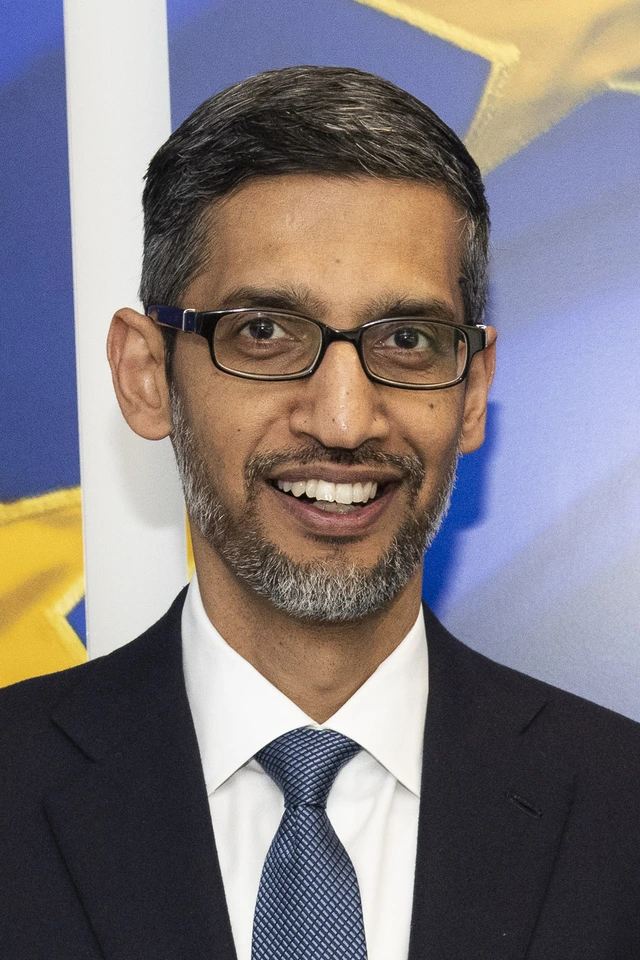
He has been CEO of Google since 2015 and, since 2019, also CEO of parent company Alphabet—one person overseeing the entire empire from Search, Android, and YouTube to the cloud, including how to place bets on that AI capital expenditure projected to reach $190 billion. For a long time, observers have stuck a label on him: a “peacetime CEO,” meaning he excels at maintaining what exists but may not be suited to the high-pressure tempo of an AI arms race. That criticism was at its fiercest in 2023, when Gemini got off to a rocky start.
But look at the numbers: Google’s revenue and cloud growth have hardly collapsed in recent years, and Gemini has steadily caught up. Whether Pichai’s style is fast enough is a matter of opinion, but what he has to balance is very real: on one side, the pressure of burning cash to sprint on AI; on the other, the imperative that Search, the cash cow, must not stumble. This “wanting it both ways” predicament is the inescapable backdrop for reading his decisions.
The Two Founders: Stepped Back but Still in Control
One layer further up are the two founders many assume retired long ago but who, in fact, still hold the final say.
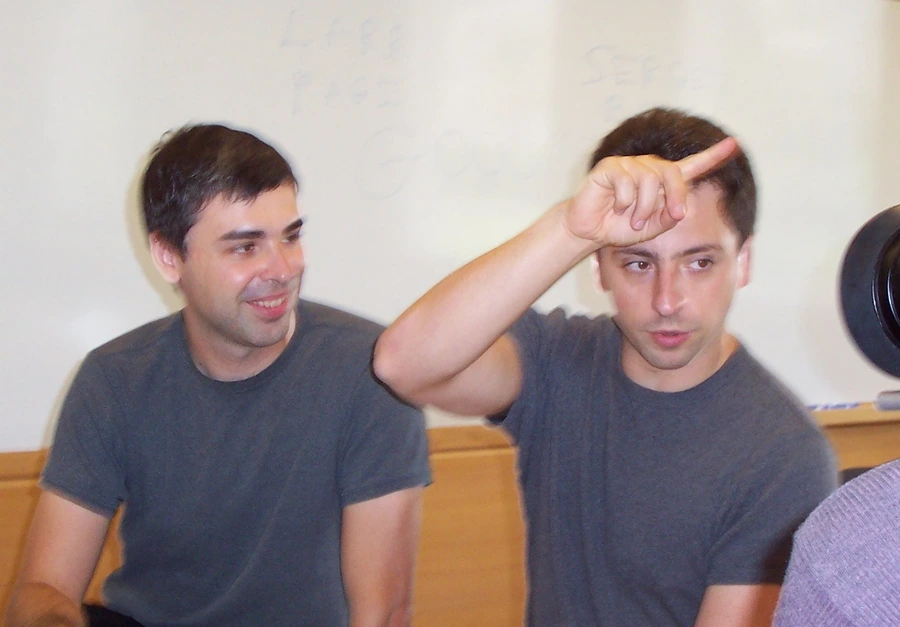
Larry Page and Sergey Brin did step away from daily operations—Page handed over the CEO role back in 2019. But they hold a special kind of stock. Alphabet uses a three-class share structure: the Class A that ordinary people buy on the market carries one vote per share; the founder-held, non-publicly-traded Class B carries ten votes per share; and a third class, Class C, carries no voting rights at all. Through their high-vote Class B holdings, Page and Brin together control roughly 52.7% of the total voting power. In other words, as long as the two of them agree, outside shareholders cannot overturn anything they want to do.
This structure is hard to spot in normal times, yet carries enormous weight at critical moments. Since 2024, Brin has returned to the Googleplex to work hands-on on Gemini’s development. His 2026 internal memo—which admitted Google had fallen behind Claude and demanded an elite team be assembled—could mobilize all of DeepMind the moment it went out precisely because of this founder-level weight. For the full story behind that memo, see even Google admits it’s behind Claude.
The Technical Core: The People Who Built Gemini
Gemini wasn’t built by one or two people, but the names that keep recurring behind it are a small group of top talent.
Beyond Hassabis, the technical side includes several key figures: chief scientist Jeff Dean, a legend of Google’s early distributed systems and deep-learning infrastructure; DeepMind CTO Koray Kavukcuoglu, who coordinates the technical architecture; Oriol Vinyals, a co-technical lead for Gemini; and Noam Shazeer, one of the co-inventors of the Transformer architecture that underpins all of generative AI. Shazeer left Google in 2021 and was brought back in 2024 to once again serve as a technical co-lead for Gemini.
Top-tier AI talent is inherently scarce, and whichever company this group joins gets a shot at the lead—which is why the major players pour fortunes into a handful of names. The fact that Google could pull Gemini from behind to the front line owes much to this talent bench: an invisible but very real asset.
Governance: Who Can Veto Whom
Stack all three layers together and the logic of Google’s AI governance becomes clear.
Ultimate control rests not with outside shareholders but in the voting power that the two founders have locked in through the share structure; the board is chaired by John Hennessy, former president of Stanford University. The upside of this design is that decisions aren’t easily held hostage by short-term share prices—when the founders want to make long-term big bets (such as the colossal AI capital expenditure), they don’t have to please Wall Street every quarter. The cost is that, when power is this concentrated, the force of external checks is correspondingly weak.
Its double-edged nature was caught perfectly by that Brin memo: a semi-retired founder able to bypass layers of management and issue orders directly to the entire research team. That’s hard to imagine at most public companies, but at Google it’s a norm the system permits.
What Outsiders Can’t See Clearly
When discussing leadership, some things genuinely aren’t clear to outsiders, so let’s flag them honestly:
- Larry Page’s actual involvement: Public records only confirm he’s a board member. As for how deeply he’s involved in day-to-day AI operations, there’s no reliable public information, so it’s not worth speculating.
- The details of internal division of labor: Who has the final say on which area among Hassabis and the various technical leads—the company hasn’t published an org chart, and outsiders can only piece it together from announcements and reports.
- Personnel changes: Top talent moves quickly. The roles listed here reflect currently available public information and will be updated over time.
Penna’s Take
Put this group of people side by side, and Google’s leadership structure actually reveals its playbook.
It hands research to a Nobel-winning scientist who genuinely believes AI can solve hard scientific problems, hands the company to a steady manager skilled at balancing, and lets the two founders at the very top guard the long-term decision rights through the share structure. The upside of this combination is that it can withstand the cash burn and ride out short-term swings; the risk is high concentration and weak external checks. In a race where no one dares to slow down, how this kind of power structure shapes Google’s every move is worth watching over the long run.
Further reading: what kind of company Google is, even Google admits it’s behind Claude: the leaked memo, why Google invests in its rival Anthropic.