
A lot of people meeting Gemini for the first time get tangled up in a row of names: Gemini Flash, Gemini Pro, Flash-Lite, Omni—with numbers like 2.5 and 3.5 trailing behind. Which one is which?
Here’s the bottom line first: Gemini is one whole family of models, and Google has split different needs into several product lines, each with its own job. If you want to get to know the company behind Gemini, start with What kind of company is Google; this piece focuses on one thing only—breaking the family down for you.
To set the frame in a sentence: Google builds its models as “one generation, split into several sizes,” like the same car offered in fuel-saver, performance, and entry-level trims—you just pick by need.
Gemini Is a Family, Not a Single Model
The trick to understanding Gemini’s naming is to split it into two layers.
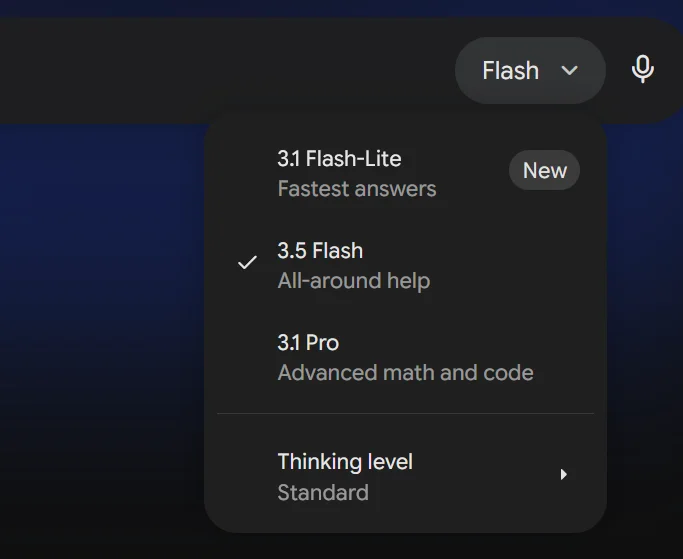
The first layer is the product line—the names Flash, Pro, Flash-Lite, and Omni—which signal what task a model “was born for.” The second layer is the generation number, like 2.5 or 3.5; a newer number usually means fresher training data and stronger capabilities. So “Gemini 3.5 Flash” simply means “the Flash line, generation 3.5.”
Remember that split, and no matter whether Google ships a 4.0 or a 5.0, you’ll see at a glance which line it’s talking about.
Where Each of the Four Lines Sits
Laying the current main lines out side by side, the division of labor looks roughly like this:
| Product line | Positioning | Best-fit scenarios |
|---|---|---|
| Pro | Strongest reasoning + longest context | Complex reasoning, reading long documents, writing code—hard tasks that need “think it through, then answer” |
| Flash | The workhorse for speed and value | High-volume, real-time, cost-sensitive applications, such as chat assistants, customer support, and batch processing |
| Flash-Lite | The cheapest tier in the family | Tasks that aren’t hard but get called in huge volume, where you want to push each call’s cost to the floor |
| Omni | Fully multimodal, audio- and video-first | Understanding and generating images, audio, and video; making multimedia content |
These four lines coexist, and Google tends to update them together within the same generation. Flash is the workhorse most people run into day to day, while Pro is the one you reach for when you’re handing off a hard problem.
One thing to add: beyond the closed-source, commercial Gemini, Google also maintains a set of open-weight small models called Gemma, with license terms that allow free use within certain bounds. This piece is about the main Gemini line; Gemma is a different story.
Omni: One Step Further Toward “Fully Multimodal”
At Google I/O in May 2026, Omni was the most talked-about new member.
Earlier Gemini could already read images, read video, and listen to audio—you could say it “understood” multimedia. What Omni wants to do is take one more step: ingest images, audio, video, and text as input all at once, and output video you can edit afterward. For anyone who wants to use AI to make short videos or create assets, this is a new line that fills in the generative side.
A reminder: this kind of capability is moving fast, and the actual scope and specs that ship will keep shifting, so it’s best to check the current official notes before you get hands-on.
Which One Should You Pick
You don’t have to memorize specs—working backward from your need is the easiest path.
If what you want is real-time, high-volume, and cost-controllable, the Flash line is the default answer, and most production-grade applications start here. When you hit tasks that need reading very long documents, doing complex reasoning, or writing tougher code, hand them to the Pro line—it thinks deeper and has a longer context window. If your task isn’t actually hard but the number of calls is staggering and you want to push the bill to the floor, Flash-Lite is designed for exactly this. When you need to handle audio and video or make generative multimedia content, then look at Omni.
If you’re already about to wire up the API, this piece gives you the direction; when it comes to actually choosing a version and reading the per-million-token quotes, check the current model in the official docs. Once the little penguin’s /ai/ tutorial pages go live, we’ll walk through the hands-on steps together.
What the Pricing Roughly Looks Like
Pricing is the thing that goes stale fastest, so here I’ll only give relative highs and lows, not fix the numbers.
On the consumer side, the Gemini app has a free allowance, with stronger models and bigger quotas bundled into Google’s AI subscription plans. Developers using the API pay by usage, and the rule is intuitive: the lighter the model, the cheaper—Flash-Lite is the most economical, Flash sits in the middle, and Pro is the priciest; long context and newer generations usually carry a higher unit price. Google also offers a batch mode, trading delayed delivery for a noticeable discount. For exact prices, refer to the official pricing page.
Where This Family Is Headed
Set the individual version numbers aside, and Gemini’s direction over these past few years is fairly clear.
The model lines head, on one front, toward thinking better—able to spend more compute reasoning before answering, and letting developers set “how long to let it think”; on another, toward longer context—stuffing in a whole document or an entire project’s worth of data at once; next, toward agentic capability that acts on its own—chaining together multi-step workflows; and finally, toward full multimodality—folding in both understanding and generation of audio and video.
Grasping these four directions is far more useful than remembering “which version is the flagship right now.” Version numbers change every few months, but this line of evolution stays relatively stable.
The Little Penguin’s Reminder
The pace at which AI models update right now will turn any “latest version” into an old one in no time. What’s truly worth remembering is this family’s layering logic: pick Flash for speed, Pro for power, Flash-Lite for savings, and Omni for audio and video. Once you understand this division of labor, the next time Google drops a new generation, all you have to ask is “which line is this a new version of”—and you’re set.
Further reading: What kind of company is Google, Gemini vs. ChatGPT: who has more users.