
If Perplexity’s answer engine was about taking search away from Google, then Comet is the move that stretches the front line to the entire browser. Comet is a browser with a built-in AI assistant, and it doesn’t just look things up for you. It can also organize your tabs, read your mail, and even finish a whole string of tasks on its own.
This piece walks you through what Comet is, how far its paired Computer agent can go, the concerns security researchers have flagged, and the browser war it’s now caught up in. If you want to get to know the whole company first, start with What kind of company is Perplexity.
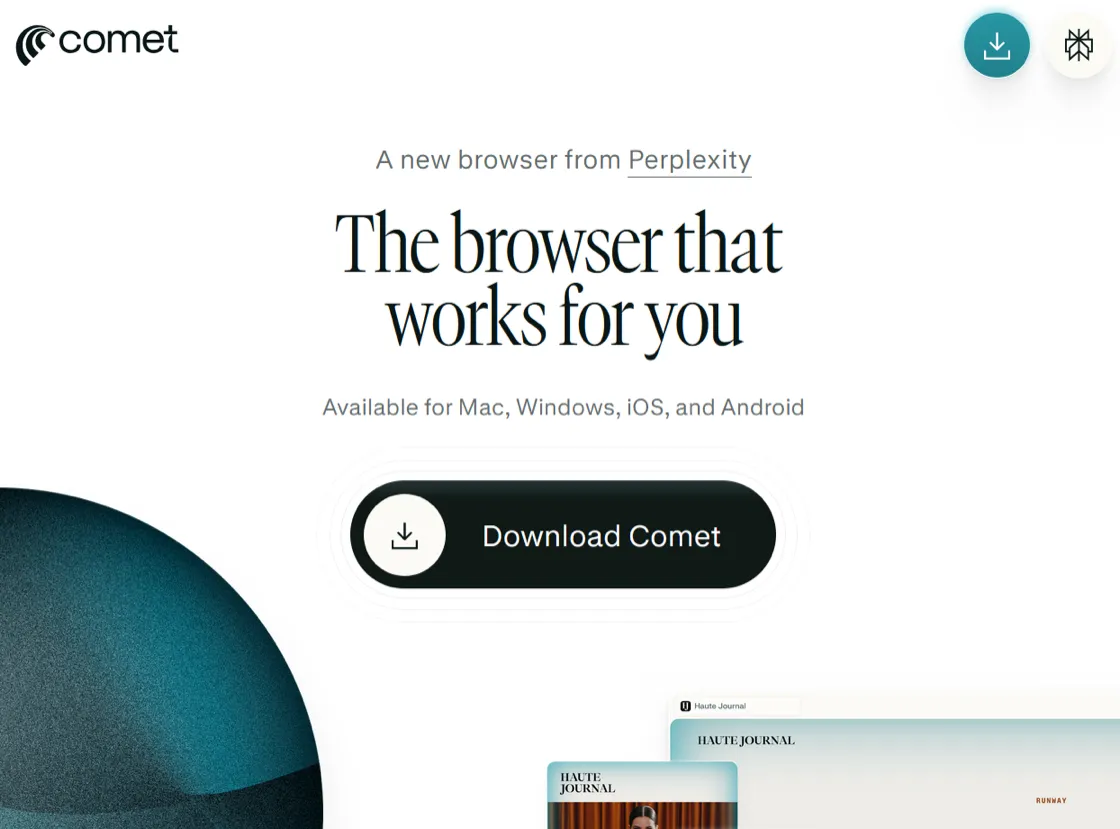
What Comet Is: A Browser That Operates on Its Own
On the surface, Comet looks just like a browser, but an AI assistant is always standing by in the sidebar. You can ask it to summarize the current page, organize a pile of open tabs, or figure out how to reply to an email, and it can also compare information across pages for you.
The timeline is worth noting. Comet first launched in July 2025 for paying Max users (when the monthly fee ran as high as about 200 US dollars and you had to join a waitlist), then turned free to download in October 2025, and arrived on iPhone in March 2026. It now runs on Mac, Windows, iOS, and Android. Going from a paywall all the way down to free shows how eager Perplexity is to pull users into this gateway.
For enterprise users, it also offers a version that meets security requirements, with support for single sign-on, audit logs, centralized deployment, and other management features. That’s the setup it’s using to break into corporate procurement.
Computer: From “Answering” to “Doing”
If Comet is the browser that lends a hand, then Computer, launched in February 2026, upgrades it into an agent that finishes the job for you automatically.
Computer can run hundreds of apps in sequence inside a cloud-isolated sandbox, from Gmail and Slack to Notion and spreadsheets, completing long tasks that span several steps in one go. There’s a clever design behind it too: it automatically picks the AI model best suited to the task at hand from more than a dozen top models, choosing one for complex reasoning and another for fast execution. It opened first to Max users, then moved into the enterprise market, and later even regular Mac users got a desktop version.
This step matters a lot. It signals that Perplexity wants to turn itself from “a search tool that answers questions” into “a digital employee that gets things done for you.” And that’s exactly why Amazon locked horns with it: when the Computer agent logs into a user’s e-commerce account and shops automatically, the line between the platform and the AI agent blows wide open. That line is laid out in full in the answer engine’s copyright war and the AI agent lawsuit.
The Security Concern: The Price of Letting an AI Operate for You
Handing your browser over to an AI has a flip side to its convenience: the risk gets amplified, and it’s a very new kind of risk, called prompt injection.
In plain terms, prompt injection is when a bad actor secretly hides malicious instructions inside a web page, an image, or a URL, and when the AI agent reads that content, it treats it as a command from you and carries it out. Several security teams have already demonstrated attack methods against Comet: the Brave team showed how to hide instructions in white-on-white text or in images, luring the AI into reading a user’s Gmail, grabbing a verification code, and leaking it. Security firms LayerX and Cato have each also demonstrated attacks that can be triggered by a single URL.
Two things need to be spelled out clearly here, so nobody overreacts. First, for now these are mostly proof-of-concept demonstrations from security research, warnings that an attack like this is possible, with no known large-scale real-world incident, and several of them were patched after being reported. Second, this is a shared problem across all agentic browsers, not something unique to Comet; even OpenAI has publicly admitted that prompt injection is like the scams online, and may be very hard to stamp out completely.
The practical reminder is this: letting an AI browser do things for you is great, but don’t authorize it to touch your most sensitive accounts (online banking, your work email) all at once. Keep the risk within a range you can afford to lose.
Browser War 2.0
Comet isn’t fighting alone. From 2025 into 2026, a new browser war officially broke out. This time everyone is fighting over the same thing: the first gateway to AI queries. Compared with how fast a browser renders pages, what decides this round is who can become the first AI a user touches after opening the web.
OpenAI launched its own ChatGPT Atlas browser, turning ChatGPT directly into a browsing interface. The biggest threat comes from Google: instead of building a new browser, it baked Gemini’s agent features straight into the Chrome everyone is already using, reaching billions of existing users the moment it went live, in what’s been called the largest agentic-browser deployment ever. On top of that, players like Opera have shipped browsers centered on AI agents, while The Browser Company, the startup that made its name with the Arc browser, was acquired by an enterprise software company amid this wave.
Comet’s advantages are starting early, a mature experience, and model neutrality (you can switch among several models). Its challenge is the same as the answer engine’s: when Google follows in with a base of 3 billion existing users, Comet has to find a way to convince people to “switch to a different browser, just for it.”
Why a Browser: A Fight Over the Gateway
Take a step back, and Perplexity’s logic for betting on a browser is actually pretty clear.
Search and browsers are all gateways to the web, and whoever holds the gateway holds the user’s attention and data. For the past two decades that gateway was Google’s search box; now that AI is rewriting the rules of the game, ownership of the gateway is being reshuffled, and every company wants to be the first AI you touch after opening the web. A browser is also stickier than any single app: it can see everything you browse, it can act across websites on your behalf, and it can hold on to you by remembering your preferences over the long term.
For Perplexity, Comet plus Computer is its key bet on upgrading from a “search tool” into a “daily gateway.” Win the bet, and it gets a chance to escape relying purely on the answer engine; lose it, and it’s still facing the same old problem, with the gateway in the hands of the giants. For its overall competitive position, you can compare it against the market-positioning angle in What kind of company is Perplexity.
Penchan’s Take
Comet is a product that turns heads. It extends “search” into “doing things for you,” and it reads the direction well. But it also puts a contradiction out in the open: how willing are we to hand over our browser, our accounts, and our inbox to an AI that can still be tricked away by a single instruction hidden on a web page?
This is exactly the question the whole agentic era has to answer over time. My take is that the value of tools like these will only grow, but maturing takes time. The smart way to use them right now is to let them handle low-risk, highly repetitive chores (organizing tabs, summarizing long reads, drafting replies), and keep the high-risk operations like online banking and company secrets in your own hands for now. Let the bullet fly a little longer; once the safety mechanisms catch up, there will still be plenty of time to hand over more keys.
Further reading: What kind of company is Perplexity, the answer engine’s copyright war and AI agent precedents, What is Sonar.