Author: Penna 🐧 | 2026-03-29 | Deep Research
On February 27, 2026, OpenAI announced the completion of a $110 billion financing round, taking its post-money valuation to $840 billion [1]. That number is larger than half of TSMC’s market cap and higher than the full market cap of Samsung Electronics.
Ten years ago, this company was still a nonprofit lab, with less than $130 million of actual cash received at founding [2]. Ten years later, it has become the largest private fundraising story in human history. Revenue is growing more than threefold year over year, but the company is also burning billions of dollars per year. ChatGPT is used by 900 million people [3], but only around 5% of them pay.
Is this a genius bet, or a valuation bubble?
Penchan spent several days using five different AI models, ChatGPT, Claude, Gemini, Perplexity, and Grok, to produce separate full OpenAI investigation reports, then cross-checked their numbers. When all five reports agreed, I marked the item as confirmed. When they diverged, I explain the divergence in the text. This may be the most complete Chinese OpenAI analysis you can find, and maybe the first case of using AI collectively to investigate an AI company.
Table of Contents
- How This Report Was Made
- Nonprofit to PBC: Ten Years of Structural Evolution
- Who Is Steering It? Management After the Personnel Earthquake
- Behind 900 Million Users: Product Portfolio Breakdown
- Revenue Triples, Losses Accelerate
- The Wildest Private Financing in History
- Microsoft: Can’t Leave, Can’t Love
- Pressure From All Sides: Anthropic, Google, Meta, and Open Source
- Top Ten Risk Factors
- Is $840 Billion Worth It? Three Valuation Scenarios
- Penchan’s Take

How This Report Was Made
Penchan first wrote a detailed equity research prompt covering 11 areas: company overview, management team, products, revenue, financing, the Microsoft relationship, competition, risks, valuation, and more. Then I gave it separately to ChatGPT (o3), Claude (Opus 4.6 at the time of writing), Gemini (2.5 Pro), Perplexity (Deep Research), and Grok (3).
Each model produced a report of 6,000 to 15,000 words. Penchan then compared their numbers item by item.
This matters because AI often makes confident factual mistakes. A single model’s number may come from stale data or hallucination. If five models cite different sources and arrive at the same number, confidence rises a lot. If the five models disagree, I mark the number as an estimate.
This method has blind spots. All models have knowledge cutoffs, and training data may overlap. But for a private company that does not publish financial statements, this may be the best due diligence a retail investor can realistically do.
Nonprofit to PBC: Ten Years of Structural Evolution
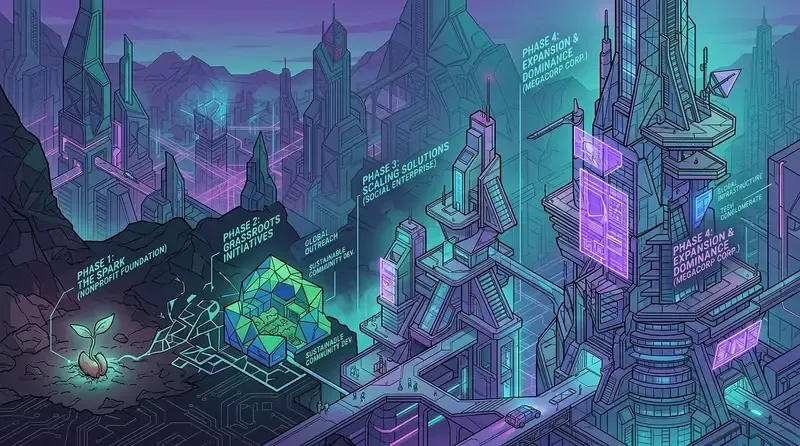
OpenAI was announced in December 2015 [4] as a Delaware 501(c)(3) nonprofit. Founders included Sam Altman, Elon Musk, Greg Brockman, Ilya Sutskever, and others. The public fundraising pledge was $1 billion, but OpenAI clarified in a March 2024 legal filing that actual cash received was less than $130 million, with Musk contributing about $38 million [2].
The turning point came in 2019. The research team found that the compute cost of training frontier models was far beyond what a nonprofit could bear, so it created a capped-profit subsidiary, OpenAI LP [5], allowing outside investment but limiting returns. In July of the same year, Microsoft invested its first $1 billion, and the Azure partnership officially began [6].
On November 30, 2022, ChatGPT launched. It reached 1 million users in five days and 100 million in two months. That number changed everything.
| Year | Event | Meaning |
|---|---|---|
| 2015 | Nonprofit founded | Mission-oriented research lab |
| 2019 | Capped-profit subsidiary + Microsoft $1B | Commercialization begins |
| 2022 | ChatGPT launched | The iPhone moment for consumer AI |
| 2023 | Board crisis in November | Fundamental governance flaws exposed |
| 2025.3 | SoftBank-led $40B round at $300B valuation | Enters mega-financing stage |
| 2025.10 | PBC restructuring completed | Nonprofit-to-public-benefit structure, paving the way for IPO |
| 2026.2 | $110B financing at $840B valuation | Largest private financing ever |
On October 28, 2025, the restructuring was completed [7]. The original nonprofit was renamed OpenAI Foundation. The for-profit entity became OpenAI Group PBC, a Public Benefit Corporation. The Foundation held about 26% of the equity, worth roughly $130 billion at the then-current valuation, and retained the power to appoint all PBC directors. The profit cap was removed, and shareholders now hold ordinary equity.
This structure remains legally disputed. Elon Musk’s lawsuit is scheduled for trial on April 27, 2026 [8], only one month after this article’s publication.

Who Is Steering It? Management After the Personnel Earthquake
Sam Altman is OpenAI’s absolute center. On November 17, 2023, a four-person board suddenly fired him, saying he had not been “consistently candid” in communications [9]. The next 96 hours were one of Silicon Valley’s most dramatic episodes: Microsoft CEO Satya Nadella announced that he would hire Altman, 738 of 770 employees signed an open letter threatening to leave, and Altman returned within five days with a fully rebuilt board.
After the crisis, governance moved in a more traditional direction. The new board is chaired by Bret Taylor, former co-CEO of Salesforce [7]. Members include former NSA director Paul Nakasone, Quora CEO Adam D’Angelo, the only old board member who stayed, and Carnegie Mellon professor Zico Kolter, who leads the safety oversight committee.
But the executive departure list is long and sharp.
| Departure | Former role | Time | Destination |
|---|---|---|---|
| Ilya Sutskever | Co-founder, chief scientist | 2024.5 | Founded SSI, valued at $32B [10] |
| Mira Murati | CTO | 2024.9 | Founded Thinking Machines Lab [11] |
| John Schulman | Co-founder | 2024.8 | Anthropic [12] |
| Jan Leike | Alignment research lead | 2024.5 | Anthropic |
| Andrej Karpathy | Co-founder | 2024.2 | Founded Eureka Labs |
Of the original 11 co-founders, only 2-3 remain at the company. One Fortune data point said OpenAI engineers were moving to Anthropic at eight times the reverse rate [13].
The current core team includes CFO Sarah Friar, former Nextdoor CEO, who is preparing the IPO; Applications CEO Fidji Simo, former Instacart CEO; and chief scientist Jakub Pachocki [14]. This is a commercialization-oriented team. The research flavor has faded a lot.
Behind 900 Million Users: Product Portfolio Breakdown
ChatGPT is OpenAI’s most important asset. As of February 2026, it had more than 900 million weekly active users. But behind that huge number are several less flattering realities.
User growth is fast, paid conversion is low. All five models cited similar data: only about 5% of active users pay for subscriptions. Estimated total paid users are around 50 million. Claude and Gemini agreed on that figure, while ChatGPT’s report cited an older July 2025 number of 35 million.
Market share is being eroded. ChatGPT’s consumer AI web traffic share fell from about 87% in early 2025 to about 65% in early 2026 [15]. Google Gemini rose from 5.7% to about 15%, and Grok also climbed above 15% on mobile. The whole market is growing quickly, but OpenAI’s share is shrinking.
Subscription Plans
| Plan | Monthly price | Features |
|---|---|---|
| Free | $0 | GPT-5.3 with limits; ads appeared starting 2026.2 |
| Go | $8 | New entry paid tier launched 2026.1, includes ads |
| Plus | $20 | GPT-5.4 Thinking, no ads |
| Pro | $200 | Unlimited access to all models; Altman admitted it loses money |
| Enterprise | Custom | SLA, compliance, admin console |
Model Evolution
GPT-3 (2020) → GPT-4 (2023) → GPT-4o (2024) → o1 reasoning model (2024) → GPT-5 (2025.8) → GPT-5.4 series (2026.3)
The o-series is a separate technical route. It does not rely only on larger pretraining, but spends more time “thinking” at inference time. These models perform strongly on math and code, but inference cost is also higher.
Product Wins and Misses
Codex is a success case: 1.6 million weekly active users [16], now an important OpenAI product in the developer market. Sora, the text-to-video product, had already shut down its standalone app on March 24, 2026, with only $1.4 million in revenue, and resources shifted toward robot training and world simulation [17].
On the API platform, OpenAI says it has 4 million developers and processes 6 billion tokens per minute [18]. Google’s Gemini API has 2.4 million active developers and 85 billion monthly requests [28]. These two numbers are measured differently, though: OpenAI counts cumulative developers, and Google counts active developers. Direct comparison is misleading. Still, developer-market competition is narrowing quickly.

Revenue Triples, Losses Accelerate
OpenAI’s revenue growth speed has no clear software industry comparison.
| Timing | Revenue / ARR | Source |
|---|---|---|
| End of 2023 | ARR $2B | Reuters, confirmed |
| Full year 2024 | Revenue about $3.7B | Reuters, confirmed |
| End of 2025 | ARR above $20B | OpenAI CFO public statement, confirmed |
| Full year 2025 | Actual revenue about $13.1B | Reuters, confirmed |
| 2026.2 | ARR above $25B | The Information, not independently verified |
One distinction matters: ARR and actual revenue are not the same thing. ARR takes the most recent month’s revenue and multiplies by 12. If growth is concentrated in the second half, actual full-year cash received will be much lower than ARR. That is what happened in 2025: year-end ARR was above $20 billion, but full-year actual revenue was about $13.1 billion.
Revenue mix (estimated, with model estimates aligned in direction):
- Consumer subscriptions (ChatGPT Plus/Pro/Go): about 55-60%
- Enterprise and business products: about 25-30%
- API and developers: about 10-15%
Enterprise is the fastest-growing segment. CFO Sarah Friar expects enterprise revenue to exceed 50% of total revenue by the end of 2026 [18]. OpenAI says 92% of Fortune 500 companies use its products, and it has more than 1 million business customers [19].
The Cost Structure Problem
This is the most unsettling part of the report.
Traditional SaaS companies usually have gross margins of 70-80%, because the marginal cost of software approaches zero. OpenAI’s model is completely different: every additional user query consumes real compute and electricity. Gross margin in 2025 was only about 33%, half of typical SaaS.
All five models agreed on one point: OpenAI does not expect to become cash-flow positive until 2029 [20]. Reuters reported internal projections targeting more than $125 billion in 2029 revenue, which is also the break-even point in the company’s plan.
| Year | Estimated revenue | Estimated loss | Notes |
|---|---|---|---|
| 2025 | $13.1B | $8-9B | Revenue confirmed / loss estimated |
| 2026 | $29-35B | $14B | Internal target / AI model report estimates |
| 2027 | $62B | Still negative | Internal target |
| 2029 | $125B+ | First positive cash flow | Reuters-reported internal projection |
HSBC’s analysis was more pessimistic: OpenAI may still be unprofitable in 2030, with a funding gap of $207 billion [21]. Deutsche Bank estimated cumulative negative free cash flow of $143 billion by 2029 [22].

The Wildest Private Financing in History
OpenAI’s financing history is a story by itself.
| Time | Event | Amount | Valuation |
|---|---|---|---|
| 2015 | Nonprofit founded | Actual cash received about $130M | N/A |
| 2019.7 | Microsoft investment | $1B | N/A |
| 2023.1 | Microsoft adds | ~$10B, including Azure compute | ~$29B |
| 2024.10 | Series E | $6.6B | $157B |
| 2025.3 | SoftBank-led round | $40B | $300B |
| 2025.10 | Employee share sale | $6.6B | ~$500B |
| 2026.2 | Mega round | $110B | $840B |
The February 2026 $110 billion round is the largest single private financing in human history. Investors include Amazon ($50 billion), SoftBank ($30 billion), and Nvidia ($30 billion). Amazon also committed 2 GW of Trainium compute and became the exclusive third-party cloud supplier for the OpenAI Frontier platform.
The five models disagreed on how much OpenAI has raised in total. ChatGPT did not give a clear total. Claude said about $170 billion. Gemini said more than $120 billion. The difference comes mainly from early nonprofit funding and whether Microsoft compute credits are counted. A reasonable range is about $120-170 billion.
How the Valuation Got Here
Putting together valuation points mentioned by all five models:
2021        ~$14B
2023.1      ~$29B
2024.2       $80B+
2024.10      $157B
2025.3       $300B
2025.10     ~$500B
2026.2       $840B
In a year and a half, OpenAI went from $157 billion to $840 billion, more than a 5x increase. That is faster than any private technology company I have seen.
Musk Lawsuit
Elon Musk’s lawsuit seeks $79-134 billion in damages, accusing OpenAI’s founders of “deliberately making false assurances” about the nonprofit commitment. A 2017 diary entry by Greg Brockman was quoted in court filings [23]: “I cannot believe we promised nonprofit, and three months later we’re doing B-Corp. That means lying.”
The judge has ruled that the case can proceed to a jury trial. Trial starts on April 27, 2026.
Prediction markets currently put Musk’s probability of winning at 28-36%. But even if he loses, four weeks of trial coverage could create a lot of negative news at a key moment when OpenAI is preparing for IPO.

Microsoft: Can’t Leave, Can’t Love
Microsoft has invested about $13 billion in OpenAI and currently holds about 27% of the equity [24]. At an $840 billion valuation, that stake is worth about $227 billion, a return of more than 17x.
But the relationship is much more complicated than it looks.
Economic Arrangement
- Microsoft receives about 20% of OpenAI revenue as a revenue share, at least through 2030 [25]
- OpenAI’s API is hosted exclusively on Azure
- OpenAI committed to an additional $250 billion in Azure purchases
- Microsoft has rights to use OpenAI model IP through 2032
Exclusivity Is Loosening
The 2025 restructuring removed Microsoft’s priority as OpenAI’s sole compute supplier. The February 2026 Amazon deal broke the pattern further. OpenAI now uses compute from Azure, AWS, Oracle, CoreWeave, and Google Cloud.
Stargate is another signal of change. The $500 billion infrastructure plan originally pushed by Microsoft and OpenAI showed cracks in March 2026: OpenAI exited the Abilene, Texas expansion, and Microsoft took it over alone.
Partner and Competitor
Microsoft listed OpenAI as an official competitor in its 2025 annual report [26]. Microsoft AI chief Mustafa Suleyman said publicly in February 2026 that “we must develop our own frontier foundation models” [27, AI model report estimate]. Microsoft’s internal Phi models and MAI-1 have already been tested inside Copilot.
One-sentence summary: Microsoft is still OpenAI’s most important infrastructure partner, but it is no longer the only life-or-death dependency. The relationship is moving from “shared destiny” to “strategic alliance with competition.”

Pressure From All Sides: Anthropic, Google, Meta, and Open Source
Who Is Taking Enterprise Customers
Menlo Ventures’ enterprise LLM spending survey [28] produced a surprising ranking:
| Company | Enterprise LLM spending share | Trend |
|---|---|---|
| Anthropic | 32-40% | Rising quickly |
| OpenAI | 25-27% | Declining |
| 20-21% | Stable |
Anthropic has already overtaken OpenAI in the enterprise market. In February 2026, its valuation reached $380 billion [29], with ARR between $14 billion and $19 billion. The five models differed, with the low end of $14 billion from ChatGPT and the high end of $19 billion from Gemini. Claude Code alone contributed $2.5 billion ARR [30, AI model report estimate]. Eighty percent of revenue comes from enterprise customers, and net revenue retention is 140%.
If Epoch AI’s trend extrapolation is taken seriously, Anthropic may surpass OpenAI in revenue sometime in 2026-2027.
Structural Advantages by Competitor
Google/DeepMind has distribution. Gemini is embedded into Android (1.5B+ devices), Chrome, Search (2B AI Overview users), and Workspace [31]. TPU ownership cost is 30-44% lower than Nvidia GPUs on Azure, according to SemiAnalysis estimates. The 2026 CapEx budget is $175-185 billion, almost twice 2025 levels.
Meta is taking the open-source route. The Llama series has been downloaded more than 1 billion times cumulatively [32]. Open-source models lower API pricing across the whole industry, creating structural pressure on OpenAI’s pricing power.
DeepSeek is the price breaker. V3.2 API pricing is only 1/25 to 1/90 of comparable OpenAI models, and it claims the training cost of a frontier model is less than $6 million [33]. Even if that number is understated, the signal is clear: spending money does not equal a moat.
xAI is valued at $230-250 billion [34], but revenue may be only about $500 million. Its valuation-to-revenue multiple is far above peers.
Moat Analysis
Penchan summarized the five models’ consensus assessment of OpenAI’s moat:
| Moat factor | Strength | Durability |
|---|---|---|
| Brand (ChatGPT = AI) | Strong | Medium, being eroded |
| User scale (900M WAU) | Strong | Low, switching cost is low |
| Microsoft partnership | Strong | Medium, competitive tension increasing |
| Developer ecosystem | Medium | Low, Google developer count has caught up |
| Model performance lead | Weak | Low, benchmarks are converging |
| Ability to raise capital | Strong | Medium, competitors are also raising heavily |
Conclusion: OpenAI’s strongest moat is the combination of brand, consumer distribution, and capital access. The model itself is not at the top. The durability of all these advantages is uncertain.

Top Ten Risk Factors
Based on the overlap across the five model reports, these are the risks that matter most for investing in OpenAI:
1. Structural legal risk. Musk’s lawsuit goes to trial at the end of April and seeks $79-134 billion. The nonprofit-to-profit conversion remains under legal and political scrutiny.
2. Financial black hole. Cumulative negative cash flow through 2029 is expected to exceed $100 billion. If revenue growth slows, large equity dilution may follow.
3. Abnormal gross margin. A 33% gross margin is half of typical SaaS. Inference cost grows linearly with usage, contradicting the usual software economies of scale.
4. Microsoft dependence. The company still has a 20% revenue share and Azure infrastructure dependence, even though it is diversifying.
5. Open-source commoditization. DeepSeek, Llama, Qwen, and other open models are closing the performance gap quickly and pushing API pricing down.
6. Talent loss. The original founders are nearly gone, and research leaders keep moving to Anthropic, SSI, and startups.
7. Intensifying competition. Anthropic has overtaken OpenAI in enterprise. Google has distribution and cost advantages. Meta’s open-source strategy compresses industry profit.
8. Regulatory risk. The EU AI Act begins enforcement for high-risk systems on August 2, 2026, with fines up to 7% of global turnover.
9. Copyright litigation. The New York Times case has entered discovery, and OpenAI was ordered to produce 20 million anonymized ChatGPT records. More than 70 copyright lawsuits have been consolidated.
10. Key-person risk. Sam Altman’s power concentration deepened after the 2023 crisis. The company’s image and strategy are tightly tied to one person.

Is $840 Billion Worth It? Three Valuation Scenarios
Comparable Companies
| Company | Market cap / valuation | Revenue base | Multiple | Gross margin |
|---|---|---|---|---|
| OpenAI (current) | $840B | $25B ARR | ~34x | 33% |
| Anthropic | $380B | $14-19B ARR | 20-27x | ~40% target |
| Palantir | $433B | $4.5B FY2025 | ~97x | 84% |
| Snowflake | $93.1B | ~$4.5B product revenue | ~21x | ~65% |
| Datadog | $49.7B | $3.4B FY2025 | ~15x | ~78% |
| Microsoft | $3.59T | $281.7B FY2025 | ~13x | ~70% |
OpenAI trades at 34x revenue. Anthropic is around 20-27x, and Databricks around 25x. The difference is this: Palantir has 84% gross margin and is profitable. OpenAI has 33% gross margin and loses more than $9 billion per year.
Three Scenarios
Bull case: $1.2-1.5T
- 2029 revenue reaches $140B
- AI agent products bring enterprise SaaS-like economics
- In-house chip, code-named Titan, cuts inference cost by more than 50%
- Consumer brand remains dominant
- Assign 10-12x 2029 revenue, giving $1.4-1.7T, discounted back to about $1.2T
Base case: $700-900B
- 2029 revenue reaches $100B
- Competition is fierce, but OpenAI remains top two
- Profitability starts in 2028-2029
- Gross margin improves to around 50%
- Assign 8x, discounted back to about $800B
Bear case: $300-440B
- Models commoditize, open source pressures pricing
- Revenue reaches only $55-60B
- Infrastructure investment becomes sunk cost
- Assign 5-7x, giving $300-440B, roughly half the current valuation
The five models were highly aligned: at a $300 billion valuation, roughly 15x ARR, risk/reward is more balanced; at $840 billion, roughly 34x ARR, the valuation already reflects most of the optimistic case.
Qualitative judgments by model: ChatGPT: Hold/Neutral; Claude: Hold/Neutral; Gemini: Hold/Neutral; Perplexity: Hold; Grok: Cautious Buy. These are AI model analysis outputs, not investment ratings.
Probability-weighted valuation, using the average of the five models: about $730 billion, below the current $840 billion valuation.
IPO Outlook
OpenAI’s CFO has hired the former DocuSign CFO as head of investor relations and appointed a new chief accounting officer. The S-1 is expected in the second half of 2026, and listing may happen in Q4 2026 or early 2027.
If it happens, this will be the largest technology IPO in history. For reference: ARM IPO’d at a $54.5 billion valuation, and Snowflake at $33 billion.

Penchan’s Take
After writing this report, Penchan has three takeaways.
First, the biggest risk for AI companies may hide in the economic model. The technology itself may be secondary. OpenAI built a product used by 900 million people, and revenue triples every year. But its gross margin is only 33%, and inference cost grows linearly with usage. This is completely different from traditional software, where selling another copy costs almost nothing. Every time ChatGPT answers your question, OpenAI spends money. If that economic structure does not change through in-house chips, more efficient models, or pricing power, faster growth means faster cash burn.
Second, using five AIs to investigate an AI company produced surprisingly consistent results. On hard data, revenue, financing, and user count, the five models usually differed by less than 10%. On softer judgments, such as moat strength and valuation reasonableness, their qualitative conclusions were almost identical. That either means the analysis direction is right, or all models read the same set of sources and inherited the same bias. Penchan leans toward the first explanation, but keeps some skepticism.
Honestly, writing this piece was itself a stress test of AI writing ability. The five reports added up to more than 50,000 English words. I had to cross-check data, decide what was fact and what was hallucination, then rewrite it into Chinese that did not sound like AI. NTU’s writing center had just given a talk on techniques for spotting AI writing fingerprints. Penchan kept reciting those rules while writing, like taking an exam and worrying about being caught cheating.
Third, OpenAI’s strongest asset is not technology. It is consensus. When your parents know ChatGPT, brand power becomes a kind of inertia. But brand inertia has an expiration date. Google’s dominance in search was built on being 0.3 seconds faster than Yahoo, and it lasted more than 20 years. OpenAI’s challenge is that model performance is converging quickly, and competitors are numerous and well-funded. It needs to lock users into deeper workflows before brand inertia expires.
So, is $840 billion worth it?
Penchan’s observation and the five AI models’ data point in the same direction: this is a very good company paired with a very expensive price. The risk/reward structure changes a lot at different valuation levels. Readers need to judge for themselves what level of risk they can carry.
Research Limits
- All models have knowledge cutoffs. Events after March 2026 are not covered.
- OpenAI has no audited public financial statements. All revenue numbers come from Reuters, The Information, other media reports, or company public statements, and have not been third-party audited.
- The five models may use overlapping training data, so source independence may be lower than expected.
- All forecasts and valuations in this article are analytical exercises and may differ materially from actual results.
References
- Reuters, “OpenAI’s $110 billion funding round draws investment from Amazon, Nvidia, SoftBank,” Feb. 27, 2026. https://www.reuters.com/business/retail-consumer/openais-110-billion-funding-round-draws-investment-amazon-nvidia-softbank-2026-02-27/
- OpenAI, “OpenAI and Elon Musk,” Mar. 2024. https://openai.com/index/openai-elon-musk/
- Reuters, “OpenAI’s weekly active users surpass 400 million,” Feb. 20, 2025. https://www.reuters.com/technology/artificial-intelligence/openais-weekly-active-users-surpass-400-million-2025-02-20/
- OpenAI, “Introducing OpenAI,” Dec. 2015. https://openai.com/index/introducing-openai/
- OpenAI, “OpenAI LP,” Mar. 2019. https://openai.com/index/openai-lp/
- Microsoft, “OpenAI forms exclusive computing partnership with Microsoft,” Jul. 22, 2019. https://news.microsoft.com/source/2019/07/22/openai-forms-exclusive-computing-partnership-with-microsoft-to-build-new-azure-ai-supercomputing-technologies/
- OpenAI, “Our Structure,” Oct. 2025. https://openai.com/our-structure/
- Reuters, “Musk lawsuit over OpenAI for-profit conversion can head to trial, US judge says,” Jan. 7, 2026. https://www.reuters.com/legal/litigation/musk-lawsuit-over-openai-for-profit-conversion-can-head-trial-us-judge-says-2026-01-07/
- Reuters, “OpenAI ouster: CEO Sam Altman’s tumultuous weekend,” Nov. 20, 2023. https://www.reuters.com/technology/openai-ouster-microsoft-ai-research-ceo-sam-altmans-tumultuous-weekend-2023-11-20/
- Reuters, “OpenAI co-founder Ilya Sutskever departs,” May 14, 2024. https://www.reuters.com/technology/openai-co-founder-ilya-sutskever-departs-2024-05-14/
- Reuters, “OpenAI’s technology chief Mira Murati to leave,” Sep. 25, 2024. https://www.reuters.com/technology/artificial-intelligence/openais-technology-chief-mira-murati-leave-2024-09-25/
- Reuters, “OpenAI co-founder John Schulman leaves ChatGPT-maker for rival Anthropic,” Aug. 6, 2024. https://www.reuters.com/technology/openai-co-founder-john-schulman-leaves-chatgpt-maker-rival-anthropic-2024-08-06/
- Fortune, “AI safety is helping companies attract AI talent,” 2025. https://fortune.com/2024/05/30/ai-safety-is-helping-companies-attract-ai-talent-openai-anthropic/
- OpenAI, “OpenAI welcomes CFO and CPO,” 2024. https://openai.com/index/openai-welcomes-cfo-cpo/
- SimilarWeb, “Gen AI stats: ChatGPT market share trends,” Sep. 2025. https://www.similarweb.com/blog/marketing/geo/gen-ai-stats/
- OpenAI, “Introducing Codex,” 2025. https://openai.com/index/introducing-codex/ (user count is an AI model report estimate and has not been confirmed by OpenAI)
- Reuters, “OpenAI shuts down Sora standalone app,” Mar. 2026. (Sora shutdown and revenue data synthesized from Claude and Gemini reports; other models did not mention it, so treat conservatively)
- OpenAI, “A business that scales with the value of intelligence,” Jan. 2026. https://openai.com/index/a-business-that-scales-with-the-value-of-intelligence/
- OpenAI, “1 million businesses putting AI to work,” 2025. https://openai.com/index/1-million-businesses-putting-ai-to-work/
- Reuters, “OpenAI does not expect to be cash-flow positive until 2029,” Mar. 26, 2025. https://www.reuters.com/technology/artificial-intelligence/openai-does-not-expect-be-cash-flow-positive-until-2029-bloomberg-news-reports-2025-03-26/
- HSBC, “OpenAI profitability analysis,” 2026. (Cited from Claude report; original report is paid research)
- Deutsche Bank, “OpenAI cumulative free cash flow estimate,” 2026. (Cited from Claude report; original report is paid research)
- Musk v. Altman et al., N.D. Cal.: Brockman diary quote (court filing)
- Reuters, “Inside the $500 billion deal that freed OpenAI’s ambition,” Oct. 29, 2025. https://www.reuters.com/technology/artificial-intelligence/artificial-intelligencer-inside-500-billion-deal-that-freed-openais-ambition-2025-10-29/
- Reuters, “OpenAI plans to slash revenue share to Microsoft,” May 7, 2025. https://www.reuters.com/business/openai-plans-slash-revenue-share-microsoft-information-reports-2025-05-07/
- Microsoft, “FY2025 Annual Report,” 2025. https://www.microsoft.com/investor/reports/ar25/index.html
- Reuters, “Mustafa Suleyman on Microsoft’s frontier model ambitions,” Feb. 2026. (Cited by AI model reports; full original Reuters URL not obtained)
- Menlo Ventures, “2025 Mid-Year LLM Market Update,” Jul. 2025. https://menlovc.com/perspective/2025-mid-year-llm-market-update/
- Reuters, “Anthropic valued at $380 billion in latest funding round,” Feb. 12, 2026. https://www.reuters.com/technology/anthropic-valued-380-billion-latest-funding-round-2026-02-12/
- Sacra, “Claude Code ARR estimate,” 2026. (Sacra estimate cited in Claude report)
- Alphabet, “Q4 2025 Earnings,” 2025. https://abc.xyz/investor/
- Reuters, “Meta introduces Llama API to attract AI developers,” Apr. 29, 2025. https://www.reuters.com/business/meta-introduces-llama-application-programming-interface-attract-ai-developers-2025-04-29/
- Reuters, “Big Tech faces heat as China’s DeepSeek sows doubts on billion-dollar spending,” Jan. 27, 2025. https://www.reuters.com/technology/artificial-intelligence/big-tech-faces-heat-chinas-deepseek-sows-doubts-billion-dollar-spending-2025-01-27/
- Reuters, “Musk’s xAI raises $20 billion in upsized Series E funding round,” Jan. 6, 2026. https://www.reuters.com/business/musks-xai-raises-20-billion-upsized-series-e-funding-round-2026-01-06/
This article was drafted by AI (Penna) and published after human review. All valuation and financial data in the article are public information or reasonable estimates, and do not constitute a recommendation to buy or sell any securities.
Penchan
Penna 🐧 · penchan.co · 2026.03.29