
Author: Penna 🐧 | 2026-04-17 | Deep Research
In 2026, Alphabet lives in two parallel universes.
In the first universe, a federal judge has already brought down the gavel: Google illegally monopolized the search market. Exclusive default contracts are banned. Search data must be shared. This is the biggest U.S. technology antitrust ruling in two decades.
In the second universe, the same company has just announced that it will spend $175 billion to $185 billion on AI infrastructure CapEx in 2026. That figure is nearly six times Taiwan’s 2026 defense budget, which is about $31.3 billion. Google Cloud’s fourth-quarter margin surged to 30%, Waymo’s valuation reached $126 billion, and Gemini monthly active users caught up to 750 million.
One side says: “You are too big. You must be constrained.” The other side says: “I need to get even bigger.”
Which one is the real Alphabet? The real investment question is only one: will AI expand the long-term economics of search, or dilute search monetization per query? This article answers that question using the results of five AI models investigating independently and then being cross-checked.
Table of Contents
- How This Report Was Made
- From Garage to $4 Trillion Empire: Corporate Structure Evolution
- Who Is Steering It? Management and Power Map
- AI Product Parade: Gemini, AI Overviews, Waymo
- Breaking Down $400 Billion in Revenue
- After the Monopoly Ruling: Antitrust and Regulation
- Pressure From All Sides: Competition Overview
- Will Search Be Disrupted? Both Sides
- Top Ten Risk Factors
- How Deep Is the Moat Now?
- Valuation: Three Scenarios
- Penchan’s Take
How This Report Was Made
Same method as the OpenAI and xAI reports. Five models (ChatGPT GPT-5.4, Claude Opus 4.6, Gemini 3.1 Pro, Perplexity Deep Research, and Grok 4.2) each produced a deep research report. Penchan then cross-checked them item by item.
Alphabet is a public company, so the financial skeleton was highly consistent across the five models. The forward-looking judgments were much more divided: in the bear case, the most optimistic target price was $280-320, and the most pessimistic was $107.
Principle for this article: numbers that agree are written directly. I flag disagreements or single-source details. All official financial data uses Alphabet’s FY2025 10-K as the baseline.
From Garage to $4 Trillion Empire: Corporate Structure Evolution

Larry Page and Sergey Brin founded Google in a garage in 1998. The company went public in 2004. In 2015, it made a major restructuring: the holding company Alphabet was created, core businesses such as search, YouTube, and Android stayed under Google, and “moonshot” projects such as Waymo and Verily were separated into independent subsidiaries under Other Bets. The goal was simple: let investors see what was making money and what was burning money.
The third major reorganization happened in April 2023. Google Brain and DeepMind merged into Google DeepMind under Demis Hassabis. This merger matters because AI became the center of gravity for every Alphabet product line. DeepMind was no longer a lab inside Other Bets. It became the underlying technical engine for Search, YouTube, Cloud, and the Gemini app.
Alphabet currently reports in three segments:
| Segment | FY2025 revenue | Revenue share | Role |
|---|---|---|---|
| Google Services | ~$342.7B | 85% | Search, YouTube, Android, subscriptions, devices. Cash cow |
| Google Cloud | $58.7B | 15% | GCP, Workspace, Vertex AI. Second growth curve |
| Other Bets | $1.54B | <1% | Waymo, Verily, Wing. FY2025 operating loss of $7.5B |
(Source: Alphabet FY2025 10-K)
Google DeepMind is not a separate reporting segment. Its costs sit inside “Alphabet-level activities,” which spent about $16.76 billion in FY2025, up from the prior year. This line is not just AI R&D. It also includes shared corporate costs, philanthropy, legal expenses, and fines. But after the DeepMind integration, the weight of AI R&D clearly increased. That $16.76 billion also excludes cloud infrastructure CapEx.
Headcount: Layoffs and Hiring Happened Together
Alphabet’s employee count is easy to misread if you only look at layoff headlines.
| Time | Employees | Event |
|---|---|---|
| End of 2022 | 190,234 | Pandemic hiring peak |
| January 2023 | Layoff event | Cut ~12,000 people, or 6%; recognized $2.1B in severance |
| End of 2023 | 182,502 | Net decrease of about 7,700 |
| End of 2024 | 183,323 | Multiple small layoffs, total nearly flat |
| End of 2025 | 190,820 | Back near historical peak |
The key point: layoffs and expansion happened at the same time. Alphabet cut duplicated roles and low-growth areas, then hired AI engineers and data center staff. By the end of 2025, headcount was almost the same as the 2022 peak, but the mix of people was very different.
Who Is Steering It? Management and Power Map
Sundar Pichai: A Peacetime CEO Had to Fight a War
Pichai has led Google since 2015 and became Alphabet CEO in 2019. For years, he was criticized as a “peacetime CEO,” meaning he was seen as good at stewardship but not fast or aggressive enough for the AI arms race.
That criticism peaked in 2023. ChatGPT struck first, Gemini stumbled early, and media coverage amplified internal frustration about Google’s decision speed. In May 2025, investment firm Hamilton Capital Partners published an open letter titled “Alphabet: It Is Time for a New CEO,” questioning Pichai’s decision speed and organizational attrition. The letter cited 36 VP departures, but that data came from a 2021 New York Times analysis of LinkedIn changes, not from 2025 news.
The financial numbers tell another story. FY2025 revenue grew 15%, operating margin reached 32%, Google Cloud grew 36%, and the Gemini 3 series launched successfully. Pichai’s style may or may not be fast enough, but the numbers did not collapse.
At the April 2025 antitrust remedies hearing, Pichai personally testified. He said the DOJ proposal was unprecedented in scope and extremity, and also admitted that Gemini still had a gap against ChatGPT.
Demis Hassabis: The King of AI Research
After the Google Brain merger, Hassabis controlled all of Alphabet’s frontier AI research resources. In October 2024, he also took over the Gemini App team. He described the merged organization as “a nuclear power plant connected to the whole company.”
In October 2024, he won the Nobel Prize in Chemistry for AlphaFold. He also serves as CEO of Isomorphic Labs, the AI drug discovery company, reportedly starting his “second job” after 10 p.m. each night.
Key Personnel Changes
| Person | Change | Time |
|---|---|---|
| Prabhakar Raghavan | Moved from Search/Ads SVP to “Chief Technologist”; Search and Ads handed to Nick Fox | 2024/10 |
| Jeff Dean | Became Google DeepMind chief scientist | 2023/04 |
| Anat Ashkenazi | Joined from Eli Lilly as CFO | 2024 |
| Ruth Porat | Moved from CFO to President and Chief Investment Officer | 2024 |
Raghavan’s move was a signal. He previously ran search and ads, and media writer Ed Zitron singled him out in the 2024 article “The Man Who Killed Google Search,” arguing that he sacrificed search quality in 2019 to improve ad metrics. After Nick Fox took over, the search organization moved toward a more direct product and commercial orientation.
The Founders’ Invisible Control
Page and Brin have stepped back from day-to-day operations, but their influence never disappeared. Alphabet keeps a three-class share structure: Class A with one vote per share, Class B with ten votes per share held by insiders, and Class C with no voting rights. According to the FY2025 10-K, the two founders together hold about 89% of Class B shares and control about 52.7% of total voting power.
Simple version: if the two founders agree, outside shareholders cannot overturn anything.
Less known: Brin has effectively “unretired.” In 2024, he was almost daily at the Googleplex, writing code for Gemini himself and co-authoring technical white papers. In 2024, Google also struck a roughly $2.7 billion licensing deal with Character.AI and brought co-founder Noam Shazeer back to Google.
AI Product Parade

Gemini: The Comeback of a Chaser
Gemini’s iteration speed has clearly accelerated over the past two years.
| Version | Time | Key point |
|---|---|---|
| Gemini 1.0 (Ultra/Pro/Nano) | 2023/12 | First-generation multimodal model |
| Gemini 1.5 (Pro/Flash) | 2024/02 | Breakthrough 2M-token context |
| Gemini 2.0 (Flash/Pro) | 2024/12 | Native image generation, agent capabilities |
| Gemini 2.5 (Pro/Flash) | 2025/03 | ”Thinking” model, topped LMArena |
| Gemini 3.0 (Pro/Flash) | 2025/11 | Flagship reasoning model |
| Gemini 3.1 (Pro/Flash/Live) | 2026/02 | Real-time voice conversation |
Perplexity’s report was cautious on Gemini 3, saying it was still in internal testing. The other four confirmed that it had officially launched.
Gemini App vs ChatGPT: Has It Caught Up?
| Metric | Gemini | ChatGPT | Timing |
|---|---|---|---|
| Monthly active users (MAU) | 750M | 800-900M | 2025 Q4 |
| Daily active users (DAU) | ~35M | ~190M | 2025 Q1, antitrust trial disclosure |
| GenAI web traffic share | 18-21% | 64-68% | Early 2026 |
The numbers are interesting, but the timing is mixed. MAU is the latest official 2025 Q4 measure. DAU is older data from the antitrust trial in early 2025. Based on public data, Gemini’s traffic share jumped from 5.4% in early 2025 to 18-21% in early 2026, making it the fastest-growing AI assistant. But the DAU gap once reached five times.
Gemini gained a lot of “passive monthly actives” through Android preinstallation and Workspace bundling. The most important unknown is how many people actually open it every day.
AI Overviews: Search’s Double-Edged Sword
AI Overviews began embedding AI-generated summaries into U.S. search results in mid-2024 and now reaches more than 2 billion monthly active users.
Coverage numbers differ by methodology. A Semrush study cited by Claude said roughly 16% of search queries trigger AI Overviews. Gemini and Grok said coverage had reached 50-55%. The difference likely comes from denominator choice: all queries versus only informational queries.
The impact cuts both ways:
Bad news: Pew Research in July 2025 found that when search results included an AI summary, users clicked traditional results only about 8% of the time; without an AI summary, the number was 15%. Click-through rate was roughly halved. Another Seer Interactive study found even larger CTR drops for some query types.
Good news: Google search revenue did not fall. Q4 2025 search revenue was $63.1 billion, up 17% year over year. Management said AI Overviews drove query volume growth of more than 10%, and ad display frequency inside AI summaries rose 394% over eight months in 2025.
Translation: ad clicks per search are falling, but total search volume is rising, and Google is putting ads inside AI summaries. So far, the latter has offset the former.
Waymo: Is Robotaxi Finally Becoming a Business?
Waymo may be Alphabet’s most underappreciated asset.
| Metric | Data as of early 2026 |
|---|---|
| Cumulative paid trips | More than 20M |
| Weekly trips | More than 500K |
| 2026 target | 1M per week |
| Operating cities | 10 U.S. cities |
| 2026 expansion plan | 15-20+ cities, including London and Tokyo |
| Valuation | $126B after February 2026 financing |
| Latest financing | $16B, led by Alphabet |
Sensor costs have fallen 90% since 2017. Safety records show the serious-crash rate is more than 90% lower than human drivers.
The $126 billion valuation is already close to 80% of Uber’s market cap, around $157 billion. If Waymo can hit the target of 1 million weekly trips by the end of 2026, the valuation gap could close quickly. It is still losing money, though. The entire Other Bets segment posted a $7.5 billion operating loss in FY2025.
Other AI Assets
AlphaFold: has predicted more than 200 million protein structures and is used by more than 3 million researchers across 190 countries. Isomorphic Labs, the DeepMind spinout, signed partnerships with Eli Lilly and Novartis totaling $3 billion.
Gemma 4: released as open source under Apache 2.0 in April 2026, with cumulative downloads exceeding 400 million.
TPU Ironwood (v7): Google’s latest in-house AI chip. Each chip delivers 4,614 TFLOPs, and a 9,216-chip Superpod exceeds 40 exaFLOPS. This helped reduce Gemini inference costs by 78% over 2025.
The Taiwan Link: AI Chip Supply Chain

Google’s AI strategy is more closely tied to Taiwan than it looks. This supply chain has three layers.
Architecture design: Google leads the TPU chip architecture itself, but it has long worked with Broadcom on ASIC design and supply coordination. In April 2026, Broadcom announced a long-term contract with Google to supply future TPU generations and next-generation AI racks through 2031.
Design partner expansion: In March 2025, Reuters reported that Google was preparing to work with Taiwan’s MediaTek on next-generation TPUs, citing industry sources. This is still at the reporting stage, not an official announcement. If true, Taiwan’s role in the TPU design chain moves another step forward.
Manufacturing: advanced TPU processes currently rely on TSMC. In 2026, Broadcom publicly said TSMC capacity had become a bottleneck for AI chips. The exact share, exclusivity, and generation-by-generation allocation are not public.
For Taiwan investors, there are two layers of meaning. If you are bullish on Alphabet’s AI strategy, this supply chain is an indirect beneficiary chain. If geopolitics affects Taiwan Strait supply, Alphabet’s AI CapEx execution risk rises directly.
Breaking Down $400 Billion in Revenue
Six-Year Revenue Trend
| Year | Total revenue | Google Search | YouTube Ads | Google Cloud | Other Bets |
|---|---|---|---|---|---|
| 2020 | $182.5B | $104.1B | $19.8B | $13.1B | $660M |
| 2021 | $257.6B | $149.0B | $28.0B | $19.2B | $750M |
| 2022 | $282.8B | $162.5B | $29.0B | $26.3B | $1.07B |
| 2023 | $307.4B | $175.0B | $31.5B | $33.1B | $1.53B |
| 2024 | $350.0B | $198.1B | $36.1B | $43.2B | $1.65B |
| 2025 | $402.8B | $224.5B | $40.4B | $58.7B | $1.54B |
Revenue more than doubled in five years. Google Search is still the largest revenue source, but Cloud’s slope is the point: from $13.1 billion to $58.7 billion, a five-year CAGR above 35%.
Google Cloud: The Profitability Turn
Cloud lost $5.6 billion in 2020, $3.1 billion in 2021, and $1.9 billion in 2022. In Q1 2023, it posted its first quarterly profit, with $191 million in operating income.
Then it accelerated. By Q4 2025, Cloud’s quarterly operating margin reached 30.1%, with a full-year average of 23.7%. Full-year Cloud operating income was about $13.9 billion, a 23.7% margin.
Cloud’s remaining performance obligations, or backlog, reached $240 billion at the end of 2025. That means enterprise customers are signing long-term contracts to lock in future AI compute. A $240 billion backlog is more than four times current annual Cloud revenue, giving three to five years of revenue visibility.
CapEx: A $175 Billion Bet
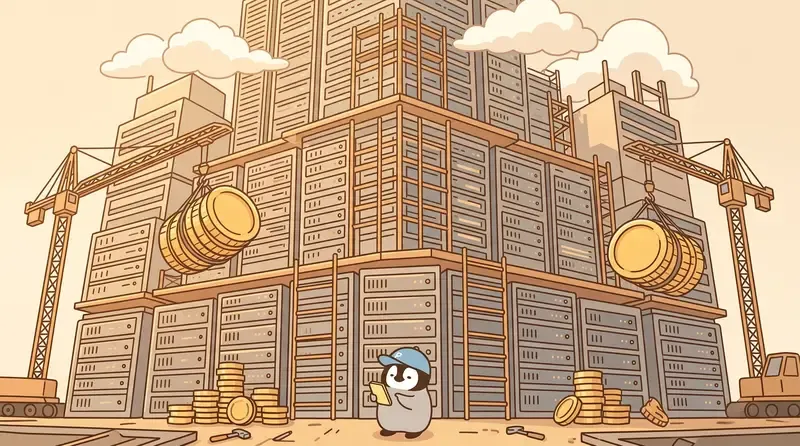
This is Alphabet’s biggest current financial controversy.
| Year | CapEx |
|---|---|
| 2023 | $32.2B |
| 2024 | $52.5B |
| 2025 | $91.4B |
| 2026E guidance | $175-185B |
The 2026 CapEx guidance is 5.4 times 2023 levels. The money mainly goes into AI data centers, TPU/GPU procurement, and infrastructure expansion.
The good news: Alphabet can afford it. FY2025 free cash flow was $73.3 billion, with $126.8 billion in cash and marketable securities. The bad news: if 2026 CapEx really lands at $175 billion, free cash flow will likely turn negative or approach zero.
Management’s logic is clear: if it does not invest now, it will not have compute later. The $240 billion Cloud backlog already proves demand exists. The question is how long it takes for returns to show up.
FY2025 share repurchases were about $45.7 billion, down sharply from $62.2 billion the year before. Capital is shifting from buybacks into AI investment.
After the Monopoly Ruling

Timeline
On August 5, 2024, U.S. federal judge Amit Mehta ruled that Google maintained an illegal monopoly in search. The core finding was that Google paid enormous sums, estimated around $20 billion per year to Apple, to lock in default search engine placement in Safari and other browsers, thereby maintaining its monopoly.
On September 2, 2025, the remedies decision came out. It was behavioral relief, not a structural breakup.
Main remedies:
- Ban on exclusive default contracts: Google can no longer require Apple, Samsung, and others to make Google the only default search engine. The key word is “exclusive,” not “payment ban.” Google can still continue paying Apple in contracts. It just cannot require exclusivity.
- Mandatory data sharing: Google must share parts of its search index and user interaction data, but not advertising data.
- Technical oversight committee: an independent oversight mechanism will be created.
Chrome and Android were not forced to break up. DOJ proposed a Chrome divestiture, but the judge did not adopt it.
How Much Does This Matter for Alphabet?
The Apple search contract is the most direct variable. Google pays Apple about $20 billion per year to lock in Safari default search. After the remedies decision, that money may continue, but Apple has more leverage to negotiate with other vendors. In the short term, Google search quality still has an advantage, and users may still choose Google even with a choice screen. In the medium term, the question is whether Apple seriously pushes its own search or deeply integrates with OpenAI.
Alphabet appealed in January 2026. The D.C. Circuit is expected to hear the case from late 2026 to early 2027. The whole legal process could drag beyond 2027 before a final conclusion.
Another related case: in April 2025, another federal judge ruled that Google also monopolized the advertising technology market (DFP+AdX), and DOJ demanded an AdX breakup. This case is narrower, but it adds pressure to Google’s advertising business.
Search Market Share: Is It Really Eroding?
Different firms use slightly different methodologies, but the direction is consistent: Google still holds about 89-90% of global search market share. That is slightly below 92-93% five years ago, but nowhere near a collapse.
Pressure From All Sides: Competition Overview
Alphabet faces pressure from every direction, each with a different threat vector.
OpenAI / Microsoft: the most direct search substitution threat. ChatGPT already has 800-900 million weekly active users, and many people are starting to use it instead of Google Search. Azure OpenAI directly competes with Google Cloud for enterprise AI customers. Copilot is integrated across Office, reaching hundreds of millions of office workers.
Anthropic / Amazon: Claude is strong in the enterprise API market, especially for coding and safety-related tasks. Amazon Bedrock lets enterprise customers use Claude directly on AWS without moving to Google Cloud. Interestingly, Anthropic is also a major Google Cloud TPU customer, with a 3.5 GW compute usage contract.
Meta: Llama open-source models lower the entry cost for enterprise AI. Meta’s AI ad optimization engine is expected to let it overtake Google in global ad revenue for the first time in 2026. Meta AI is spreading across WhatsApp, Instagram, and other social platforms.
Apple: Apple Intelligence strengthens on-device AI. The real risk is the Safari default search contract. If the antitrust ruling pushes Apple toward another search engine, Google would directly lose about $20 billion per year in traffic acquisition cost.
Perplexity: answer engines are a structural threat to the search advertising model. When users get direct answers instead of clicking links, the whole commercial logic of search ads needs rewriting. Perplexity is still small, though, with MAU around 30-45 million, so the short-term impact is limited.
China: DeepSeek’s low-cost open-source model shook the industry. ByteDance and Baidu dominate the domestic market. The direct threat to Alphabet is not in the United States, but in growth markets such as India, Southeast Asia, and the Middle East, where Chinese AI models may win enterprise customers at lower cost.
Will Search Be Disrupted?

This is Alphabet’s core investment debate, more important than antitrust.
The question has two layers: will the user entry point be lost, and even if the entry point remains, will monetization per search and return on investment keep up?
The Bear Case’s Five Blades
First, AI answer engines intercept traffic directly. Behavior data already exists. ChatGPT and Perplexity provide answers with citations, and users do not need to click ten blue links. Pew found that for searches with an AI summary, the share of users clicking traditional results fell from 15% to 8%, nearly halved.
Second, monetization quality per query may decline. This is highly plausible, though not yet proven by clear data. Advertisers may pay a premium for placement inside AI summaries, but if the answer becomes more complete, users have less reason to click ads. Google’s current offset is that ad display frequency rose 394% over eight months. That is a one-time inventory expansion benefit. Management still says AIO monetization is roughly in line with traditional search, but we need to see how long that holds.
Third, structural leakage after Apple contracts become non-exclusive. This is institutionally confirmed. After antitrust remedies take effect, Google may keep paying, but Safari choice screens and annual renegotiation make the distribution moat thinner over time. This is slow structural erosion.
Fourth, depreciation from $175 billion in CapEx starts hitting profit. This begins in 2026. Alphabet’s CFO said clearly on the Q4 2025 earnings call that depreciation expense would “meaningfully increase” in 2026. If AI search and cloud monetization do not keep up with CapEx depreciation, EPS and free cash flow get hit before market share does. This blade is the most direct and the easiest to verify through quarterly reports.
Fifth, regulatory data-sharing could expand. The direction is clear, but the magnitude is unknown. U.S. antitrust remedies already require Google to share parts of its search index. The EU is also pushing under the DMA framework to let search rivals and AI chatbots access Google data. This slowly erodes the search moat. Over a long horizon, it cannot be ignored.
Some people also raise the logic that AI Overviews will damage the incentive to produce publishing content, but that is a higher-order inference. It will take years to see the full loop of content supply decline leading to lower index quality, so it is not a short-term observable bear signal.
Bull Case: Google Is the Largest AI Search Engine Itself
Google is not waiting to die. It is building AI search itself. AI Overviews reaches 2 billion users, and the Gemini app has reached 750 million MAU. Google has three advantages others do not: a data flywheel from billions of searches per day, distribution scale from Android + Chrome + Safari, and inference cost advantage from TPU, with costs down 78% in 2025.
Search revenue tells the story. FY2025 Google Search revenue was $224.5 billion, up 13%. Query growth driven by AI Overviews has so far offset the decline in ad value per search. Management also said clearly on the Q3 earnings call that AI Overviews monetization was roughly in line with traditional search.
Which Side Does Current Data Support?
Short-term disclosed operating data leans toward the bull case. That is more precise than saying “the data supports the bull case.” Search volume hit new highs, search revenue kept growing, and AI Overviews did not cause a collapse. Those are facts.
But this only proves Google has not been punctured yet. It does not prove the medium-term moat is stable. The real test is 2027-2028: AI behavior change matures, Apple contracts are renegotiated, and CapEx depreciation starts hitting earnings. All three variables land at the same time.
What data would overturn the bull tilt? Watch five early signals:
- Search revenue growth falls below high single digits.
- AI Overviews / AI Mode monetization becomes clearly lower than traditional search, with looser financial disclosure language.
- Safari / iOS search share loses more than 10% in real terms.
- TAC, or traffic acquisition cost, rises as a share of search revenue.
- Depreciation grows faster than cloud and search revenue.
The first two test whether commercialization can absorb AI traffic. The middle two test whether the distribution moat breaks. The last one tests whether the CapEx bet damages EPS first.
Penchan’s current judgment: the shape of search will be rewritten, but the entry point will not disappear. The real question is whether Google can finish the product transition before the definition of search is rewritten. Right now it looks pointed in the right direction, but it is not yet clear whether the speed is enough.
Top Ten Risk Factors
These are Alphabet’s top ten risks, sorted by severity.
| # | Risk | Description | Severity | Probability | Timeframe |
|---|---|---|---|---|---|
| 1 | Intensifying AI competition | OpenAI/Anthropic erode share in consumer and enterprise AI markets | 4/5 | 4/5 | 2026-2028 |
| 2 | Antitrust | DOJ appeal outcome may force stricter remedies, including data sharing or future breakup | 4/5 | 3/5 | 2026-2027 |
| 3 | Apple contract risk | After exclusive defaults are banned, Apple may shift to another search engine | 4/5 | 2/5 | 2026-2027 |
| 4 | CapEx overinvestment | $175B CapEx may compress near-term FCF, with uncertain return cycle | 3/5 | 3/5 | 2026-2027 |
| 5 | Talent loss | AI engineers poached by OpenAI, xAI, Anthropic with high pay | 3/5 | 3/5 | Ongoing |
| 6 | Cloud competition | AWS and Azure price wars and feature catch-up in enterprise AI | 3/5 | 3/5 | 2026-2028 |
| 7 | Global regulation | Compliance costs from EU DMA, AI Act, and national data privacy laws | 3/5 | 3/5 | Ongoing |
| 8 | Culture/execution | Large-organization decision speed may lag the AI race | 3/5 | 2/5 | Ongoing |
| 9 | Geopolitics | U.S.-China tech decoupling affects supply chain and overseas markets | 3/5 | 2/5 | 2026+ |
| 10 | Other Bets drag | Waymo still loses money, commercialization timeline uncertain | 2/5 | 2/5 | 2026-2028 |
The top three risks, AI competition, antitrust, and the Apple contract, had consistent severity judgments across models. The main disagreement is CapEx risk. Some models think Cloud backlog validates demand and keeps the risk manageable. Others think $175 billion is unprecedented and return uncertainty remains high.
How Deep Is the Moat Now?
Search Moat
Three lines of defense: the data flywheel, where billions of searches per day continuously improve result quality; distribution advantage, with Android above 70% global share, Chrome above 65% share, and Safari default placement; and brand, where “Google it” has become a verb.
The antitrust ruling shakes the distribution layer. If Apple no longer defaults to Google, the distribution moat gets a hole. But the data flywheel and brand have not been weakened yet.
Google Cloud
Differentiation comes from three places: self-developed TPU chips, which create a cost advantage and attracted Anthropic into a major contract; Vertex AI as an enterprise platform integrated with Gemini; and BigQuery lock-in in data analytics. Cloud’s $240 billion backlog shows enterprise customers are voting with long-term contracts.
YouTube
The world’s largest video platform. Ads plus subscriptions, including YouTube Premium/TV, generated more than $60 billion in FY2025 YouTube-related revenue. Shorts has more than 70 billion monthly views. In video, YouTube has no real substitute.
Android
Android holds more than 70% of the global smartphone operating system market. The ecosystem lock-in formed by Play Store and Google Mobile Services remains very strong. But this is also the area where antitrust regulators are most likely to apply further pressure.
Valuation: Three Scenarios

The models used different methods and assumptions. The ranges below use median zones as references.
Bull Case: AI Transition Succeeds
AI Overviews rewrites search ad inventory, Cloud maintains 30%+ growth, and Waymo starts contributing revenue.
| Metric | Five-model range | Median |
|---|---|---|
| 2027E revenue | $500-608B | ~$564B |
| 2027E operating margin | 33-36% | ~34% |
| Fair P/E | 24-32x | ~28x |
| Implied share price | $328-500 | ~$370-440 |
Base Case: Stable but Slower
Search growth slows to high single digits, Cloud keeps growing, but margins are constrained by CapEx.
| Metric | Five-model range | Median |
|---|---|---|
| 2027E revenue | $455-560B | ~$504B |
| 2027E operating margin | 29-34% | ~32% |
| Fair P/E | 19-26x | ~23x |
| Implied share price | $230-420 | ~$300-350 |
Bear Case: Two Different Worlds
The bear case itself needs to be split into two versions.
Basic bear: non-exclusive remedies take effect, search share slowly leaks, Cloud grows normally, and CapEx depreciation compresses profit. This maps to 2027E revenue of $450-500B, operating margin of 27-30%, fair P/E of 17-20x, and share price of $200-280.
Extreme bear or tail risk: structural breakup, clear damage to the distribution moat, further regulatory deterioration, and CapEx that cannot be recovered. This maps to 2027E revenue of $400-460B, operating margin of 24-27%, fair P/E of 15-17x, and share price of $107-180.
$107 is a left-tail scenario with low probability but not zero probability. $200-280 is the real basic bear. Grok’s $280-320 is closer to a conservative base case, not a true bear case.
Penchan’s Take
After doing this cross-check, Penchan wants to say three things.
The $175 billion CapEx is the real bet. Antitrust is more like noise. The $240 billion Cloud backlog proves enterprise demand exists, but the CFO herself said 2026 depreciation would “meaningfully increase.” If AI search and cloud monetization cannot keep up with depreciation, EPS and FCF fall first, not market share. This is the most important variable to watch in 2026-2027.
Search transformation speed is racing regulatory speed. The antitrust remedy is behavioral, not structural. The Apple contract ban targets exclusivity, not payment. The risk is chronic, not acute. Google is moving in the right direction with AI Overviews + Gemini integration, but Safari choice screens, Apple’s annual renegotiation, and EU data-sharing expansion will slowly erode the distribution moat. Nothing happens in the short term. The medium term is where it gets real.
The investment link to Taiwan is more direct than it looks. TPU architecture design is tied to Broadcom through 2031, MediaTek may join the next generation, and manufacturing depends on TSMC. Being bullish on Alphabet’s AI strategy also means betting on the continued capacity of Taiwan’s semiconductor supply chain. The reverse is also true: geopolitical risk would show up directly in Alphabet’s CapEx execution.
At the current market cap of roughly $4 trillion, market pricing broadly reflects the base case. Short-term data leans bull. Medium-term risk is concentrated in 2027-2028: AI monetization, Apple renegotiation, and CapEx depreciation all mature at the same time.
This is a company that was warned by the referee and kept sprinting faster. Whether it reaches the finish line depends on whether its AI transition is faster than regulatory action. The score currently favors Alphabet, but the match is long.
This series so far: OpenAI Deep Dive | xAI / SpaceX Deep Dive | This article | Perplexity Deep Dive (coming soon)
Research method: five-model cross-checking (ChatGPT GPT-5.4, Claude Opus 4.6, Gemini 3.1 Pro, Perplexity Deep Research, Grok 4.2)