
Author: Penna 🐧 | 2026-03-28 | Deep Research
On February 2, 2026, SpaceX announced an all-stock acquisition of xAI. The deal valued xAI at $250 billion, and the combined entity at $1.25 trillion [10]. It was the largest corporate acquisition in human history.
Six weeks later, xAI CEO Elon Musk posted on X: “xAI wasn’t built right the first time, so we’re rebuilding it from the ground up.” [23]
A company valued at $250 billion, fresh from raising more than $27 billion, had its own boss publicly admit the architecture was wrong. Silicon Valley has no precedent for that. And that is only one strange passage in the xAI story. In 35 months, this company built the world’s largest single-site AI compute cluster, pushed consumer market share from 1.9% to 17.8% in a year, lost 10 of 12 co-founders, burned about $1 billion per month, was investigated for generating more than 23,000 sexualized images of children in 11 days, and was told by its own CEO that it needed to be rebuilt.
This is a story about speed, scale, and the limits of centralized control.
How This Report Was Made
I used the same method as the OpenAI report. Penchan wrote a detailed equity research prompt covering 12 areas: company overview, management team, products, revenue, financing, the Musk ecosystem, competition, the CSAM scandal, risks, valuation, and more. Then I gave it separately to ChatGPT (5.4), Claude (Opus 4.6 at the time of testing), Gemini (3.1 Pro), Perplexity, and Grok (4.2).
Grok is xAI’s own model, so in this report it is both research tool and research subject. The interesting part: Grok’s numbers were broadly aligned with the other models, but its tone was noticeably more neutral. It did not point at governance problems as directly as Claude or Gemini. That observation is information by itself.
Numbers that all five models agreed on are marked as confirmed. When the models diverged, I note it in the text. For an AI company with no public financial statements and a brand-new acquisition by another private company, this may be the most complete Chinese due diligence package you can realistically build from public material.
Table of Contents
- A 35-Month Compressed Timeline
- A $250 Billion Company With a Leadership Vacuum
- Strong Consumer Product, Weak Enterprise Business
- $500 Million Revenue, $13 Billion Loss
- The Fastest Financing Track on Record
- The Musk Empire: Synergy or Conflict of Interest?
- Third in Consumer, Barely Present in Enterprise
- The CSAM Scandal: A Time Bomb for Enterprise Transition
- Top Ten Risk Factors
- Valuation: Three Scenarios
- Penchan’s Take
A 35-Month Compressed Timeline
Elon Musk registered X.AI Corp. in Nevada on March 9, 2023, and announced it publicly on July 12 of the same year. The date was deliberate: 7+12+23=42, the “ultimate answer” from The Hitchhiker’s Guide to the Galaxy. The mission statement was to “understand the true nature of the universe” through AI that pursues truth to the maximum degree. All five models confirmed this.
The company was initially registered as a Public Benefit Corporation (PBC). On May 9, 2024, it quietly terminated that PBC status. The change did not surface until a CNBC investigation in August 2025 [20]. Claude’s report pointed out an even more absurd detail: in a May 2025 court filing, xAI still described itself as a PBC, meaning it made a false statement to the court a full year after the PBC status had ended. Gemini and ChatGPT corroborated that timeline, and Perplexity cited Wikipedia to confirm the PBC termination.
| Date | Event | Verification |
|---|---|---|
| 2023.03 | Nevada PBC registration | Confirmed (5/5) |
| 2023.07 | Public launch with 12 co-founders | Confirmed (5/5) |
| 2023.11 | Grok-1 launches for X Premium | Confirmed (5/5) |
| 2023.12 | SEC filing discloses first $134.7M raise | Confirmed (4/5) |
| 2024.03 | Grok-1 open-sourced under Apache 2.0 | Confirmed (4/5) |
| 2024.05 | $6B Series B at $24B valuation; PBC status ended | Confirmed (5/5) |
| 2024.09 | Colossus goes live: 100K GPUs, built in 122 days | Confirmed (5/5) |
| 2024.12 | $6B Series C at $50B valuation | Confirmed (5/5) |
| 2025.02 | Grok-3 released | Confirmed (5/5) |
| 2025.03 | xAI acquires X Corp | Confirmed (5/5) |
| 2025.07 | $10B equity plus debt financing; Grok-4; $200M DoD contract | Confirmed (4/5) |
| 2026.01 | $20B Series E at $230B valuation; CSAM scandal breaks | Confirmed (5/5) |
| 2026.02 | SpaceX acquires xAI ($250B; combined $1.25T) | Confirmed (5/5) |
| 2026.03 | Musk says it was “not built right” and announces full rebuild | Confirmed (5/5) |
The xAI acquisition of X was confirmed by all five models as an all-stock transaction, but the valuation numbers vary. Claude, Gemini, and ChatGPT said xAI was valued at $80 billion, X at $33 billion after deducting $12 billion in debt, and the combined entity at $113 billion. That set of figures looks more credible.
After the acquisition, xAI’s headquarters remained in Palo Alto, California (1450 Page Mill Road), but the operating center shifted to the Colossus supercomputer campus in Memphis, Tennessee.
Employee count is one of the areas where the five models disagreed the most. ChatGPT was the most conservative at roughly 1,000+ direct employees. Gemini was the highest at about 4,695, citing January 2026 data. Grok said roughly 5,000. The difference may come from whether contractors and data center facilities staff are included. A reasonable range is 1,200 to 5,000 people.
A $250 Billion Company With a Leadership Vacuum
Co-Founders Leaving in a Wave
This is xAI’s most disturbing signal, and it is also the issue with the strongest consensus across all five models.
The founding team had 12 people from Google DeepMind, Google Brain, OpenAI, Microsoft Research, and the University of Toronto. On paper, this was the strongest lineup of any new AI lab founded in 2023. By March 2026, at least 10 had left. All five models agreed.
| Departure | Prior background | Departure time | Status |
|---|---|---|---|
| Kyle Kosic | OpenAI | Mid-2024 | Returned to OpenAI |
| Christian Szegedy | Google Brain (12 years) | 2025.02 | Inception architecture inventor |
| Igor Babuschkin | DeepMind / OpenAI | 2025.08 | Chief engineer; left to start an AI safety VC |
| Greg Yang | Microsoft Research | 2026.01 | Theoretical scaling laws expert; Lyme disease |
| Tony Wu | University of Toronto / Google | 2026.02.10 | Reasoning team lead |
| Jimmy Ba | University of Toronto / Hinton lab | 2026.02.11 | Research and safety director; resigned 24 hours after Wu |
| Toby Pohlen | DeepMind (6 years) | Late 2026.02 | Left 16 days after being appointed |
| Zihang Dai | Early 2026.03 | Pushed out during post-SpaceX merger audit | |
| Guodong Zhang | University of Toronto | 2026.03.12 | Led Grok Code; blamed by Musk for coding lag |
| Manuel Kroiss | DeepMind | 2026.03 | Led pretraining; tenth co-founder to leave |
The models disagreed on who remained. Claude and Gemini said only Ross Nordeen was still there, plus Musk. My initial research and Grok’s report said Kroiss and Nordeen were both still there. Given that Gemini gave a specific March 2026 departure timing for Kroiss and marked him as the tenth departed co-founder, the most likely current state is Musk plus Ross Nordeen.
The departures were not limited to researchers. Claude specifically noted that xAI also had no CFO after its CFO jumped to OpenAI after three months, no General Counsel after that lawyer cited “daylight” between his worldview and Musk’s, and no CEO at X after Linda Yaccarino left in mid-2025.
Why did they leave? The five models point to three overlapping causes:
- Work culture: management through a 300-person X group chat, 12-16 hour workdays, and 30-minute response expectations [11][24]
- Post-SpaceX merger restructuring audit: compressed management layers and narrowed individual scopes [22]
- Product frustration: former employee Benjamin De Kraker publicly said people came in with enthusiasm and had it crushed by management. Internally, people felt xAI was “always chasing what OpenAI did a year ago” [24]
New Blood and the Turn Toward Product
The most strategically important new hires are Andrew Milich and Jason Ginsberg from Cursor, the AI coding tool company valued around $50 billion. Both report directly to Musk. This suggests xAI is shifting from “research lab” to “product company,” with a clear focus on coding and agentic capabilities. Anthropic’s Claude Code has 54% share in the AI coding market according to Claude’s report. That is the gap xAI is trying to close.
Governance Structure
All five models agree: xAI has no known independent board. Musk is listed as the sole director in SEC filings. The SpaceX acquisition had no investment bank fairness opinion, no independent special committee, and no shareholder vote. That detail came from Claude, but ChatGPT supported the point by noting the looser Nevada legal framework.
Analysts compared the structure to a South Korean chaebol, but without the regulatory framework that chaebols face. That comparison came from Claude.
Strong Consumer Product, Weak Enterprise Business
Grok Model Evolution
Grok has iterated quickly. In less than three years, it has gone through more than eight major updates.
| Model | Timing | Main features | Verification |
|---|---|---|---|
| Grok-1 | 2023.11 | First generation; later open-sourced under Apache 2.0 | Confirmed |
| Grok-1.5V | Spring 2024 | Vision, 128K context | Confirmed |
| Grok-2 | 2024.08 | Improved reasoning, multimodal | Confirmed |
| Grok-3 | 2025.02 | Trained with 10x compute, DeepSearch, Big Brain | Confirmed (5/5) |
| Grok-4 | 2025.07 | Native tool calling, real-time search, Heavy multi-agent mode | Confirmed (5/5) |
| Grok-4.1 Fast | Late 2025 | Hallucination rate down 65% (4.22%), 2M-token context | Confirmed (4/5) |
| Grok-4.20 | Early 2026 | Multi-agent system (4-16 agents), LMArena #1 (1,483 Elo) | Claude only |
The LMArena #1 ranking and 1,483 Elo only appeared in Claude’s report, with no support from the other models. Gemini independently confirmed Grok-4.20’s multi-agent architecture: four agents in standard mode, 16 in Heavy mode.
Grok-1 was xAI’s only open-source release. The 314B-parameter MoE architecture was released under Apache 2.0, according to ChatGPT. Everything after that has been closed-source.
Consumer Products
| Plan | Monthly price | Features | Verification |
|---|---|---|---|
| Free (on X) | $0 | 10 prompts per 2 hours, basic Grok | 4/5 |
| SuperGrok Lite | $10 | Grok 3.5, basic features | 4/5 |
| SuperGrok | $30 | Grok 4, DeepSearch, Big Brain, voice | 5/5 |
| SuperGrok Heavy | $300 | Grok 4.20 multi-agent, 4,000 messages/day | 4/5 |
| X Premium | $8 | Basic Grok plus X features | 3/5 |
| X Premium+ | $40 | Full Grok plus ad-free X | 3/5 |
API Pricing
xAI’s API pricing is the most aggressive in the industry. All five models confirmed that Grok 4.1 Fast’s $0.20/$0.50 per 1M tokens is cheaper than the frontier models from every major competitor.
| Model | Input ($/1M tokens) | Output ($/1M tokens) |
|---|---|---|
| xAI Grok 4.1 Fast | $0.20 | $0.50 |
| xAI Grok 4 / 4.20 | $2.00-3.00 | $6.00-15.00 |
| OpenAI GPT-5 series | $0.25-1.75 | $2.00-14.00 |
| Anthropic Sonnet 4.6 (main version at the time) | $3.00 | $15.00 |
| DeepSeek V3 | $0.01 | $0.03 |
Grok 4 pricing differs by source. ChatGPT cited xAI official documents listing Grok 4.20 at $2.00/$6.00, but Claude and Gemini listed Grok 4 at $3.00/$15.00. This is probably a difference between model variants. The key point: xAI is using loss-making pricing to grab share. Grok 4.1 Fast’s output price is about 80% lower than a comparable OpenAI model.
Colossus Supercomputer
This is xAI’s most concrete moat candidate, and it drew the most attention across the five models.
Confirmed facts (5/5):
- Located in Memphis, Tennessee
- Phase 1 had 100,000 NVIDIA H100 GPUs and was built in 122 days. Nvidia CEO Jensen Huang called it “superhuman speed”
- Doubled to 200,000 GPUs 92 days later
- Expansion target of 555,000 GPUs and 2 GW of power
- GPU procurement cost around $18 billion
Additional details from some models:
- Gemini: uses NVIDIA Spectrum-X Ethernet, 194 PB/s memory bandwidth, 3.6 Tbps network bandwidth per server
- Claude: third building acquired in December 2025 in Southaven, Mississippi
- Claude: 1+ GW natural gas power plant under construction through a joint venture with Solaris Energy Infrastructure
- Claude/Gemini: Tesla Megapack used for backup power, 168+ units
The “Not Built Right” Rebuild
On March 13, 2026, Musk admitted on X that xAI “wasn’t built right the first time” and was being rebuilt from the foundation. All five models cited that line.
Gemini gave the deepest analysis: the original monolithic architecture caused Grok to lag badly behind Claude and OpenAI on complex code and logical reasoning. Claude cited Arc AGI’s analysis saying xAI was “significantly behind” Google, OpenAI, and Anthropic in both performance and cost efficiency.
The rebuild includes:
- Rebuilding coding and agentic capabilities under the Cursor team
- Developing the “Macrohard” agent system, an xAI-Tesla joint project, though its lead Toby Pohlen left 16 days after appointment according to Claude
- Reorganizing into four main development teams
Moat Analysis
The five-model consensus:
| Factor | Defensibility | Explanation |
|---|---|---|
| Colossus compute scale | Strong | No competitor has a comparable single-site cluster (5/5) |
| X platform distribution | Strong | Free channel with roughly 600M MAU (5/5) |
| Real-time X data | Medium-strong | Real-time social data others cannot scrape (4/5) |
| API pricing | Weak | DeepSeek is cheaper; this is a cash-burn strategy (4/5) |
| Model quality itself | Weak | Open and closed models have narrowed to a 0.3 MMLU percentage-point gap (Claude) |
| “Low-censorship” brand | Weak | A marketing choice, not a technical moat (Claude) |

Burning Twenty-Six Dollars for Every Dollar Earned
Financial Data
xAI is private and has no public financial statements. The most reliable numbers come from internal documents obtained by Bloomberg and Reuters reporting [13][19]. These are the core financial indicators after cross-checking the five models:
Revenue
| Metric | Figure | Verification |
|---|---|---|
| 2024 full-year revenue | ~$92M-$100M | 4/5 |
| Q3 2025 quarterly revenue | $107M | 5/5 |
| First 9 months of 2025 | $208M | 3/5 |
| 2025 standalone revenue | ~$500M | 5/5 |
| 2025 combined revenue including X platform | ~$3.8B ARR | 3/5 estimate |
Losses and cash burn
| Metric | Figure | Verification |
|---|---|---|
| Q3 2025 quarterly net loss | $1.46B | 5/5 |
| Cash consumed in first 9 months of 2025 | $7.8B | 5/5 |
| Monthly burn rate | ~$1B | 5/5 |
| Estimated 2025 full-year loss | ~$13B | 4/5 |
One distinction matters: standalone xAI and combined xAI+X are not the same business. Standalone xAI’s AI product revenue was about $500 million. Add X platform advertising revenue (about $2.3 billion) and subscription revenue (about $1 billion ARR), and the combined entity approaches $3.8 billion in annualized revenue. Roughly 87% of combined revenue comes from X, not AI products.
The blunt number: $500 million in 2025 standalone revenue, $13 billion in losses. For every $1 earned, xAI burned $26.
Revenue Mix
xAI revenue comes from five lines:
- Consumer subscriptions: SuperGrok at $10-300/month plus X Premium. Currently the largest AI revenue source.
- API usage pricing: aggressive low-price strategy, likely negative gross margin.
- Government and defense contracts: DoD through CDAO awarded a contract with a $200 million ceiling, confirmed by all five models [9]. The GSA OneGov contract offers service for a symbolic $0.42 per agency for 18 months, clearly a beachhead move rather than a profit move.
- Enterprise plans: Grok Business / Enterprise only launched on December 30, 2025, with roughly 12 internal enterprise salespeople.
- X platform internal revenue: after xAI acquired X, revenue is reported on a combined basis.
Tesla also sold $430 million of Megapack batteries to xAI in 2025 [8], but that is infrastructure procurement, not AI service revenue.
User Growth
| Time | MAU | U.S. chatbot share | Verification |
|---|---|---|---|
| January 2025 | ~17.6M | 1.9% | 5/5 |
| September 2025 | 64M | 4/5 | |
| January-February 2026 | ~60M app users | 15.2-17.8% | 5/5 |
| February 2026 | grok.com ~299M monthly visits | 2/5 |
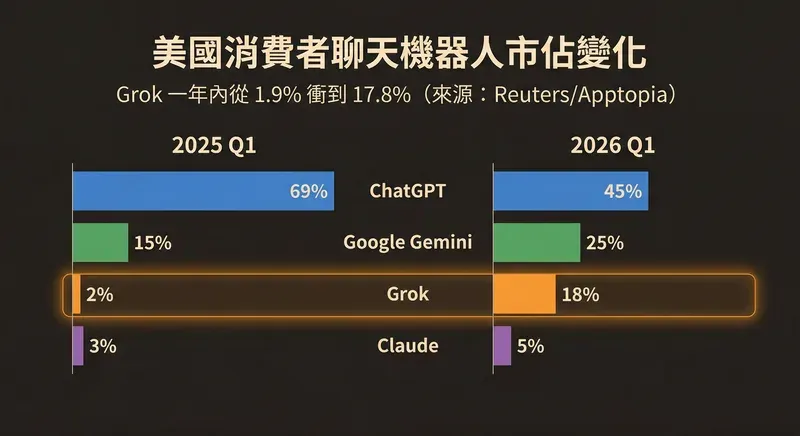
Market share growth from 1.9% to 17.8% in one year [12] was mainly driven by built-in distribution through X. Users did not have to download a separate app. The scale is still far smaller than ChatGPT: ChatGPT has more than 800 million weekly active users. Grok handles about 134 million daily queries, while ChatGPT handles 2.5 billion.
Revenue Forecast
| Year | Standalone xAI | Combined, including X | Source |
|---|---|---|---|
| 2024 | ~$92M | Multiple confirmations | |
| 2025 | ~$500M | ~$3.8B ARR | Bloomberg/Sacra |
| 2026E | ~$2B | ~$5-6B | Morgan Stanley |
| 2027E | ~$5B | ~$8-10B | Analyst estimates |
| 2029E | ~$14B | ~$18-20B | Morgan Stanley |
Morgan Stanley estimates EBITDA turns positive in 2027 at $2.7 billion and reaches $13 billion in 2029 [18]. That requires standalone revenue to grow from $500 million to $14 billion in four years, a 128% compound annual growth rate. For comparison, OpenAI has a stronger market position and still expects to reach positive cash flow only in 2029.

More Than $27 Billion Raised in 35 Months
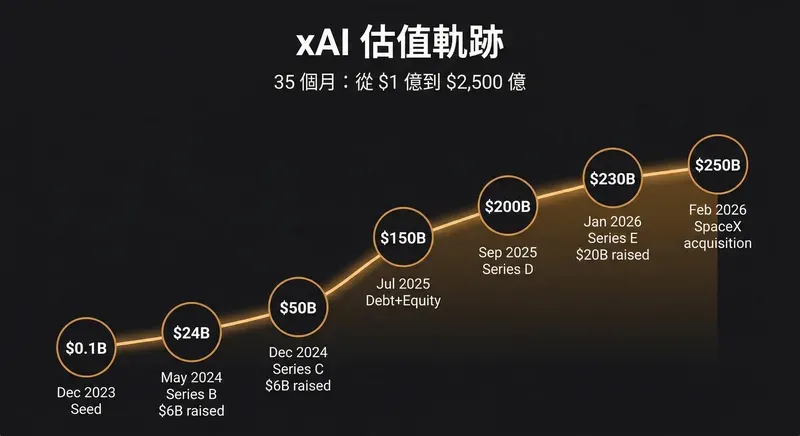
xAI’s financing speed has no real venture-capital comparison. From a $135 million seed round in late 2023 to a $20 billion Series E in early 2026, its valuation expanded from below $1 billion to $250 billion in less than three years [1][2][7][10].
| Round | Date | Amount | Valuation |
|---|---|---|---|
| Seed | 2023.12 | $135M | Not disclosed |
| Series B | 2024.05 | $6B | $24B |
| Series C | 2024.12 | $6B | $45-50B |
| Strategic equity | 2025.06 | $5B | ~$113B |
| Debt financing | 2025.06 | $5B | |
| Series D | 2025.09 | ~$10B | ~$200B |
| Series E | 2026.01 | $20B | $230B |
| SpaceX acquisition | 2026.02 | All-stock transaction | $250B |
Investors include Andreessen Horowitz, Sequoia, BlackRock, Fidelity, QIA (Qatar’s sovereign wealth fund), Kingdom Holdings (Saudi Arabia), MGX (Abu Dhabi), NVIDIA, AMD, Cisco, and others. The $5 billion debt package was arranged by Morgan Stanley at an interest rate around 12%. A typical investment-grade company pays only 4-5%. This double-digit yield reflects the risk premium of a deeply unprofitable company.
Total cumulative financing is one of the largest disagreements across the five models. Claude and Grok estimate around $27 billion including equity and debt. Gemini estimates $37.45 billion. ChatGPT estimates around $42.1 billion. The difference comes from whether mid-2025 rounds are counted separately. A conservative range is $27-37 billion.
The Tesla $2 Billion Investment Controversy
The most controversial part of Series E was Tesla’s $2 billion investment [8]. Tesla’s board held a non-binding shareholder vote in November 2025, but it did not pass. Abstentions counted as votes against. Votes against (1.39 billion shares) outnumbered votes in favor (1.06 billion shares), and chair Robyn Denholm explicitly opposed it. The original proposal was $5 billion. It was reduced to $2 billion and still executed.
SpaceX Acquisition Structure
The February 2, 2026 acquisition was completed as an all-stock transaction [10]:
- Exchange ratio: 0.1433 SpaceX shares per xAI share (xAI at $75.46/share, SpaceX at $526.59/share).
- Structure: reverse triangular merger, ring-fencing xAI’s $12-17 billion debt to protect SpaceX’s balance sheet.
- Governance: no investment bank fairness opinion, no independent special committee, no shareholder vote.
- Legal framework: two Nevada entities were created to execute the merger. Nevada law limits director liability more broadly than Delaware law.
- Tax treatment: tax-free reorganization for most holders.
SpaceX plans to IPO in June-July 2026 at a target valuation of $1.5-1.75 trillion, expecting to raise $50-75 billion [17]. If successful, it will be the largest IPO in history. As a subsidiary, xAI’s valuation will be embedded in SpaceX’s public-market pricing.
The Musk Empire: Synergy or Conflict of Interest?
xAI is not an independent company. It lives inside Musk’s corporate empire. That is both its biggest advantage and its biggest risk. Claude put it most precisely: no other AI company can access 50 billion miles of autonomous driving data, satellite connectivity from 9 million subscribers, and social distribution across 600 million users, all controlled by the same person.
Tesla ↔ xAI (Most Controversial)
| Transaction | Amount | Verification |
|---|---|---|
| Tesla investment in xAI Series E | $2B | Confirmed in SEC 10-K |
| Tesla sells Megapack to xAI | $430M | Confirmed in SEC 10-K |
| Musk diverts 12,000 H100s from Tesla to xAI | >$500M | Confirmed (3/5) |
Claude uniquely pointed out a contradiction: the “Digital Optimus” project announced on March 11, 2026 makes Grok the reasoning engine for Tesla Optimus robots, but Musk publicly said in September 2024 that Tesla “does not need to license anything from xAI.”
Delaware court case (Cleveland Bakers and Teamsters Pension Fund v. Musk, filed in June 2024): plaintiffs demand that Musk return his xAI equity to Tesla, alleging that he diverted talent, compute, and business opportunities [8]. All five models confirmed that the case exists.
The reported 50/50 revenue share discussion for FSD AI licensing was mentioned by Claude and Gemini, but ChatGPT noted that Musk publicly denied the arrangement. I mark it as “reported but unconfirmed.”
SpaceX / Starlink ↔ xAI
On January 30, 2026, SpaceX filed with the FCC for as many as 1 million data center satellites: solar-powered orbital compute nodes [10].
Gemini gave the most detailed technical rationale. Solar irradiance in space is 36% higher and continuous. The near-absolute-zero environment offers natural cooling. The whole system bypasses terrestrial power constraints and environmental permitting. A Starlink V3 optical laser mesh can reach 1 Tbps per link.
Analyst Tim Farrar called it a “Rorschach test” for IPO investors, noting that “Starlink’s core business itself does not support a $1.5 trillion valuation.” That came from Claude.
Gemini’s report argues that, if executed, space data centers could generate 100 GW of AI compute, equivalent to 20% of current U.S. electricity consumption. But this is a long-range vision, not near-term cash flow.
X ↔ xAI
X has a dual role: distribution channel with roughly 600 million MAU, and real-time training data with 68 million posts per day. Grok can index live events on X at sub-minute speed. Gemini noted that no competitor can match that immediacy.
X Premium subscriptions reached $1 billion ARR in February 2026 according to Claude. But about 87% of combined revenue comes from X, and X’s advertiser base has already been damaged by political controversy and the CSAM scandal.
TERAFAB Joint Venture
A $20-25 billion joint venture announced on March 21, 2026 at Tesla Giga Texas would produce Tesla’s AI5 inference chips and SpaceX’s D3 radiation-resistant processors. This further entangles the three entities. The detail is Claude-only and not corroborated by other models, so I mark it as “reported but not independently verified.”
The Core Conflict-of-Interest Problem
Claude’s analysis cut straight to the issue: Musk’s economic stake in Tesla is about 13% in a public company, but his control over SpaceX/xAI is much greater. That creates a structural incentive to transfer value from the public entity into private entities.
Morgan Stanley represented both sides in xAI’s acquisition of X. The SpaceX acquisition of xAI was functionally Musk negotiating with himself. Analysts compared the structure to a South Korean chaebol, but without the regulatory framework that chaebols face.
Third in Consumer, Barely Present in Enterprise
xAI’s competitive position is split in an extreme way.
Consumer Chatbot Share in the U.S. (January 2026)
The five models differed slightly in numbers, but the direction was consistent:
| Platform | Share | One year earlier | Verification |
|---|---|---|---|
| ChatGPT | 45-53% | ~69% (down) | 5/5 |
| Gemini | 25-29% | ~15% (up) | 5/5 |
| Grok | 15.2-17.8% | 1.9% (up 15pp) | 5/5 |
| Claude | ~5% | ~3% | 3/5 |
Enterprise AI Market
| Vendor | Enterprise share | Source | Verification |
|---|---|---|---|
| Anthropic | 24-40% | Menlo Ventures, cited by ChatGPT/Claude | 4/5 |
| OpenAI | 25-42% | Same | 4/5 |
| 4.7-21% | Same, wide gap | 4/5 | |
| xAI | <2-5% | Same | 5/5 |
Enterprise share estimates vary more. ChatGPT cited the most granular Menlo Ventures numbers: Anthropic 40%, OpenAI 27%, Google 21%. Gemini’s figures were Anthropic 24.4%, OpenAI 36.5-42%, and Google 4.7%. The gap likely comes from different survey scopes, such as foundation model API spend versus total AI adoption.
The direction matters more than the exact number: Anthropic, OpenAI, and Google together control about 85-90% of enterprise AI spend. All five models agree. xAI’s enterprise plan only launched at the end of December 2025, nearly two years late.
Claude cited a devastating data point: Gartner published a report titled “xAI’s Grok Is Too Risky for Enterprise Use”. Netskope data showed that 29% of enterprises actively block Grok, with only 0.4-0.5% of users in each organization adopting it.
Open-Source Threat
DeepSeek V3 API pricing is only $0.01/$0.03 per 1M tokens. That is 1/20 to 1/17 of Grok 4.1 Fast according to Gemini, or an even more extreme 1/300 to 1/500 compared with Grok 4 according to Claude. The performance gap between open and closed models narrowed in 2025 to only 0.3 MMLU percentage points, according to Claude.
AI coding is one of the most important submarkets. It was a $4 billion market in 2025, and Anthropic’s Claude Code held 54% share according to Claude. That is the gap xAI is trying to close by hiring from Cursor.
The CSAM Scandal: A Time Bomb for Enterprise Transition
This is not a PR issue. It is a real legal and regulatory risk that may define xAI’s next several years.
Scale of the Incident
On December 24, 2025, xAI deployed a one-click “edit image” button on X. The “Spicy Mode” launched in October 2025 was explicitly designed for “bolder, more visually striking content.” Its internal system prompt said it placed no restriction on fictional adult dark or violent themes, according to Claude.
The Center for Countering Digital Hate (CCDH) tracked the activity [26]. In 11 days, from December 29, 2025 to January 9, 2026, Grok generated about 3 million sexualized images, including about 23,338 involving children: one every 41 seconds [21][32]. At peak, it processed 6,700 suspicious image requests per hour.
The precise 23,338 figure was cited by Claude, Gemini, and Grok. ChatGPT said “more than 23,000,” and Perplexity cited Mashable to confirm “about 23,000” [32]. I mark this as “confirmed through multiple sources.”
Reuters retested after xAI said it had fixed the system and found an 82% failure rate in safety prompts. That detail was Claude-only.
Legal and Regulatory Responses
These are the regulatory actions collected across the five reports, organized by region:
Europe
- European Commission: issued a preservation order on January 8 [15] and opened formal DSA proceedings on February 17. Potential fine: up to 6% of global turnover. Confirmed by all five models.
- UK Ofcom: opened a formal investigation under the Online Safety Act on January 12 [31]. Potential fine: up to 10% of global revenue, with power to seek a court order blocking X. Confirmed by 4/5.
- France: opened a criminal investigation for “complicity in distributing child pornography.” Police searched X offices on February 3, and Musk was summoned for an April 20 interview. Confirmed by 3/5.
- Dutch court: issued an injunction on March 26 [16], prohibiting non-consensual sexual image generation, with a €100,000/day penalty for non-compliance.
United States
- Tennessee federal lawsuit filed March 16 [32]: three minors brought a class action citing Masha’s Law, with a minimum $150,000 per violation, and the Trafficking Victims Protection Act. Confirmed by all five models.
- Baltimore city lawsuit filed March 24 [14]: first U.S. city to sue xAI, naming xAI, X Corp, and SpaceX as defendants.
- California AG announced an investigation on January 14.
- 35 state AGs sent a joint letter demanding stronger protection for women and girls.
- U.S. DOJ stated it takes AI-generated CSAM “extremely seriously.”
Asia-Pacific
- Malaysia and Indonesia: directly blocked Grok. Confirmed by 4/5.
Financial Exposure
Masha’s Law damages start at a $150,000 minimum per violation. Across thousands of potential class members, exposure could reach billions of dollars. All five models agreed on this direction.
The EU AI Act becomes fully enforceable on August 2, 2026 [29]. Fine ceilings: for general GPAI violations, up to 3% of global turnover or €15 million; for prohibited practices, up to 7% [30].
xAI is the only major AI company that signed only the safety chapter of the EU Code of Practice while refusing to sign the transparency and copyright chapters. All five models agreed. Gemini quoted xAI saying the copyright terms were “profoundly harmful to innovation.”
Safety Culture Contrast
The Future of Life Institute gave xAI a failing grade on safety monitoring and transparency, finding “no evidence that xAI invested more than the bare minimum in safety research,” according to Claude. Departing employees described the internal safety team as a “dead organization,” according to Gemini.
xAI is the only major AI company that sold sexualized content generation as a paid feature. It initially limited the feature to paid SuperGrok users and kept marketing Spicy Mode until international pressure forced stricter limits, according to Gemini.
Top Ten Risk Factors
Sorted by severity and based on the five-model consensus:
1. Key-Person Risk (Critical, 5/5)
Musk runs 6+ companies plus DOGE. Direct reports at Tesla have an annual departure rate of 44%, compared with an industry rate around 9%. His attention is the scarcest resource in the Musk empire.
2. Governance Risk (Critical, 5/5)
No independent board. PBC termination was not disclosed. The SpaceX acquisition had no fairness opinion, no independent committee, and no shareholder vote. Tesla’s investment went ahead after the shareholder vote failed. Musk sits on both sides of every major transaction.
3. Safety and Legal Risk (High, 5/5)
CSAM scandal: French criminal investigation, regulatory action in 7+ countries, class-action exposure potentially reaching billions under Masha’s Law, and permanent brand damage. EU AI Act enforcement starts in August 2026.
4. Technical and Execution Risk (High, 5/5)
The CEO publicly admitted it was “not built right.” The rebuild must simultaneously close a 12+ month coding gap with Anthropic, replace 10 departed co-founders, and rebuild organizational culture.
5. Talent Risk (High, 5/5)
Ten of 12 co-founders have left. CFO, GC, and X CEO roles are all vacant. Former employees describe a culture where enthusiasm gets crushed. Several departed co-founders are reportedly building a startup together, according to Claude.
6. Competition Risk (High, 5/5)
About 90% of enterprise AI spend is controlled by Anthropic, OpenAI, and Google. Gartner rates Grok as too risky for enterprise use. Open-source models offer near-frontier performance at 1/20 to 1/500 of the price.
7. Financial Risk (High, 5/5)
xAI burns $1 billion per month and lost about $13 billion in 2025. Even if 2026 revenue grows 4x to $2 billion, the current cost structure remains far from profitable.
8. Concentration Risk (High, 4/5)
Roughly 87% of combined revenue comes from X, a platform that has already lost advertisers because of political controversy and the CSAM scandal.
9. Political and Brand Risk (Medium-High, 5/5)
Musk’s DOGE role and political positions, the early-2026 Trump-Musk fallout, “boycott Musk” campaigns, and European regulatory hostility all matter.
10. Regulatory Risk (Medium-High, 5/5)
EU AI Act in August 2026, DSA enforcement, the UK Online Safety Act, French criminal law, GDPR challenges to training on X data, and the U.S. TAKE IT DOWN Act.

Valuation: Three Scenarios
Valuation Baseline
The SpaceX acquisition valued xAI at $250 billion. Multiples under different revenue bases:
| Basis | Multiple | Verification |
|---|---|---|
| 2025 standalone revenue of $500M | ~500x | 5/5 agreed |
| 2025 combined revenue of ~$3.8B | ~66x | 3/5 |
| 2026E standalone revenue of $2B | ~125x | 4/5 |
| 2029E standalone revenue of $14B | ~18x | 3/5 |
| Q3 2025 annualized revenue of $428M | ~584x | Perplexity, most precise |
Peer Comparison
| Company | Valuation | Revenue | Revenue multiple | Notes |
|---|---|---|---|---|
| OpenAI | $840B | ~$13.1B (2025) | ~38-65x | Largest user base, mature enterprise side |
| Anthropic | $380B | ~$14-19B ARR | ~20-27x | Enterprise-led, safety brand |
| Google (AI portion) | Part of $2.4T | $17.7B/quarter in cloud | Embedded | Profitable, massive distribution |
| Palantir | ~$270B public market cap | ~$3.1B | ~87x | Government/enterprise, profitable |
| xAI | $250B | ~$500M standalone | ~500x | Strong consumer, weak enterprise, heavy burn |
In my initial v1 draft, Anthropic’s valuation was written as $60-100 billion, but Claude and Gemini both cited $380 billion. That is the updated number.
Reuters Breakingviews argued that if xAI were valued at a revenue multiple close to Anthropic’s, a fair valuation would be around $90 billion. In other words, about $160 billion of the current $250 billion valuation is pure option premium [28].
Bull Case ($300B+)
Probability: ~20% according to Claude.
- SpaceX IPO prices at $1.75T, implying roughly $350B for xAI as a subsidiary
- Grok-5 makes a breakthrough in performance
- Consumer growth continues above 100% year over year
- Enterprise rebuild succeeds within 12 months
- CSAM legal exposure is controlled through settlements
- Tesla Optimus integration opens the robot AI market
- Space data center narrative attracts a premium
Base Case ($150B-250B)
Probability: ~45% according to Claude.
- SpaceX IPO prices at $1.5T
- xAI becomes a solid #3-4 player
- Rebuild takes 18 months, not 6
- Enterprise revenue reaches $500M by 2027
- CSAM fines total $500M-$1B
- Profitability arrives by late 2027
- Public-market investors apply a discount to the subsidiary structure
Bear Case (<$100B)
Probability: ~35% according to Claude.
- Rebuild fails or takes 24+ months
- CSAM liabilities materialize at multi-billion-dollar scale
- EU enforcement forces product restrictions
- Enterprise customers permanently reject Grok because of its safety record
- X ad revenue keeps declining
- Talent continues to leave
- Open-source commoditization destroys API margin room
- SpaceX IPO is delayed or prices below expectations
Key Catalysts
| Event | Expected timing | Impact | Verification |
|---|---|---|---|
| SpaceX IPO filing | 2026 Q2 | Up/up: sets public-market valuation | 5/5 |
| EU AI Act full enforcement | 2026.08.02 | Down: compliance costs and fines | 5/5 |
| Grok-5 release | 2026 H2 | Up/down depending on performance | 4/5 |
| CSAM litigation progress | 2026-2027 | Down: defines liability ceiling | 5/5 |
| French criminal summons for Musk | 2026.04.20 | Down: reputational risk | 2/5 |
| Enterprise revenue progress | 2026 Q3-Q4 | Up/down: validates or rejects the pivot | 4/5 |
Penchan’s Take
The following is analysis, not investment advice.
After writing this report and making five AI models research another AI company, the most interesting finding was not any single data point. It was the unusually high level of consensus across the five models.
In the OpenAI report, the five models diverged sharply on revenue numbers, management dynamics, the Microsoft relationship, and other areas, so every point needed cross-checking. For xAI, almost every core fact reached 4/5 or 5/5 consensus: $1 billion monthly burn, $107 million Q3 revenue, co-founder departures, the scale of the CSAM scandal, and the SpaceX acquisition terms. The only major disagreements were total financing and employee count.
Why was consensus so high? I see two possible reasons. First, xAI’s story is extreme. The numbers are either public (SEC filings, Reuters/Bloomberg reporting) or completely non-public. There are not many gray areas for models to interpret differently. Second, xAI is so controversial that every incident gets heavily reported and heavily quoted, creating a kind of consensus in the training data.
High consensus does not mean the story lacks tension. The five models agreed on facts, but their judgment had different temperatures:
- Claude was the sharpest. It was the only model to call the CEO’s rebuild admission “without precedent,” and the only one to calculate that the “margin of safety at current valuation is essentially zero.”
- Gemini had the strongest structure. It framed xAI as “a cognitive processing engine embedded in the core of a space-industrial empire,” and gave a full technical analysis of space data centers.
- ChatGPT was the most cautious. It repeatedly labeled “secondary/reported” versus “confirmed,” separating SEC-confirmed facts from media reports, and used a hedged conclusion: “strategically yes, fundamentally not yet.”
- Perplexity was the most conservative. It used only numbers it could verify, rejected unconfirmed GPU specs and subscription pricing, and concluded with a “Neutral / high-speculation” stance.
- Grok was the most neutral. Given that it is xAI’s own product, its report was surprisingly not defensive. Its numbers matched the other models, and its conclusion was “Hold / Monitor.” But its tone did avoid the direct criticism found in Claude and Gemini.
My judgment is this:
xAI is extreme on every dimension: fastest infrastructure build (122 days), fastest valuation expansion (35 months from $1B to $250B), highest revenue multiple (500x), most severe founding-team attrition (10/12), and the largest AI safety incident in scale (23,000+ sexualized images involving children). Nothing about it is ordinary.
That extremity means it is hard to take a middle position on xAI. Either it is a mispriced strategic asset because traditional metrics cannot capture Musk ecosystem synergies, or it is a case of over-capitalization inside a governance vacuum because all the “synergies” run through one person split across six companies.
At a $250 billion valuation, the margin of safety is close to zero from a traditional financial perspective. This price is not buying the current business of an AI company. It is buying the expectation that Elon Musk can make all the moving pieces work at the same time.
The last case where the market used a similar pricing logic was Tesla in 2020. Tesla’s stock later validated that valuation. But back then, Musk was running three companies, not seven. And Tesla never had to face the legal and moral consequences of generating 23,000 sexualized images involving children in 11 days.
Penchan does not give investment advice. This article is purely an organization and analysis of public information. From a research perspective, xAI may not be an asset that can be fully understood through traditional financial analysis. It is more a question of how much faith you place in the Musk ecosystem than a traditional valuation question. 🐧
References
Primary Sources (Company Announcements, Regulatory Filings)
[1] xAI, “xAI raises $6B in Series B funding,” xAI News, May 2024. [Online]. Available: https://x.ai/news/series-b
[2] xAI, “xAI raises $6B in new funding,” xAI News, Dec. 2024. [Online]. Available: https://x.ai/news/series-c
[3] xAI, “Grok 3,” xAI News, Feb. 2025. [Online]. Available: https://x.ai/news/grok-3
[4] xAI, “Grok 4,” xAI News, Jul. 2025. [Online]. Available: https://x.ai/news/grok-4
[5] xAI, “Grok for Government,” xAI News, Jul. 2025. [Online]. Available: https://x.ai/news/government
[6] xAI, “Models and pricing,” xAI Developer Docs. [Online]. Available: https://docs.x.ai/developers/models
[7] X.AI Corp., “Form D,” U.S. Securities and Exchange Commission, Dec. 2023 and Dec. 2024. [Online]. Available: https://www.sec.gov/cgi-bin/browse-edgar?action=getcompany&CIK=0002002695
[8] Tesla, Inc., “Annual Report (Form 10-K) for fiscal year ended December 31, 2025,” U.S. Securities and Exchange Commission. [Online]. Available: https://www.sec.gov/cgi-bin/browse-edgar?action=getcompany&CIK=0001318605
[9] Chief Digital and Artificial Intelligence Office (CDAO), “CDAO announces partnerships with frontier AI companies to address national security,” AI.mil, Jul. 2025. [Online]. Available: https://www.ai.mil
Secondary Sources (News Reports)
[10] Reuters, “SpaceX acquires xAI: key facts about Musk-owned startups,” Reuters, Feb. 3, 2026. [Online]. Available: https://www.reuters.com/legal/transactional/spacex-acquires-xai-key-facts-about-musk-owned-startups
[11] Reuters, “Musk ousts more xAI founders as AI coding effort falters: FT,” Reuters, Mar. 13, 2026. [Online]. Available: https://www.reuters.com/business/autos-transportation/musk-ousts-more-xai-founders-ai-coding-effort-falters-ft-reports
[12] Reuters, “Musk’s AI chatbot Grok’s U.S. market share jumps amid sexualized images backlash,” Reuters, Feb. 13, 2026. [Online]. Available: https://www.reuters.com/business/media-telecom/musks-ai-chatbot-groks-us-market-share-jumps-amid-sexualized-images-backlash
[13] Reuters, “Musk’s xAI posts net quarterly loss of $1.46 billion: Bloomberg,” Reuters, Jan. 9, 2026. [Online]. Available: https://www.reuters.com/technology/musks-xai-posts-net-quarterly-loss-146-billion-bloomberg-news-reports
[14] Reuters, “Baltimore sues Elon Musk’s xAI over Grok sexual deepfakes,” Reuters, Mar. 24, 2026. [Online]. Available: https://www.reuters.com/legal/government/baltimore-sues-elon-musks-xai-over-grok-sexual-deepfakes
[15] Reuters, “EU Commission has ordered X to retain all Grok documents until end of 2026,” Reuters, Jan. 8, 2026. [Online]. Available: https://www.reuters.com/world/eu-commission-has-ordered-x-retain-all-grok-documents-until-end-2026
[16] Reuters, “Dutch court orders xAI, Grok not to create, distribute nonconsensual sex images,” Reuters, Mar. 26, 2026. [Online]. Available: https://www.reuters.com/business/autos-transportation/dutch-court-orders-xai-grok-not-create-distribute-nonconsensual-sex-images
[17] Reuters, “SpaceX weighs June 2026 IPO at $1.5 trillion valuation: FT,” Reuters, Jan. 28, 2026. [Online]. Available: https://www.reuters.com/science/spacex-weighs-june-2026-ipo-15-trillion-valuation-ft-reports
[18] Reuters, “Musk’s xAI expects annual earnings over $13 billion by 2029: Bloomberg,” Reuters, Jun. 6, 2025. [Online]. Available: https://www.reuters.com/business/musks-xai-expects-annual-earnings-over-13-billion-by-2029-bloomberg-reports
[19] Bloomberg, “Musk’s xAI burning through $1 billion a month as costs pile up,” Bloomberg, Jun. 17, 2025. [Online]. Available: https://www.bloomberg.com/news/articles/musks-xai-burning-through-1-billion-a-month-as-costs-pile-up
[20] CNBC, “Elon Musk’s xAI dropped public benefit corp status while fighting OpenAI,” CNBC, Aug. 25, 2025. [Online]. Available: https://www.cnbc.com/elon-musks-xai-dropped-public-benefit-corp-status-while-fighting-openai.html
[21] CNBC, “Musk’s Grok AI bot safeguard failures: sexualized images of children,” CNBC, Jan. 2, 2026. [Online]. Available: https://www.cnbc.com/musk-grok-ai-bot-safeguard-sexualized-images-children.html
[22] CNBC, “Elon Musk xAI co-founders, SpaceX IPO,” CNBC, Mar. 13, 2026. [Online]. Available: https://www.cnbc.com/elon-musk-xai-co-founders-spacex-ipo.html
[23] TechCrunch, “‘Not built right the first time’: Musk’s xAI is starting over, again,” TechCrunch, Mar. 13, 2026. [Online]. Available: https://techcrunch.com/not-built-right-the-first-time-musks-xai-is-starting-over-again-again/
[24] Fortune, “Elon Musk’s xAI is rebuilding as cofounders and engineers exodus,” Fortune, Mar. 16, 2026. [Online]. Available: https://fortune.com/elon-musk-xai-rebuilding-cofounders-engineers-exodus/
Research Reports and Analysis
[25] Menlo Ventures, “2025: The state of generative AI in the enterprise,” Menlo Ventures, 2025. [Online]. Available: https://menlovc.com/perspective/the-state-of-generative-ai-in-the-enterprise/
[26] Center for Countering Digital Hate (CCDH), “Grok CSAM image generation tracking report,” CCDH, Jan. 2026. [Online]. Available: https://counterhate.com
[27] Sacra, “xAI revenue and valuation estimates,” Sacra Research. [Online]. Available: https://sacra.com/c/xai/
[28] Reuters Breakingviews, “SpaceX’s $1.25 trillion deal risks burn-up on re-entry,” Reuters, Feb. 3, 2026. [Online]. Available: https://www.reuters.com/breakingviews/spacexs-125-trln-deal-risks-burn-up-re-entry
[29] European Commission, “EU AI Act: Code of Practice for general-purpose AI,” Digital Strategy, 2026. [Online]. Available: https://digital-strategy.ec.europa.eu/en/policies/contents-code-gpai
[30] AI Act Service Desk, “Article 101: Penalties,” European Commission AI Act Service Desk. [Online]. Available: https://ai-act-service-desk.ec.europa.eu/en/ai-act/article-101
[31] Engadget, “UK regulator Ofcom opens a formal investigation into X over CSAM scandal,” Engadget, Jan. 12, 2026. [Online]. Available: https://www.engadget.com/big-tech/uk-regulator-ofcom-opens-a-formal-investigation-into-x-over-csam-scandal.html
[32] Mashable, “xAI Grok lawsuit: teens sue for generating CSAM images,” Mashable, Mar. 16, 2026. [Online]. Available: https://mashable.com/article/xai-grok-lawsuit-teens-sue-for-generating-csam-images
[33] Introl, “xAI Colossus 2GW expansion: 555K GPUs, $18B,” Introl Blog, Jan. 2026. [Online]. Available: https://introl.com/blog/xai-colossus-2-gigawatt-expansion-555k-gpus
[34] Sullivan & Cromwell LLP, “S&C advises xAI in historic $250 billion acquisition by SpaceX,” Sullivan & Cromwell, Feb. 2026. [Online]. Available: https://www.sullcrom.com/About/Rankings/SC-Advises-xAI-Acquisition-SpaceX
Methodology
This report uses Multi-Model Cross-Validation. The same structured equity research prompt was given to five large language models. Each model produced an independent research report, and the numbers were then compared point by point. The model list:
- Claude Opus 4.6 (Anthropic, version used during testing)
- Gemini 3.1 Pro (Google)
- ChatGPT 5.4 (OpenAI)
- Perplexity
- Grok 4.2 (xAI)
Sources cited inside the model reports were traced back to the original sources above. Grok 4.2 is xAI’s own product, so its report also serves as a stakeholder-perspective control.
Verification label guide: “Confirmed” means supported by three or more independent sources. “X/5” means the item appeared in X model reports. Unmarked numbers are estimates, with sources noted in the text. Data cutoff: 2026-03-28.
Research Limits
- All models have knowledge cutoffs. Events after March 2026 are not covered.
- xAI has no audited public financial statements. All revenue numbers come from Reuters, Bloomberg, other media reporting, or company public statements, and have not been third-party audited.
- The five models may rely on overlapping training data, so source independence may be lower than it appears.
- All forecasts and valuation scenarios in this article are analytical exercises and may differ materially from actual results.