
If you have recently seen the name “Meta Muse,” it may be a little confusing: Meta uses the same name for both an AI model family and a new personal AI agent app. They are completely different things, and it is easy to mix them up the first time you hear about them.
Here is the short version: Muse is Meta’s personal AI agent app, launched on September 8, 2026 and powered by the Muse Spark model. It is currently available in the US and Canada, and its pitch is not just answering questions but actually getting things done for you, such as opening a browser to fill out forms or planning your schedule. This article gives you the essentials: what it is, who can use it, how much it costs, and the recent controversy over humans making calls on its behalf.
First, separate the two Muses
The name “Muse” is easy to mix up because it refers to two things at once: the AI model behind the service and the app you install on your phone. Think of Muse Spark as the engine and the Muse app as the car built around it.
| Muse model family | Muse (agent app) | |
|---|---|---|
| What it is | A series of AI models developed by Meta Superintelligence Labs, including Spark, Image, and Glimmer | A standalone app launched on 2026-09-08 that is designed to get things done for you |
| Who uses it | It powers the Meta AI chat assistant and is also available to developers through an API | Everyday consumers, through the Muse app or muse.ai |
| Launch date | The first model was released on 2026-04-08 | Launched on 2026-09-08 |
In simple terms: Muse Spark is the model underneath that makes Meta AI smarter, while Muse is a separate app with its own product identity. They share technology, but they are not the same product, and one is not a renamed version of the other.
What Muse can do
Meta says the Muse agent can:
- Run tasks in the background, opening a browser and filling out forms without making you watch every step
- Read emails, pull out the key points, and turn them into lists or to-dos
- Connect to apps you already use, such as Instagram, Shopify, and Messenger, to send emails, book trips, and negotiate prices with merchants
- Ask for confirmation before sensitive actions such as sending an email or placing an order; payments are completed through a service called Link, which creates a one-time card
In other words, it is meant to take over a whole chain of everyday chores, not just one task. That is the biggest difference from a typical chatbot: it does not only answer; it also takes action. In the official demo video released on launch day, Muse read an email from a school and automatically turned it into a shopping list:
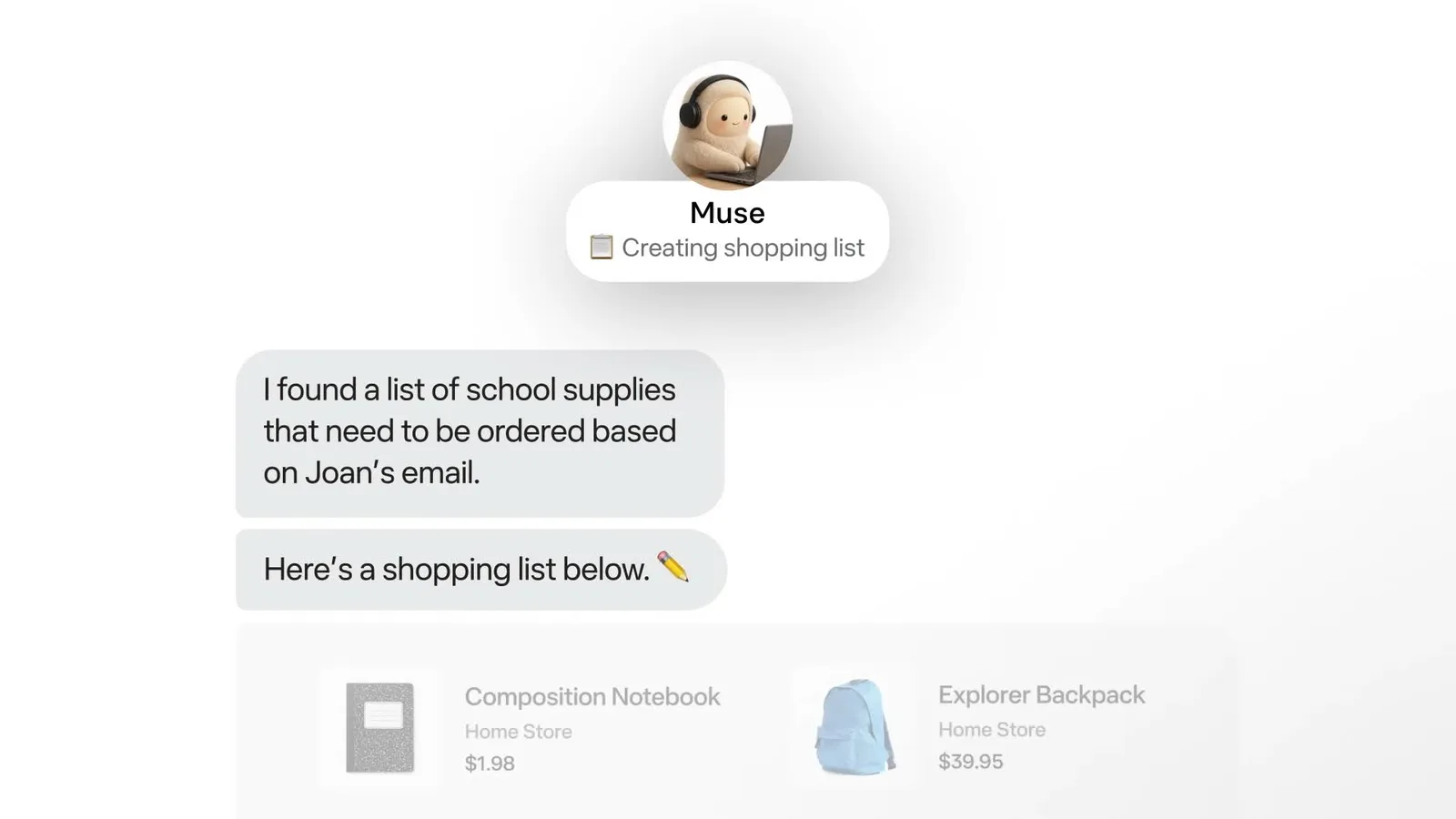 Image source: Meta’s official Muse introduction video
The same video also showed Muse filling out an online form. At any point, you can press “Take over browser” or “Stop task”:
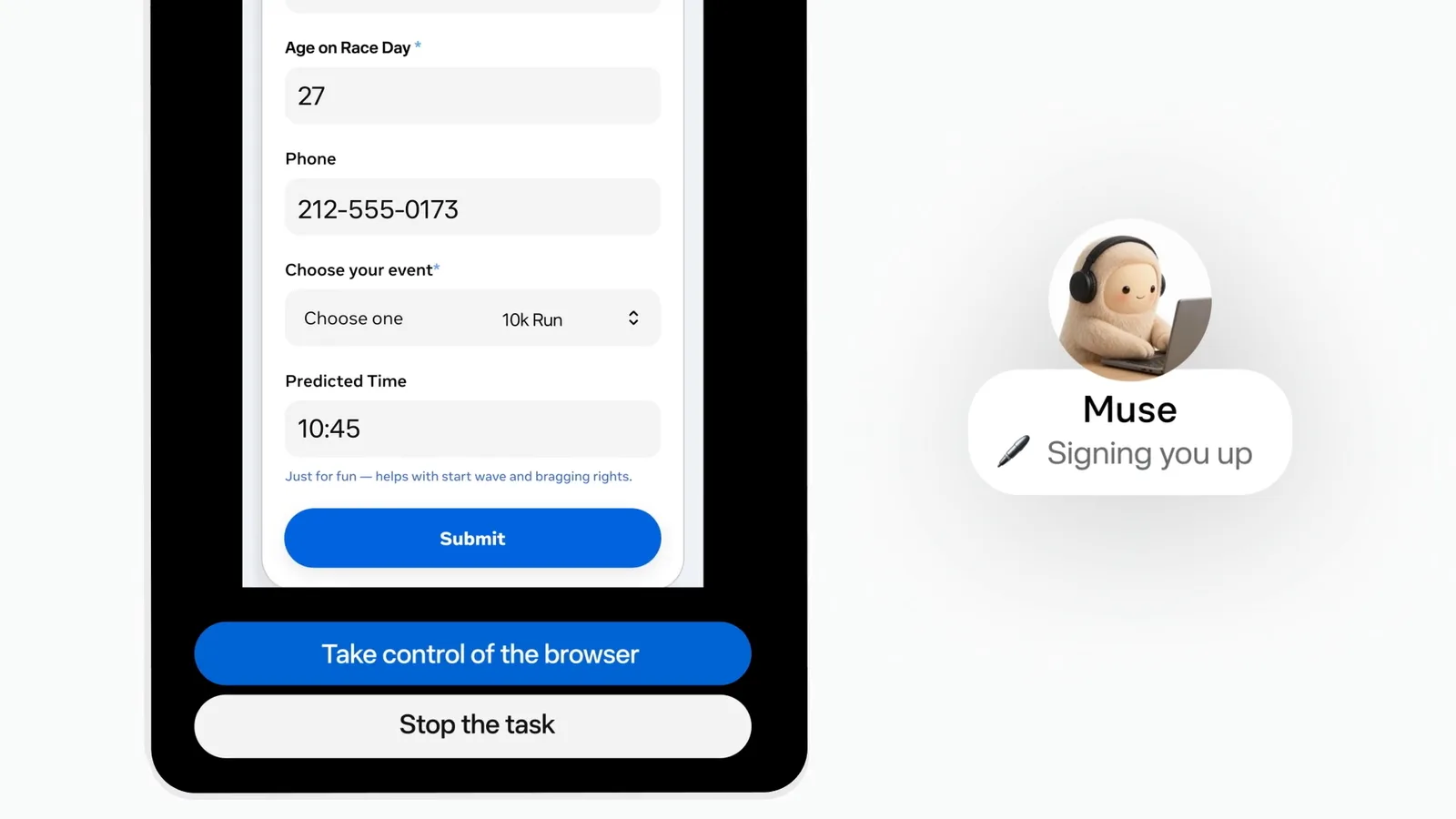 Image source: Meta’s official Muse introduction video
There was also a scene where Muse was about to complete an order. The screen waited for your permission before continuing; the English interface showed Deny / Allow:
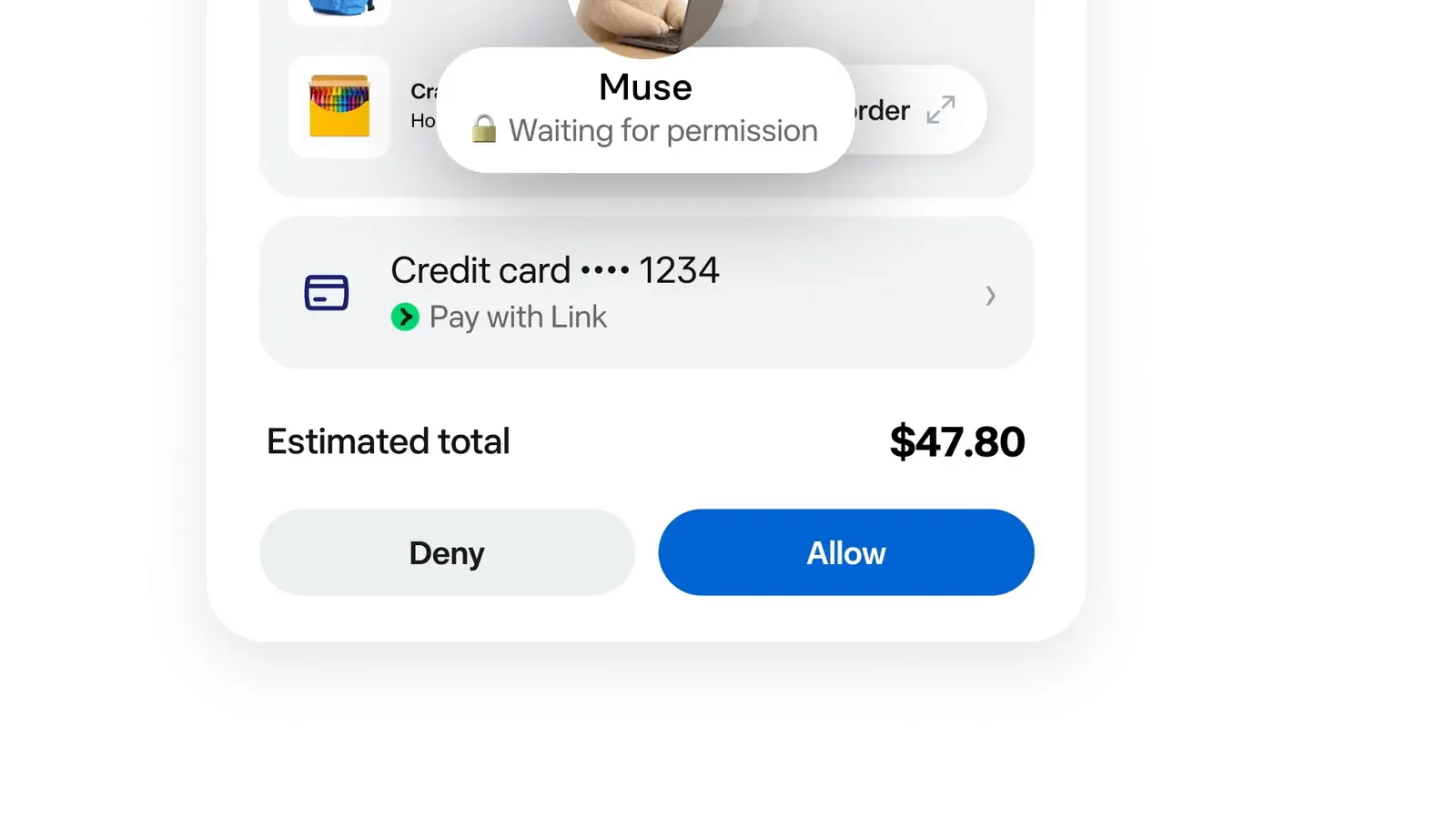 Image source: Meta’s official Muse introduction video
Who can use it, and how much does it cost (as of September 2026)
When Muse first launched, it was available only to users in the US who were 18 or older, according to Meta’s official account and an AP report. iPhone in Canada reported that it expanded to Canada on September 18; Canada initially received only the iOS and web versions. Meta has not announced a timeline for other regions. If you are outside the current launch markets, Muse is not officially available yet, so the practical answer is to wait for Meta to announce the next rollout.
For the free tier, Zuckerberg said on launch day that up to 100 million tokens per week would cost nothing, and a subscription would be required only above that allowance. Meta has not published the actual subscription prices. TechCrunch reported two paid plans on launch day: Power at $20 per month and Maximum at $100 per month, both billed monthly. In short, availability currently depends on where you live, and the paid pricing is based on media reports rather than an official Meta price sheet.
Privacy: what are you handing over?
Muse’s official privacy materials emphasize three points:
- You can opt out of training, so your interactions with Muse are not used to train Meta’s models
- Your conversations and data inside the virtual machine are not shared with Meta’s advertising system
- But the broader Meta AI terms of use—not Muse-specific—also say that interactions with AI may sometimes be reviewed by people or automated systems and used for personalization and advertising. Do not confuse these two points: “not used for ads” does not mean “no one can see the content.”
Penchan’s reminder: avoid proactively pasting passwords, full credit-card numbers, and national ID numbers into an AI agent when you can. Using the official authorization flow, such as the one-time card mentioned above, is safer.
Phone calls: humans were used during internal testing
Starting September 16, 2026, Muse’s feature for calling US businesses entered public beta. The examples in media coverage included booking restaurants and scheduling haircuts. On September 22, 404 Media and Reuters separately reported that during Meta’s internal testing, some calls were placed by trained human operators working as contractors. 404 Media also cited an internal message from an employee saying that some testers learned only afterward that a human had made the call. Reuters reported that the human-operator arrangement had since been withdrawn for now; Meta said publicly that it would launch it only when ready and with appropriate disclosure.
Having humans fill in behind an AI agent has happened before; the difference is whether the company explains it up front. The three products below are similar examples:
| Product | What humans did | How it was disclosed |
|---|---|---|
| Facebook Messenger M | Humans trained and supervised the AI, and personally answered more complex requests | It publicly said “trained and supervised by people” on launch day |
| Google Duplex | About one-quarter of calls were initially made by humans, and some calls that began with the system also required human intervention | Google confirmed the share of human-made calls only after a 2019 New York Times report |
| Amazon Just Walk Out (Amazon Fresh stores) | Humans reviewed video to verify receipts in some checkout cases, and some people also labeled video clips to train the model | The company explained it only after media reports and did not provide an actual percentage |
Of these three examples, only Facebook M explained the human role clearly on launch day. For the other two, the companies explained the human share only after media reports.
References
Cover image source: Meta (ai.meta.com/muse)
- https://about.fb.com/news/2026/04/introducing-muse-spark-meta-superintelligence-labs/
- https://about.fb.com/news/2026/09/introducing-muse-personal-ai-agent/
- https://ai.meta.com/muse/
- https://www.404media.co/meta-tests-muse-ai-agent-calls-that-are-actually-made-by-humans-in-a-call-center/
- https://www.reuters.com/business/media-telecom/meta-testing-human-concierge-its-new-personal-ai-agent-muse-2026-09-22/
- https://techcrunch.com/2026/09/08/meta-debuts-its-muse-ai-agent-will-consumers-trust-it/
- https://techcrunch.com/2026/09/17/rival-ai-agents-instinct-and-metas-muse-both-add-the-ability-to-make-calls/
- https://apnews.com/article/meta-muse-ai-agent-3a4572eb4cf4e95d8a0dfdad6e6ca065
- https://apnews.com/article/amazon-just-walk-out-india-checkout-160bf03c1654f665834ab141e6db7516
- https://techcrunch.com/2019/05/22/googles-duplex-calls-still-frequently-require-human-intervention/
- https://techcrunch.com/2018/01/08/facebook-is-shutting-down-its-standalone-personal-assistant-m/
- https://x.com/finkd/status/2097402109092053085
- https://x.com/Muse/status/2098171340561776648
- https://www.iphoneincanada.ca/2026/09/18/metas-muse-ai-agent-is-now-available-in-canada/