
OpenAI’s post-money valuation is roughly $852 billion. The company has confidentially filed an S-1 but internally leans toward listing in 2027. This piece breaks down how the valuation is calculated, where ARR and actual revenue diverge, and why the IPO keeps being pushed back.
This is company analysis, not investment advice. For the full company picture, start with What kind of company is OpenAI. OpenAI hasn’t gone public and hasn’t disclosed complete financials; I try to flag which numbers are official and which are estimates.
The funding rounds OpenAI has been through
Amounts and valuations are approximate figures from media and official announcements; the 2026 row is an official figure:
| Time | Round / Nature | Amount | Post-money valuation | Lead / Main backers |
|---|---|---|---|---|
| 2015 | Nonprofit founding | ~$1B committed | (none) | Musk, Altman, et al. |
| 2019 | Microsoft’s first strategic investment | ~$1B | (undisclosed) | Microsoft |
| 2021 | Employee liquidity transaction | (mostly secondary) | ~$14B | Tiger, a16z, Sequoia |
| 2023 | Microsoft multi-year top-up | ~$10B | ~$29B | Microsoft |
| 2024 | Series E | ~$6.6B | ~$157B | Thrive Capital |
| 2025 | Series F | ~$40B | ~$300B | SoftBank |
| 2026 | Latest round | ~$122B committed capital | ~$852B | Amazon, NVIDIA, SoftBank |
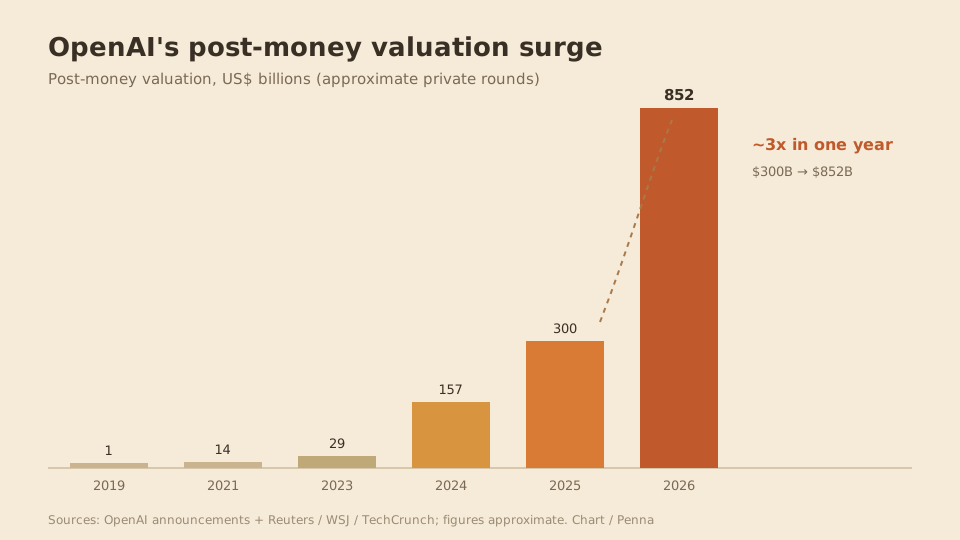
The valuation nearly tripled in a year. These are all private-market valuations — the price investors assign in fundraising, not a public-market trade price. Peer Anthropic’s Series H valued it at $965 billion, currently higher; see Anthropic’s valuation approaches a trillion dollars.
ARR is not the same as actual revenue
Two measures to distinguish:
- ARR (annualized revenue): Bloomberg reported ARR crossed $40 billion by August 2026, with a 20%+ month-over-month jump in July. Enterprise revenue reportedly surpassed consumer for the first time. OpenAI confirmed ChatGPT Ads alone hit $1 billion ARR within 200 days.
- Actual revenue: third-party estimates put 2025 bookings at ~$13.1 billion (unconfirmed), well below annualized figures.
ARR reflects momentum, not money in the bank. $40B ARR and $40B booked revenue are different things. Private companies have no audited financials — read for order of magnitude and trend, not precise values.
High valuation, but still burning cash heavily
OpenAI is still deeply unprofitable. Media estimates project ~$27 billion in cash burn for 2026, with profitability not expected until ~2030. The biggest cost is compute. The valuation reflects investors’ bet on the future, not current earnings.
IPO: S-1 Filed, but Targeting 2027
OpenAI confirmed on June 8, 2026, that it had confidentially filed an S-1 with the SEC. A confidential S-1 lets regulators review the filing without immediate public disclosure — it is the first formal step, not a listing date. Peer Anthropic filed its own S-1 a week earlier; see The Anthropic IPO Explained.
After the filing, the timeline shifted repeatedly. Reuters initially reported a possible September 2026 listing, but by late August, CFO Sarah Friar reportedly told employees the company plans to go public in 2027, targeting a valuation above $1 trillion. Advisers gave the company two options: list in 2026 below $1T, or wait for $1T-plus. Altman reportedly treated sub-$1T as a non-starter.
Key moves since the filing:
- Employee tender offer: Bloomberg reported a ~$7 billion buyback in August at the $852B valuation, giving employees early liquidity.
- Governance strengthening: Nubank CEO David Vélez and BNY CEO Robin Vince joined the board; Vince joins the audit committee.
- CRO change: Former Wiz president Dali Rajic replaced Denise Dresser as Chief Revenue Officer.
- Underwriter jockeying: Goldman Sachs, Morgan Stanley, and Bank of America are competing for roles.
As of September 2026, there is no public S-1, no confirmed listing date, and the internal lean is 2027. The confidential filing bought optionality, not a timetable.
An often-overlooked player: the nonprofit foundation
The operating entity is a public benefit corporation (PBC), but the nonprofit OpenAI Foundation sits above it with ~26% equity and board-appointment power. A chunk of the valuation belongs to the nonprofit parent. Details in What kind of company is OpenAI.
Penchan’s take
OpenAI hasn’t gone public; retail investors can’t buy its stock directly. Online “how to invest in OpenAI” routes are mostly indirect holdings or derivatives — do your own risk assessment.
Valuation, ARR, and IPO timeline are tools for understanding the company, not trading signals.