
Anthropic’s valuation nears a trillion dollars, its S-1 is filed, and the IPO is moving. This piece lays out the funding ladder, revenue metrics, and listing progress. Public information only, not investment advice. For background: What kind of company is Anthropic.
One sentence: “private-market valuation,” “annualized revenue,” and “actual booked revenue / public share price” are three different things.
A Triple Jump in Half a Year: The Funding and Valuation Ladder
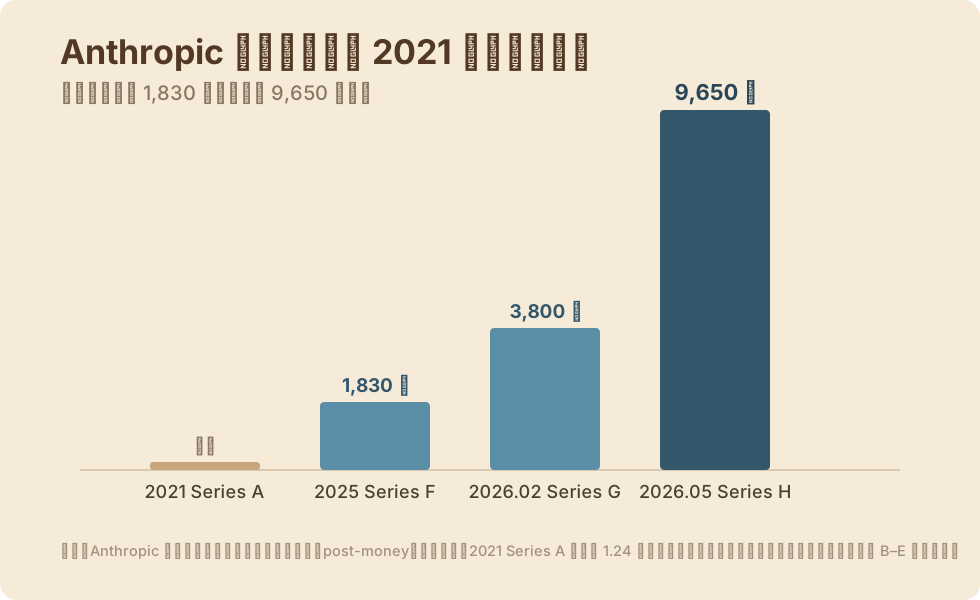
What draws the most attention to Anthropic is the speed at which it has stacked up its valuation. Putting a few of the officially confirmed large rounds together:
| Round | Date | Amount Raised | Post-Money Valuation |
|---|---|---|---|
| Series A | 2021 | ~$124 million | Early stage, full valuation not disclosed |
| Series F | September 2025 | ~$13 billion | ~$183 billion |
| Series G | February 2026 | ~$30 billion | ~$380 billion |
| Series H | May 2026 | ~$65 billion | ~$965 billion |
(There were also multiple rounds from B through E in between; here we only pick the largest recent milestones.)
The key is in the last three rows: in just half a year, the post-money valuation went from $183 billion to $380 billion, all the way up to $965 billion, nearing a trillion dollars. Series H was led by Altimeter, Dragoneer, Greenoaks, Sequoia, and others, with even memory suppliers like Samsung, SK hynix, and Micron joining as strategic partners. After completing this round, Anthropic briefly surpassed OpenAI (whose round in March 2026 was roughly $852 billion post-money) to become the highest-valued AI startup.
One thing to keep in mind: this is a private-market valuation, a price negotiated by a small number of investors in a specific round, not a share price traded out in the public market every day. The two are different in nature.
ARR Is Not the Same as Actual Revenue
Anthropic’s ARR (annualized revenue) has climbed from roughly $1 billion in early 2025 to a reported ~$65 billion—a 65× jump in under two years.
But ARR is not actual revenue. It takes a recent stretch of revenue and multiplies it into an annual estimate—a measure of speed, not the full-year result. Reuters has cautioned that the gap between annualized and actual figures can be significant. The S-1 is filed but not yet public; audited financials remain unavailable.
In one sentence: ARR is the speedometer for “how fast it’s going,” not the odometer for “how far it went over the full year.”
How the Valuation Is Calculated: Three Views in the Market
So how is that $965 billion figure actually derived? Here we lay out three views commonly seen in the market, with the goal of helping you understand “what the argument behind this number is about,” not to make you pick a side, and certainly not as advice.
- The optimists: believe enterprise AI spending will keep compounding, that Anthropic’s enterprise revenue is sticky and Claude Code is driving paid expansion, and so are willing to assign a very high revenue multiple, viewing today’s price as “getting positioned early for the future.”
- The neutrals: hold that the growth is real, but the current valuation has already priced in plenty of good news, and going forward it will take actual revenue and gross margin to deliver before the multiple can hold, with upside and risk coexisting.
- The conservatives: question whether ARR overstates true revenue, point to an opaque gross-margin structure, and add downward pressure on compute and subscription pricing, arguing this price treats too many optimistic expectations as established fact.
These three views each use different key assumptions: whether revenue is measured by ARR or actual bookings, how much of a multiple to assign, and whether gross margin can improve. For the same company, swap in a different set of assumptions and the calculated “fair valuation” comes out wildly different. That’s also why valuing a private company is essentially a debate about assumptions, rather than market pricing.
Behind the Valuation: The Compute Commitments on Its Shoulders
When you look at the valuation, you also have to look at what it’s carrying on the other side.
Anthropic doesn’t make its own chips; it relies on signing long-term contracts to rent compute from cloud giants. The scale of these commitments is quite staggering: a ten-year technology spend with AWS exceeding $100 billion, roughly $30 billion in compute purchased from Microsoft Azure, plus multi-GW-class TPU capacity from Google/Broadcom. These are fixed cost obligations already signed, far exceeding its current revenue scale.
In other words, the flip side of a high valuation is high commitment. The market is willing to give it a price tag nearing a trillion dollars on the premise of believing this compute will ultimately convert into enough revenue and profit; should growth slow, these long-term contracts would turn from “fuel for growth” into “a heavy bill.” For how the compute thread works, see Anthropic’s compute gamble.
S-1 and IPO Progress
Anthropic filed a confidential S-1 with the SEC on June 1, 2026, formally starting the IPO process.
Multiple financial media outlets report a target of October 2026 on Nasdaq, led by Goldman Sachs, JPMorgan, and Morgan Stanley, with a potential raise exceeding $60 billion. Some reports put the target IPO valuation at up to $2 trillion—which, if achieved, would surpass SpaceX’s $1.77 trillion June 2026 offering as the largest IPO ever.
The S-1 filing is confirmed fact; the specific listing date, pricing range, and final valuation have not been publicly confirmed. Some sources place the timeline between Q4 2026 and early 2027. Until the roadshow launches, both dates and valuations remain subject to change.
The Parts Not Yet Laid Bare
The S-1 is filed but not yet public. Key figures still unavailable:
- GAAP revenue: audited financials not yet accessible.
- Gross margin: per-inference cost and margin structure undisclosed.
- Burn rate: one report puts Q3 profit above $1 billion, but this is unverified.
- Equity stakes: founder and investor holdings not fully disclosed.
These gaps should narrow once the S-1 becomes public.
Penchan’s Take
Anthropic’s valuation story is a microcosm of the AI investment boom: the growth is real, the price the market is willing to pay is real, and between them lies a thick layer of assumptions. Understanding the metrics behind the numbers matters more than memorizing the numbers.
Public information only, not investment advice. Fuller context: Pre-IPO deep-dive report.
Further reading: What kind of company is Anthropic, Anthropic vs OpenAI, Why a public benefit corporation.