The one-sentence takeaway
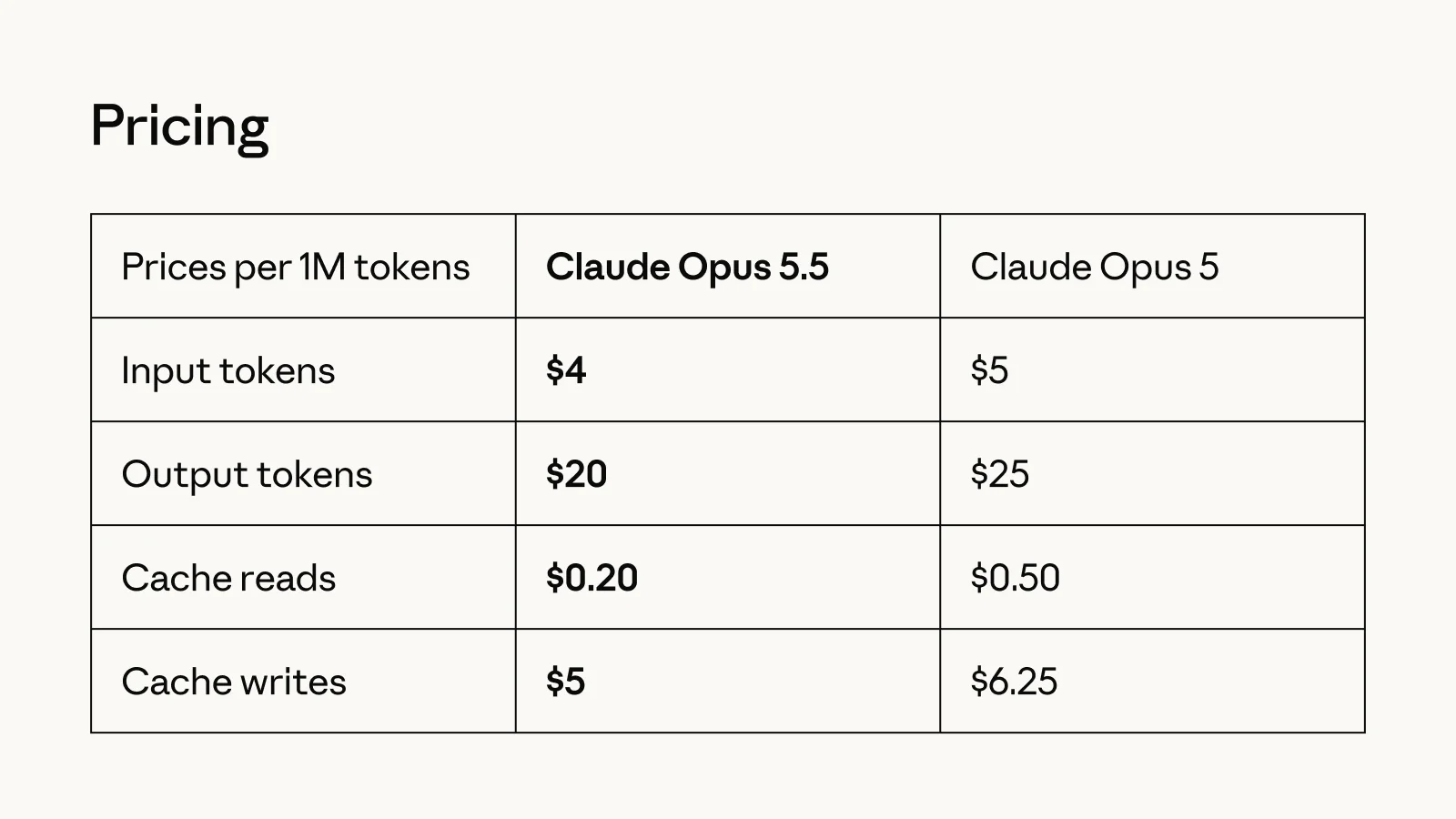
Anthropic launched its new AI model Claude Opus 5.5 on September 22, 2026, the first model in the Claude 5.5 series. Anthropic says it reaches Fable 5.1-level performance on most tasks and costs about 40% less than Opus 5 with the default settings. If you regularly use Claude Code for programming or pay for Claude through the API, this upgrade is worth knowing about. As of September 2026, Claude is divided into the Fable, Opus, Sonnet, and Haiku families, ranked from higher to lower capability and price. Opus 5.5 is a mid-to-high-end model focused on long-running tasks that can take action on their own. The API price is $4 per million input tokens and $20 per million output tokens, lower than Opus 5 at $5/$25. Its model ID is claude-opus-5-5.
What changed in this upgrade
Several things changed. These are the points most general users should know:
- Fable 5.1-level performance on most tasks: Fable 5.1 is a more expensive high-end model, priced at $10 per million input tokens and $50 per million output tokens through the API. Anthropic says Opus 5.5 reaches its level on most tasks while costing much less. Anthropic also cautions that at this capability level, benchmark gaps do not reflect real-world differences very well.
- Lower cost: In the Terminal-Bench coding test, Opus 5.5 at the default effort level beat Opus 5’s score at the highest level, at about one-fifth the cost (according to the official chart caption).
- Faster output: Generation is more than 30% faster than Opus 5 (official figure).
- Lower default thinking effort: Claude “thinks” before answering. Deeper thinking is usually more accurate, but it is also slower and more expensive. There are several effort levels: Opus 5.5 defaults to medium, while Opus 5 defaults to high. You can raise either setting manually if needed.
- Claude Code’s default model changed: According to the Claude Code changelog, Claude Code users on Pro or Team Standard now get Opus instead of Sonnet by default, without having to select it manually.
How to read the benchmarks
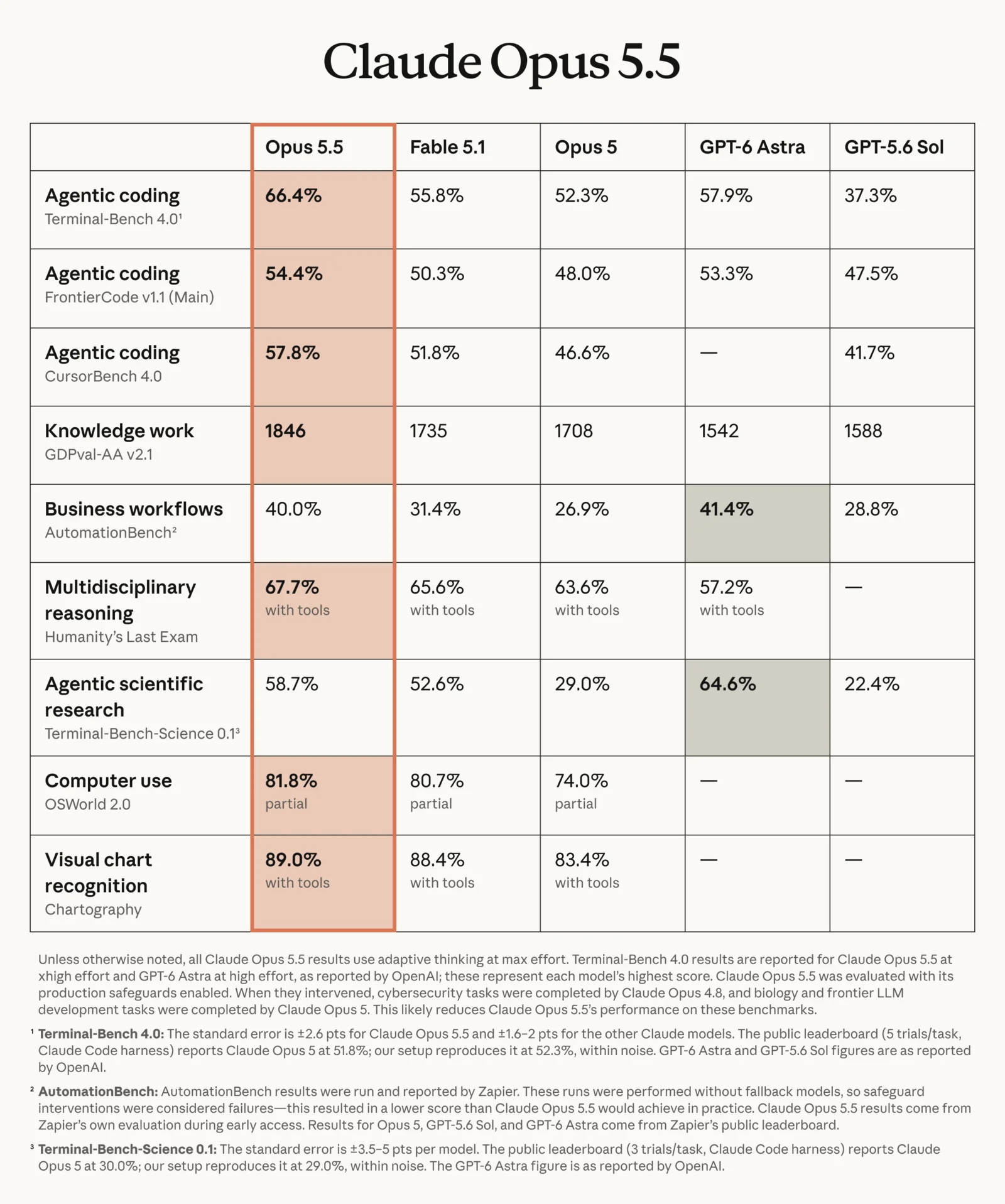
What is a benchmark? In simple terms, different models are given the same set of tasks and scored based on their performance. A higher score means better performance on that task.
In the 9 tests published by Anthropic, Opus 5.5 earned the highest score shown in 7 categories. GPT-6 Astra did not publish a score in 3 of them, and the GPT model scores were self-reported by OpenAI. The results include 66.4% on Terminal-Bench 4.0, a test in which an AI writes code in a terminal, and 1846 points on GDPval-AA v2.1, a knowledge-work test. Opus 5.5 lost both of the remaining categories to GPT-6 Astra: 40.0% versus 41.4% on AutomationBench, an automated business-process test, and 58.7% versus 64.6% on Terminal-Bench-Science, a scientific-research test. Anthropic also cautions that at this capability level, benchmark gaps do not map very well to how models feel in real use.
Pricing and plans
| Item | Opus 5.5 | Opus 5 |
|---|---|---|
| Input | $4/MTok | $5/MTok |
| Output | $20/MTok | $25/MTok |
| Cached read | $0.20/MTok | $0.50/MTok |
The unit in the table above is per million tokens (MTok). For example, if a task uses 1 million input tokens and generates 1 million output tokens, Opus 5.5 costs about $24 ($4 plus $20), while Opus 5 costs $30 ($5 plus $25). Cached reads are charges for reusing the same conversation content and are usually much cheaper than the first input. People who use Claude Code for long tasks and repeatedly revisit the same material will notice the difference.
Who can use it: If you subscribe to Pro, Max, Team, or Enterprise on claude.ai, you can select Opus 5.5 from the model menu. The free plan still cannot use it as of September 2026. Developers can access it through the Claude API, Amazon Bedrock, Google Cloud, and Microsoft Foundry. GitHub says paid Copilot users (Pro+, Max, Business, and Enterprise) can also select it, with access rolling out gradually.
One important note: the price table above shows API charges for developers connecting to the model. If you subscribe to a claude.ai plan such as Pro or Max, you pay a fixed monthly fee rather than calculating token costs yourself, although usage is capped. These are different payment models, so do not confuse them.
Changes developers should know about
This section is for developers who write code or connect to the API. General users can skip it:
- Thinking cannot be turned off: You could previously disable thinking with a parameter, but Opus 5.5 does not allow it. Forcing it off returns an error.
- Forced tool selection causes an error: You could previously require the model to call a specific tool. That setting causes an error in Opus 5.5; automatic tool selection still works normally.
- Thinking blocks are tied to the model: Opus 5.5 can read thinking records left by older Opus versions, but it cannot read those left by Fable. Take care when mixing models.
- The old computer-use tool no longer works: On the Claude API and Google Cloud, the old tool for operating a computer screen has been retired. You must switch to the new one.
Safety highlights
Whenever Anthropic releases a new model, it publishes a several-hundred-page “system card” describing the safety tests the model underwent and the risks it presents. You do not need to read the whole thing. These are the main points this time:
- Strong alignment-test results: The system card says Opus 5.5 had the lowest rate among recent Claude models of “misaligned” behavior, meaning behavior that deviates from human expectations and may cooperate with misuse.
- Worse performance against prompt injection in pasted text: If you paste text into a conversation containing malicious instructions, Opus 5.5 is more likely to follow them than previous models. With the official safeguards enabled, however, it generally does not follow them.
- Sensitive tasks are automatically routed to another model: In the Claude app, when you ask sensitive cybersecurity or biology-related questions, the system automatically routes the conversation to Opus 4.8 or Opus 5. The interface tells you that the model has changed; it does not happen secretly.
Penchan’s take
Honestly, after spending a day with Opus 5.5, Penchan was a little moved. It finally feels easy to talk to again, like Opus 4.6, rather than sounding like a robot as Opus 5 did. It is also especially smooth for orchestrating other agents. At last, it can spawn subagents to split up the work on its own, something Opus 4.6 handled more awkwardly. It also uses fewer tokens. The most noticeable thing is that those strange “—” marks have finally disappeared from its replies 😭
Penchan will keep testing Opus 5.5 and share more impressions when there are new ones.
The two groups that benefit most directly are people paying Opus 5 prices through the API and people using Claude Code on Pro or Team Standard, whose default model has now changed to Opus. Developers should retest the effort level instead of carrying over their old settings, and watch for the 4 breaking changes listed above. Free-plan users still cannot use Opus 5.5 as of September 2026.
This article provides consumer information about AI model API billing and subscription plans; it is not securities or investment advice. Actual pricing is determined by Anthropic’s latest official announcements. The information in this article is current as of September 23, 2026 and may become outdated.
Further reading
- Complete Claude Fable 5.1 guide
- Claude Opus vs Sonnet: Which one should you use?
- Complete Claude Code guide
- Introduction to Claude Opus 4.8
References
Cover image source: Anthropic (anthropic.com/claude-opus-5-5)
- Anthropic official announcement: https://www.anthropic.com/claude-opus-5-5
- Claude Opus 5.5 System Card: https://www.anthropic.com/claude-opus-5-5-system-card
- Model overview: https://platform.claude.com/docs/en/models/opus-5-5/overview
- API pricing: https://platform.claude.com/docs/en/about-claude/pricing
- Plans pricing: https://claude.com/pricing
- GitHub Changelog: https://github.blog/changelog/2026-09-22-claude-opus-5-5-is-now-available-in-github-copilot/
- Claude Code CHANGELOG: https://github.com/anthropics/claude-code/blob/main/CHANGELOG.md