The earlier liquid-cooling gate gave an overview of why AI racks can’t avoid liquid cooling. This piece dives into a sub-topic that gets named often yet is also the most misunderstood: immersion cooling.
It sounds like the most extreme approach (dunking a whole server in liquid), but whether it’s the final answer to AI heat is not so simple. This piece spells immersion out: what it is, how it differs from cold plate, why it draws attention yet hasn’t gone mainstream, and which Taiwanese firms actually have products. This is the deep-dive offshoot of the cooling gate in The AI Hardware Supply Chain, End to End.
What Is Immersion Cooling
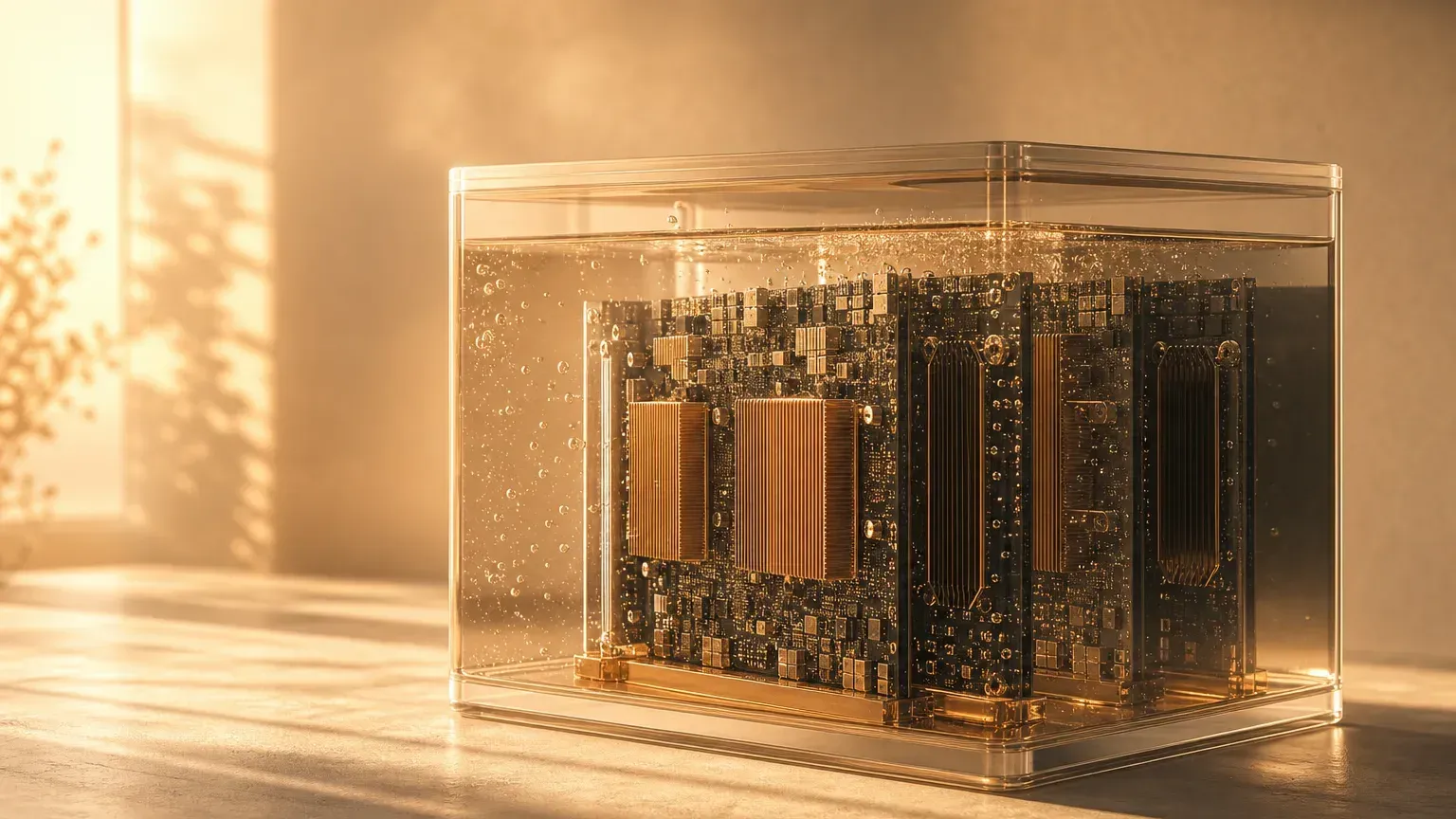
Immersion cooling means submerging a server or its key components entirely in a non-conductive coolant (a dielectric liquid), letting the liquid touch the heat-generating parts directly and carry the heat away. Note that it differs from “cold plate”: a cold plate only seals the liquid circulating inside a metal plate pressed against the chip, and under the definition of the industry standards body OCP, that does not count as immersion.
It comes in two flavors. Single-phase means the liquid absorbs heat but doesn’t boil; a pump circulates it and a heat exchanger sends the heat out of the facility. It’s structurally simpler, often uses hydrocarbon or ester coolants, and carries lower fluorinated (PFAS) risk. Two-phase means the liquid absorbs heat and boils at a relatively low temperature into vapor, which turns back into liquid when it meets the condenser above; the phase change removes more heat and suits ultra-high density, but the sealing and condensing structures are more complex, and it often involves fluorinated coolants.
How It Differs from Air Cooling and Cold Plate
Lining up the three cooling methods makes it clearest.
| Technology | How it cools | Trade-offs |
|---|---|---|
| Air cooling | Fans plus facility air conditioning carry the hot air away | Mature and easy to maintain, but in high-density racks airflow, noise, and power draw degrade fast |
| Cold plate (direct liquid cooling) | Liquid flows through a metal plate pressed onto the CPU/GPU | Small retrofit, the main route for the GB200/GB300; mainly captures the key heat sources, the rest may still need fan assistance |
| Immersion | The whole unit is submerged in coolant | In theory captures close to all of the heat at high density, but maintenance, coolant, and facility load-bearing all need to be redesigned |
Research (Nature’s life-cycle analysis) points out that cold plate removes roughly 50 to 80 percent of the heat, while immersion lets the coolant absorb close to all of it. An analogy: air cooling is like blowing on a hot pot with a fan, cold plate is like pressing an ice pack against the bottom of the pot, and immersion is like dunking the whole pot in cold water.
Why AI Has Put It in the Spotlight
The direct cause is the explosion in power density. NVIDIA’s GB200 NVL72 runs about 132kW per rack, peaking toward 192kW, and the GB300 toward 142kW; at that level, fan cooling fell short long ago. Immersion’s appeal lies in coping with extremely high power density while improving energy use, and research also points out that, relative to air cooling, immersion has room to improve on both energy and water.
But keep it level-headed: drawing attention doesn’t equal going mainstream (more on that next). AI is genuinely pushing the whole liquid-cooling market forward, but the volume workhorse right now is cold plate, not immersion.
The 2026 Picture: Not Yet Mainstream
This point matters; don’t get carried away by the “immersion is the strongest” impression. In 2026, data-center liquid cooling is still dominated by cold plate (direct-to-chip), with immersion mostly in pilots, special high-density, or crypto-mining scenarios.
Industry surveys (Uptime) show most facilities still run mainly on air cooling, with the share adopting direct liquid cooling still a minority, and the biggest barriers to adopting immersion being non-uniform standards, high cost, and doubts about reliability and maintenance. Even Microsoft once publicly trialed two-phase immersion, but recent data shows its data centers currently use cold plate, not immersion. So understanding immersion as “high-potential but still early” is more accurate than “about to replace everything.”
Players and Taiwanese Firms’ Roles
Internationally, firms making immersion tanks and solutions include Submer, GRC, and LiquidStack; on servers and integration there are Supermicro and GIGABYTE; on CDUs and heat dissipation there is Vertiv. On the coolant side, one risk deserves a special mention: chemicals giant 3M has announced it will exit all PFAS (fluorinated) product manufacturing by the end of 2025, which is a supply and regulatory concern for two-phase solutions that rely on fluorinated coolant.
On the Taiwanese side, those with clearer immersion products are Wiwynn (a two-phase immersion tank, once developed with Microsoft), Delta (a two-phase immersion solution), and Kenmec (whose thermal-transfer business line covers immersion liquid-cooling systems and coolant). As for Taiwanese firms often grouped into “cooling stocks” such as Auras, Asia Vital Components, Kaori, and Chenbro, most of their public information centers on cold plate, CDUs, and heat exchange, with less clarity on immersion products. To be clear: putting them into the immersion supply chain is often market association; being named only reflects a possible industry role, not orders or degree of upside. This article only describes roles, does not recommend individual stocks, and does not constitute investment advice.
Where It’s Stuck: Coolant, Maintenance, and Standards
For immersion to go mainstream, it has to clear a few gates. First is coolant: the fluorinated liquids common in two-phase systems run into PFAS regulation and 3M’s exit, putting pressure on both cost and supply. Second is maintenance: servers have to be fished out of the liquid for servicing, so the procedures, protection, and training all have to be rebuilt. Third is standards: the industry standards still aren’t uniform, the most-cited adoption barrier in surveys. Fourth is facility retrofits: the tanks are heavy, so load-bearing, plumbing, fire safety, and leak protection all have to be redesigned, a far bigger hurdle than a cold-plate retrofit.
These challenges don’t mean immersion has no future, but for it to become mainstream, the time and supporting infrastructure it needs really are more than people imagine.
Key Takeaways for This Gate
Immersion cooling dunks the server in a non-conductive coolant, comes in single-phase and two-phase forms, and in theory can capture close to all of the heat at very high density. AI rack power blowing past 100kW has put it in the spotlight, but the 2026 mainstay is still cold-plate (direct-to-chip) liquid cooling, with immersion mostly in pilots and special scenarios.
Its bottlenecks are coolant (PFAS regulation), maintenance, standards, and facility retrofits. Among Taiwanese firms, Wiwynn, Delta, and Kenmec have clearer immersion products; most others sit in the liquid-cooling / cold-plate chain, so treat the related list as roles, nothing more.
To see why AI racks can’t avoid liquid cooling and the full picture of the cooling supply chain, go back and read liquid cooling; to see the compute and power ceiling of a data center, read the AI data center; to look back at the whole chain, head back to the supply-chain overview.