
One of many people’s first impressions of Grok is that “it’s very open.” That impression has roots: in 2024, xAI fully open-sourced its first-generation model, Grok-1, a generous move that was rare in the industry at the time. But if you go looking for the weights of Grok’s current flagship now, you won’t find them to download; it went closed long ago.
From generous open-sourcing to fully closed, that turn is itself a good story, and it’s about business rather than technology: how a latecomer AI company went from “using openness to grab attention” to “using closed weights to guard assets.” This piece walks you through that strategic bend; it doesn’t teach operation. To learn how to actually use Grok, see Penchan’s Grok how-to guide. To first get to know Grok and how it relates to xAI and SpaceX, see What Is SpaceX?
First, let’s be clear about the words “open source”
Before discussing Grok’s openness strategy, we have to unpack a term many people conflate.
“Open weights” and “open source” are not the same thing. Open weights means releasing the model’s trained parameter file (the weights) for you to download; open source has a stricter industry meaning, usually a license that lets you freely use, modify, and redistribute, without awkward restrictions, like Apache 2.0 or MIT.
The key: a model can be “open weights” yet not count as “open source,” because the released weights may come with strings, for instance forbidding commercial use, forbidding using them to train a competitor’s model, or reserving the vendor’s right to revoke at any time. That’s called “source-available,” not true open source. So whenever a model claims to be “open source,” the correct reaction is to read down to its license terms, not to take the two words at face value.
Hold that distinction and Grok’s story becomes clear.
Grok’s openness only fully existed in the first generation
Back to Grok itself, its degree of openness tightened all the way along:
- Grok-1 (2024): fully open-sourced under Apache 2.0; anyone can freely download, use, and modify the weights. This is genuine open source, and the source of xAI’s open image.
- Grok-2: xAI later released weights too, but under a custom license with more restrictions, not counting as open source in the usual sense, closer to “source-available.”
- Current flagship: fully closed, usable only through official products or the API, with weights not public.
So “Grok is open source,” strictly speaking, only fully holds for the earliest Grok-1. The Grok you use on the web or in an app today is not open-source software.
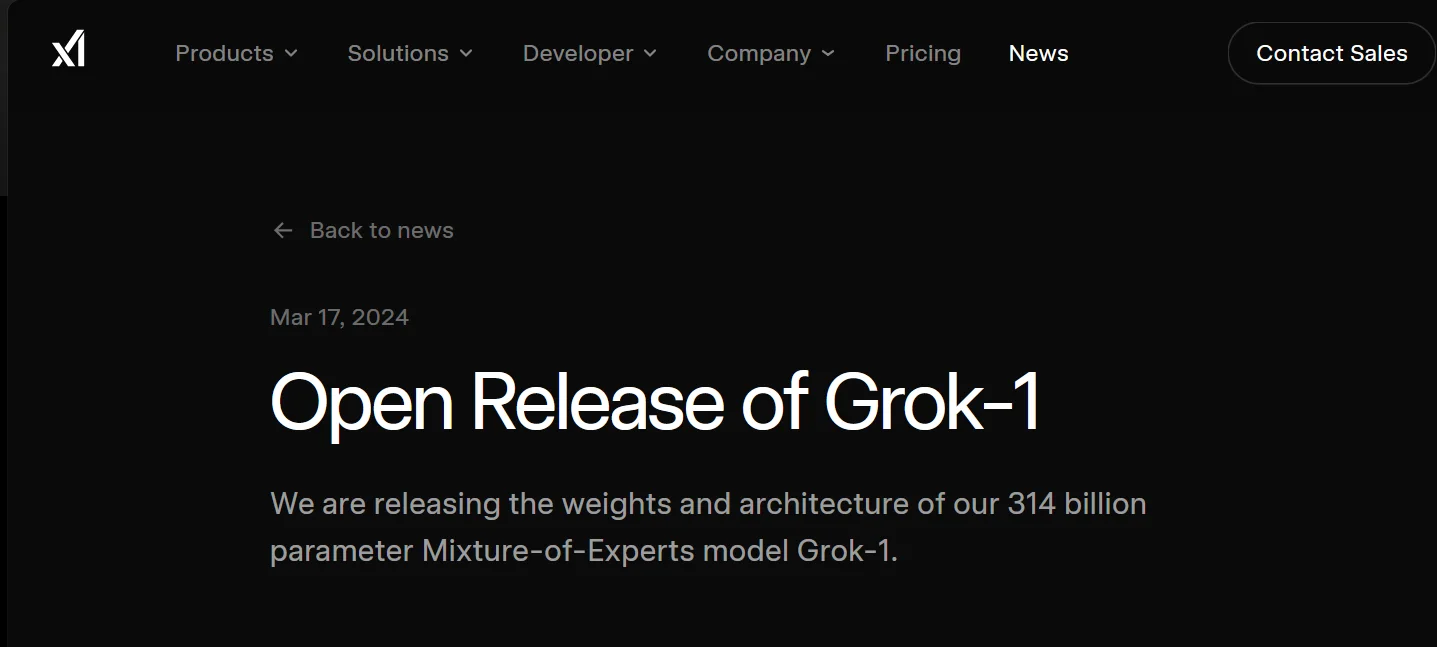
Figure: In March 2024, xAI announced the open release of its first model, Grok-1, on its official News page, releasing the weights and architecture of this 314-billion-parameter Mixture-of-Experts model. This was the origin of Grok’s open image.
Why open it at first? The latecomer’s play
To understand this turn, go back to the context of 2024. xAI then was a latecomer on the AI track, with OpenAI, Google, and Anthropic ahead of it. For a latecomer, open-sourcing the flagship model is a sensible move.
Open-sourcing buys several things a latecomer most needs: mindshare (cutting into the conversation with a “standing on the open side” posture), research talent (the engineers who want hands-on access to weights show up), and a developer community (an ecosystem grows when people build on your model). At the same time, it let xAI contrast against an OpenAI often criticized as “calling itself Open but not open enough,” seizing a narrative.
In other words, open-sourcing Grok-1 meant more for marketing and recruiting than for the technology itself at that point.
Why pull it back later? Because the company’s stage changed
An openness strategy usually turns not because the philosophy changed, but because the company’s stage did.
xAI’s path went from independent challenger, to being acquired by SpaceX and folded into the AI division SpaceXAI, to the parent group heading toward an IPO. With each step forward, the model and the compute behind it look more like “core assets,” less suited to giving away for free. A company that’s commercializing and answerable to shareholders, open-sourcing its strongest flagship, would be filling in its own moat.
Competition also intensified. A flagship model’s capability is itself the selling point, and only closed weights keep that selling point in your own hands, converting it into subscription and API revenue. So the strategy naturally shifted from “use openness to grab attention” to “use closed weights to guard assets.”
Worth noting: this path isn’t unique to xAI. In the AI industry, embracing openness while behind and tightening up while ahead or monetizing is a pattern that recurs. Put Grok’s open-to-closed arc in that bigger frame and it stops looking self-contradictory; it just walked a road many companies have walked.
Two reminders for readers
To close, two takeaways you can carry:
- Don’t be marketed by the word “open source.” What really decides how you can use a model is its license terms, not the two words in a press release. When you see “open source,” find the license first.
- A company’s stance on openness shifts with its business stage. It may open up to grab market when behind, and tighten when ahead or monetizing. That’s not necessarily bad, but understanding the motive will make you more clear-eyed about any AI company’s “openness declaration.”
To place Grok back in the whole rocket empire’s context, see What Is SpaceX?; to actually use Grok, see the Grok how-to guide. This piece is about the backstory of its “openness strategy.”