
No matter how smart an AI model is, behind it sits a massive burn of computing resources. For OpenAI, compute isn’t just a cost, it’s the lifeline that determines how fast it can run and how big it can grow.
This piece walks you through OpenAI’s compute map: the core Stargate data center alliance, its pivotal shift with Microsoft from exclusive to multi-cloud, and the roles Amazon, Nvidia, Oracle, and Broadcom each play. To get the full picture of the company first, start with what kind of company OpenAI is.
Remember the through-line in one sentence: OpenAI is moving from “Microsoft exclusivity” to “building its own empire plus going multi-cloud with many partners.”
Stargate: The Core of Building Its Own Compute
Stargate is the flagship of OpenAI’s compute strategy. Announced in early 2025, it’s a mega-scale data center project led by OpenAI alongside SoftBank, Oracle, and the Middle Eastern sovereign fund MGX. The rough division of labor: OpenAI runs operations, SoftBank shoulders the financing.
The scale sounds staggering: the goal is to invest roughly $500 billion across the US over several years and build 10GW (gigawatt-scale) of compute capacity, with about $100 billion deployed in the early phase, breaking ground on sites simultaneously across Texas, New Mexico, Ohio, and other states. But here’s where we tap the brakes: most of these are planning targets, not capacity already built. 10GW is equivalent to a sizable share of total US data center power use, and quite a few analysts are reserved about whether it can land on schedule.
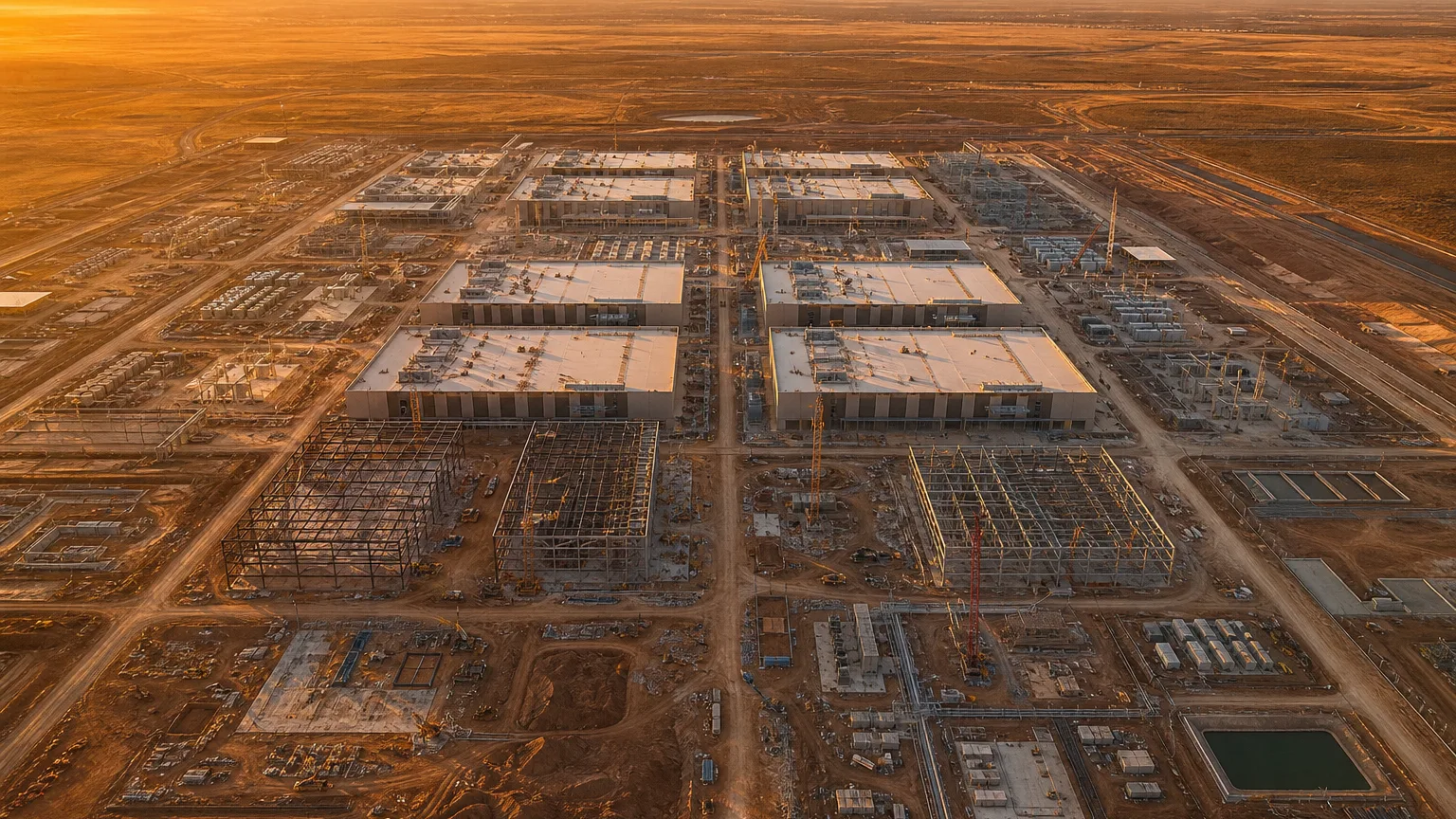
An aerial illustration of a large AI data center campus: the enormous buildings and surrounding construction give the “compute arms race” a concrete shape. (Illustration, not an actual site photo.)
The Microsoft Renegotiation: From Exclusive to Multi-Cloud
If you had to pick the single biggest turning point in OpenAI’s 2026 compute strategy, it would be the renegotiated deal with Microsoft.
Microsoft used to be OpenAI’s exclusive cloud partner. In April 2026, the two re-signed their agreement, with several key changes: the cloud relationship moved from “exclusive” to “non-exclusive,” letting OpenAI serve customers on other clouds, but Microsoft remains its primary cloud partner, and new models still launch first on Azure. On top of that, Microsoft’s IP license was extended through 2032, and the revenue-sharing arrangement between the two was rewritten.
The backdrop for this renegotiation was that OpenAI had separately struck a large partnership with Amazon, which could have crossed a red line in its contract with Microsoft; the new deal cleared up that legal concern in one move. Put simply, this was “trading exclusivity for longer-term lock-in and greater flexibility.”
The Other Players on the Compute Map
Beyond Microsoft and Stargate, OpenAI has pulled in a roster of partners to form its multi-cloud, multi-supplier map:
- Amazon (AWS): Announced a major partnership in 2026, including an equity investment in OpenAI plus a multi-year cloud purchase. The figures cited across outlets don’t match, ranging from tens of billions to over a hundred billion dollars, because “existing contract,” “new investment,” and “cloud buildout” are three separate numbers that should be read apart; it’s not appropriate to just cherry-pick the biggest one when citing them.
- Oracle: A key Stargate partner that signed large data center development and compute-leasing agreements, and delivers the bulk of the Nvidia chips for the flagship site.
- Nvidia: The primary GPU supplier and also an OpenAI investor. That dual identity, plus OpenAI’s own custom-chip plans, makes the relationship especially delicate.
- SoftBank: Besides being a major OpenAI shareholder, it’s also the principal funder of Stargate.
- Broadcom: Helping OpenAI develop its own AI chips, with the long-term goal of reducing dependence on Nvidia.
Custom Chips: Taking the Lifeline Back in Hand
Beyond multi-cloud, OpenAI also wants to push further upstream: making its own chips. Partnering with Broadcom and using TSMC as the foundry, it’s developing chips designed specifically for AI inference, with phased deployment expected to begin in the second half of 2026.
The motive is simple: compute has long been tied to Nvidia’s GPUs, high cost, tight supply. If custom chips succeed, OpenAI can take more of its “lifeline” back into its own hands. But this path is equally cash-intensive and full of variables, with both capacity and timeline still to be seen. For how the whole chip and supply chain works, see the AI hardware supply chain end to end.
The Risks of This Mega-Bet
OpenAI’s compute strategy is, at its core, a bet on scale. Building its own empire gives it the strongest control, but in return the financial pressure is also the greatest: hundred-billion-dollar commitments need someone to fund them, data centers need available power and land to build on, none of which happens automatically just because a plan is announced.
Compared with peers who chose to “plug into existing hyperscale clouds and stay relatively asset-light,” OpenAI is taking the heaviest, most self-reliant, and most cash-intensive path. Its bet is that “controlling compute means controlling the future”, but the bill for that bet will show up all along its cash-burn rate.
Penchan’s Take
Pull this map together and OpenAI’s compute story is really a process of “de-single-sourcing”: from being tied to a single Microsoft, to building its own Stargate, spanning multiple clouds, and on to custom chips, step by step prying apart its dependence on any single supplier.
This gives it scale and flexibility no one else has, at the cost of putting itself on an extremely cash-intensive track. For readers, the most useful yardstick when reading OpenAI compute news is this: tell apart what’s “already built” from what’s merely an “announced planning target.” The gap between the two is often where the real risk of this mega-bet lies.